
Bitcoin still has rebound potential
Despite the market sentiment being somewhat weak in the past few weeks, Bitcoin (#BTC ) still has certain rebound potential, especially as some key factors affecting its price trajectory have not yet been fully resolved. On-chain data shows that although cryptocurrency prices have declined, bears have not completely taken control of the market. Instead, bullish forces still exist, and this force may still drive prices upward as market conditions change.
Key indicators at the crossroads
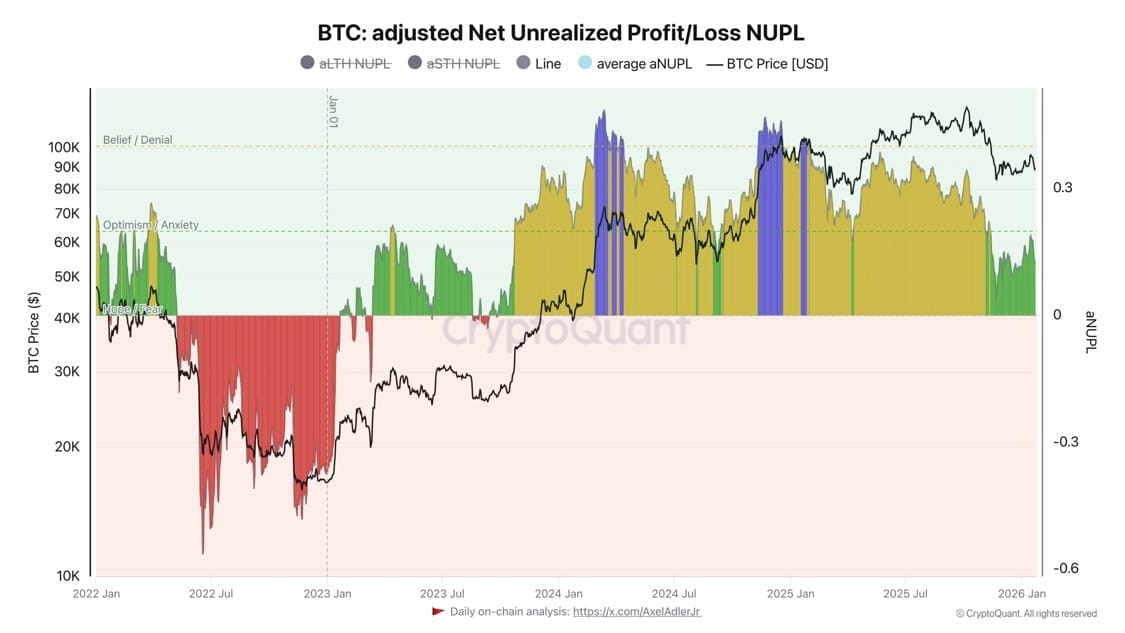
From on-chain data, Bitcoin's Net Unrealized Profit/Loss (NUPL) metric shows noteworthy dynamics. NUPL compares the realized capital of short-term and long-term holders with Bitcoin's market capitalization. Currently, this metric is in a region historically associated with the end of bear markets, known as the 'Fear and Anxiety Zone'. In past cycles, this region has often influenced the overall trend of Bitcoin, but it does not directly confirm a price reversal.
In other words, even if the accumulation of Bitcoin may be quietly happening, the bulls will continue to hold without immediately taking profits or losses. However, if some investors choose to realize profits or cut losses, it may still trigger short-term downward pressure, benefiting bears or investors waiting for confirmation. Overall, Bitcoin is currently at a critical turning point, with neither bulls nor bears having a clear advantage.
Risks and opportunities coexist.
In addition to NUPL, some market risk indicators are also worth noting. Bitcoin's Sharpe ratio has fallen into a range that historically supported price rebounds, and it has currently fallen below zero, having occurred only four times since 2018. In the past, such levels often indicated that the market might be bottoming, but it does not mean that the bottom has been confirmed. If the Sharpe ratio continues to decline, it may still bring mid-term downward pressure on prices, but it also suggests that the possibility of a rebound is increasing.
Foreign exchange reserve data also provides additional reference. An increase in exchange reserves usually indicates a rise in investors' willingness to sell, while a decrease in reserves indicates a tendency to hold long-term. Recently, the exchange reserves of Bitcoin increased from 2.71 million to 2.73 million, suggesting that there may still be some selling pressure in the short term until reserves start to decline, making the market cautious.
Seasonal signals suggest an early bull market.
From a market seasonality perspective, Bitcoin's seasonal index also provides some reference for investors. As of now, the seasonal index is reported at 29. Although it is overall in a sideways consolidation, it shows that the market is gradually leaning towards Bitcoin dominance. The sideways range reflects investors' indecision, with sentiment fluctuating between cautious bearishness and early bullishness. If Bitcoin's price can stabilize and break upward through this range, it means that funds may flow back into Bitcoin, providing support for a stronger upward trend and thereby solidifying the early bull market that is forming.

Summary
Overall, Bitcoin has not yet entered a confirmed bear market phase, and most key conditions are still not fully met, which means that market momentum may still turn back to the bulls. On-chain data, risk indicators, and seasonal signals show that Bitcoin is at a crossroads, with both bulls and bears having opportunities to influence the next move. As long as momentum strengthens, the seasonal index approaches the bull market area, and funds flow back into Bitcoin, there is still potential for a short-term rebound and a mid-term rise.
