
Decentralized storage has been in that awkward part of the stack of crypto all its history. Necessary, but never central. Something that teams reluctantly purchased, aggressively optimized and discussed when costs achieve outliers or performance failed. Storage was seen as a back-end liability - a line to minimize as opposed to a system to be designed.
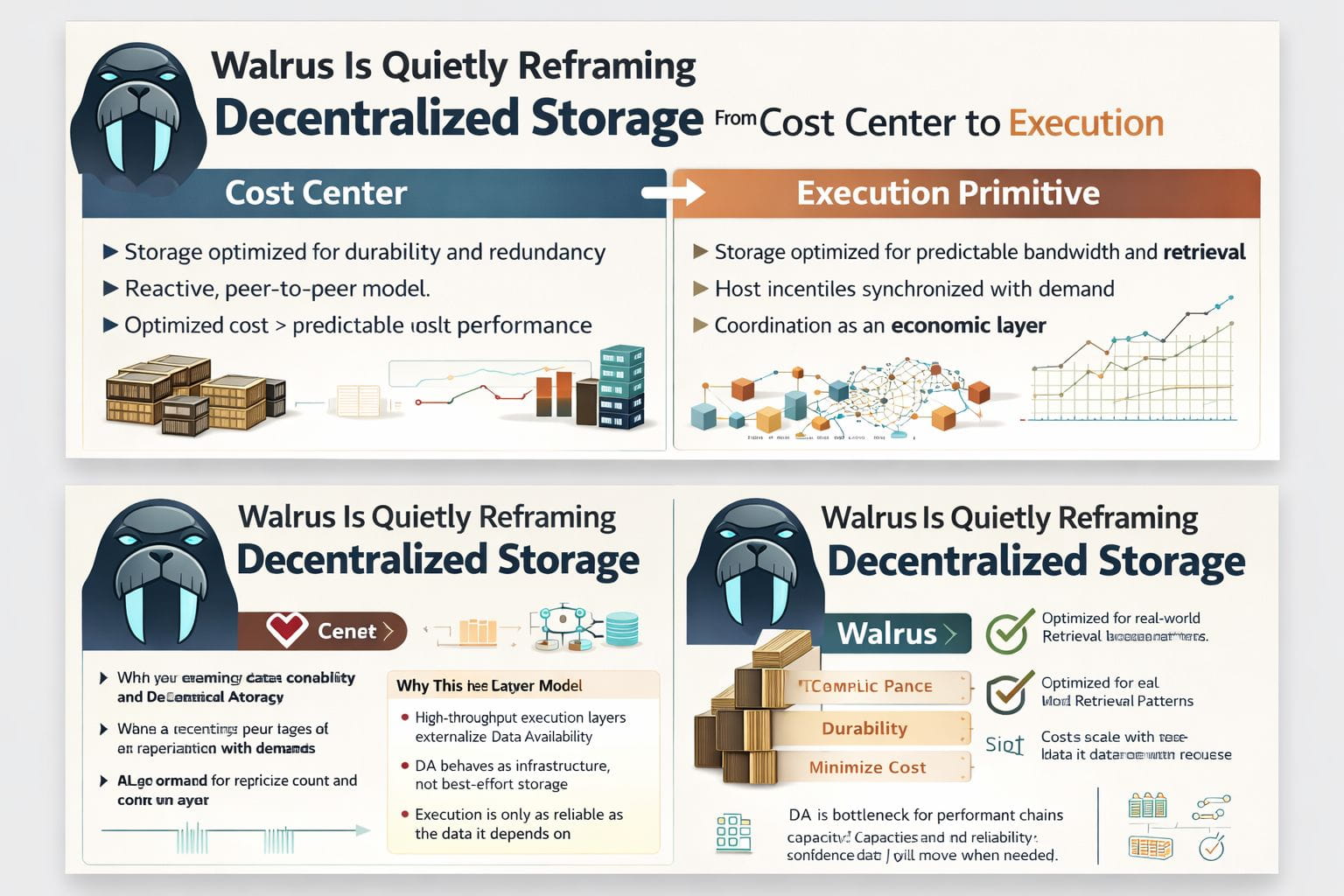
Framing is literally disintegrating, and @Walrus 🦭/acc happens to be at the fault line.
It is not necessarily that storage has become exciting and thus shifted. It is occurring so because the execution environments evolved at a higher rate than the assumptions the storage systems were constructed out of. The current blockchains, rollups, and application-specific chains do not face the most significant problem of consensus and compute any longer. They have difficulties in transporting, authenticating, and availing huge amounts of data in a dependable fashion to numerous parties simultaneously. The availability of data and bandwidth have ceased to be, and remain, second-order concerns.
After you view that, the previous model of decentralized storage begins to appear out of place. The systems were mostly configured to operate in a manner that is durable and redundant rather than predictable retrieval, coordinated bandwidth, and cost-beneficial incentives that increase with demand bursts. They modeled equations in terms of the existence of the data, as opposed to the execution capability of the system under load should this data be required immediately, by numerous agents, and in large amounts?
@Walrus 🦭/acc tackles the issue in a different direction. It does not view data as a passive object that has to be stored but as a dynamic contribution to the performance. That one change manages to make storage a cost center an execution primitive - something which applications and chains can reason about, rely on and structure against with confidence.
It is not significant that @Walrus 🦭/acc holds big lumps. Plenty of systems can do that. How it organizes storage, availability, and retrieval in an economical way is what is important. Rather than presuming that an idle capacity will somehow be used to fulfill demand, Walrus is built to bring to the surface real incentives that will cause nodes to take on the duty of serving data when it is truly needed, at scale, and contended with. No technical flourish that, it is an acknowledgment that decentralized infrastructure can only be effective when it is supported by incentives that more closely reflect reality, as shown by real-world patterns of usage.
This is particularly true when blockchains go more towards increased throughput and modular design. There is a growing specialization and high speed of execution layers, but externalizing data availability. That isolation can only be achieved when the DA layer is used as infrastructure rather than as best-effort storage. The existence of predictable costs, known performance envelopes and failure modes are more important than raw measures of decentralization.
@Walrus 🦭/acc fits in this fact because of its emphasis on coordination instead of maximalism. It is not an effort to substitute execution, consensus and settlement. It does not deny that it has a more limited but imperative role. Through this, it will be able to optimise things that actually break systems in practice: bandwidth saturation, uneven demand and gap between nominal capacity and usable capacity.
There is even a subtle implication here. The inclusion of storage as an implementation primitive alters the way applications are implemented. The developers cease compressing, batching, and distorting data simply to endure cost models that are not based on usage. They can build in the direction of more prosperous state, larger evidence, or more communicateive off-chain calculation, and understand that the data layer can never fall under achievement.
This is the reason why @Walrus 🦭/acc is less of a storage network launch and more of a correction. It recognizes what the ecosystem failed to learn via experience: it is not that execution does not work when the data that it needs does not run: rather, it is that the data that it needs cannot be transported, verified or accessed in a dependable and reliable manner at the right time.
These changes are normally detected in the market late. The issue of storage as cheap or expensive will continue to be debated. However, it is changing below that language. @Walrus 🦭/acc is not requesting people to become concerned with storage because it cares about the storage. It is compelling an acknowledgement that, in the contemporary decentralized systems, execution is never more than real as the data it can rely on.
That’s not a new insight. It is one that the industry is finally willing to develop on.

