

We have spent the last five years screaming "Institutional Adoption is coming!" at every minor partnership announcement. Yet, in 2026, the vast majority of real-world capital—pension funds, sovereign wealth, and corporate treasuries—remains completely off-chain. Why?
It’s not because they don’t understand the tech. It’s not because they hate yield. It’s because the infrastructure we built during the last bull run is fundamentally incompatible with the legal reality of capital markets.
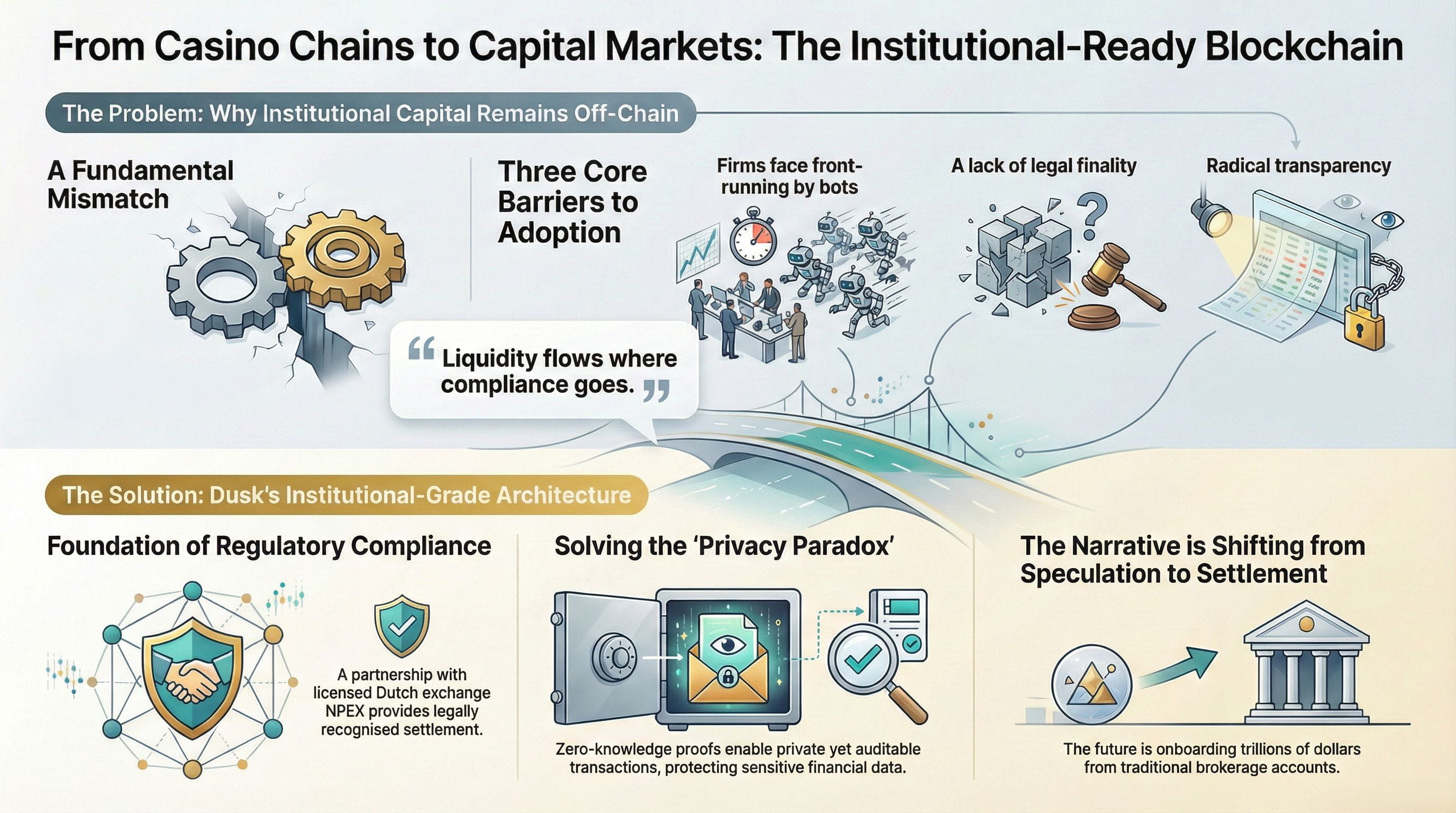
We need to stop pretending that a permissionless, fully transparent ledger is a viable environment for regulated securities. It isn’t. No asset manager in their right mind is going to trade tokenized equity on a platform where they can be front-run by a teenager with an MEV bot, or where the settlement layer cannot guarantee legal finality in a court of law.

This is the uncomfortable truth that the market ignores: Liquidity flows where compliance goes.
This brings us to the architecture of Dusk and why its approach to 2026 is radically different from the "casino chain" narrative we are used to. With the launch of DuskTrade, we are finally seeing a setup that mirrors how the financial world actually operates, rather than how crypto anarchists wish it operated.
The critical differentiator here isn't just "tokenization"; it is the regulatory stack underpinning it. Dusk isn't just partnering with a tech provider; they are collaborating with NPEX, a Dutch exchange that holds the holy trinity of European financial licenses: MTF (Multilateral Trading Facility), Broker, and ECSP (European Crowdfunding Service Provider).
Let’s break down why those acronyms are worth more than high TPS metrics. An MTF license essentially allows the platform to operate as a regulated trading venue, similar to a stock exchange. This means that when Dusk Trade brings €300M+ in tokenized securities on-chain, those assets aren't just synthetic tokens floating in a legal grey area. They are legally recognized financial instruments settled on a blockchain that was built to handle them.
This creates a "walled garden" of compliance within a decentralized ecosystem. It solves the liquidity trap. Previously, you had compliant assets trapped in TradFi silos, or liquid assets on non-compliant DeFi chains. Dusk bridges this by using a modular architecture where DuskEVM handles the smart contracts (the fun stuff developers like), while the base layer handles settlement with privacy and compliance baked in.
We also need to talk about the "Privacy Paradox." Institutions want the efficiency of blockchain settlement, but they cannot accept the transparency of a public ledger. If a large fund is unwinding a position, they cannot broadcast that move to the entire world in real-time before the trade settles. That is financial suicide.
Dusk’s implementation of Hedger solves this by using zero-knowledge proofs and homomorphic encryption. It allows the network to verify a transaction is valid without revealing the position size or the counterparty to the public. It is "privacy-preserving yet auditable". This is the specific feature set that turns a blockchain from a toy into financial infrastructure.
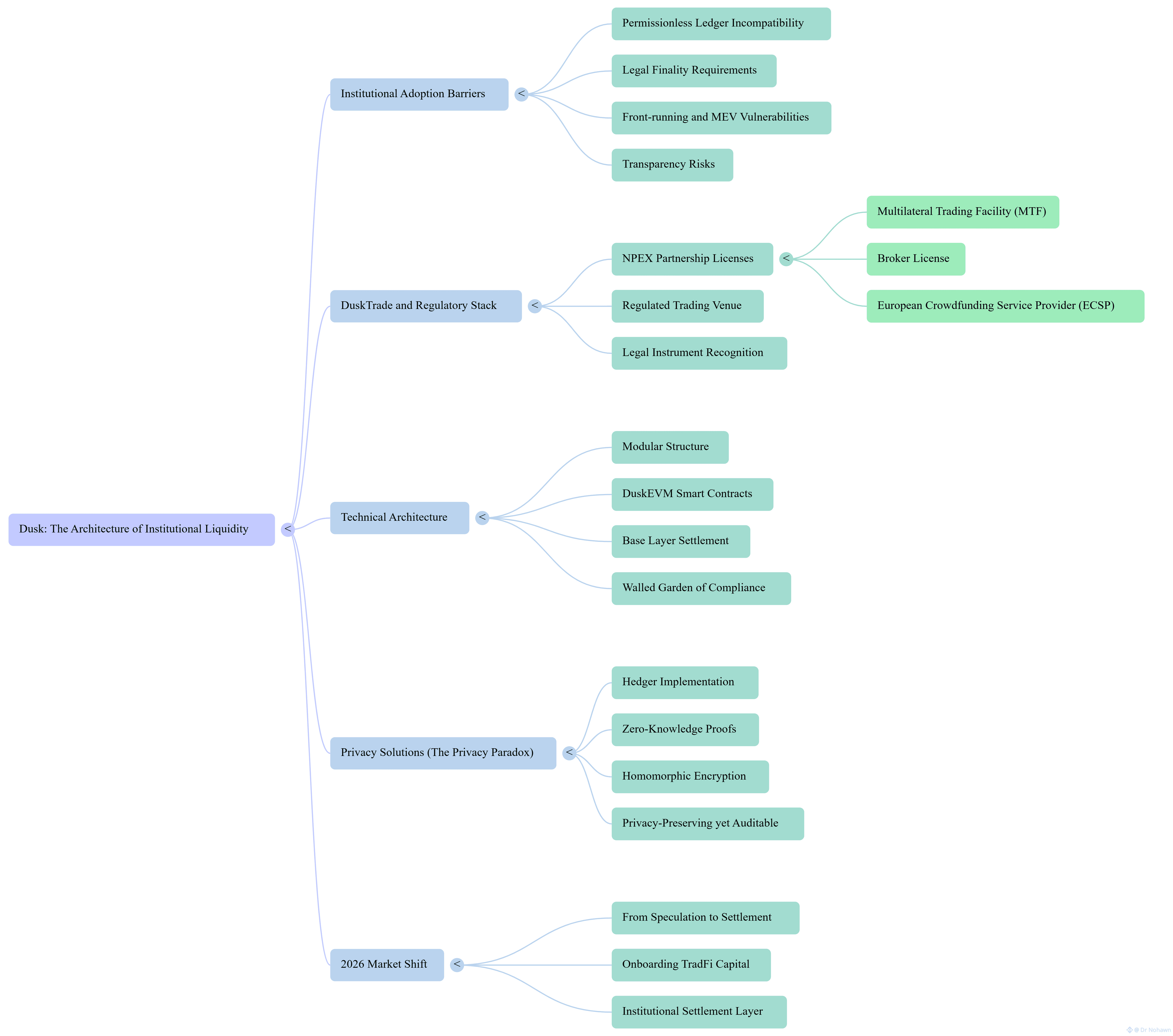
As we move deeper into 2026, the narrative is shifting from "Speculation" to "Settlement." The projects that win won't be the ones with the wildest meme coins; they will be the ones that can legally onboard the trillions of dollars sitting in traditional brokerage accounts. By aligning with NPEX and launching a mainnet designed for privacy and compliance, Dusk has positioned itself as the settlement layer for the grown-ups in the room.
