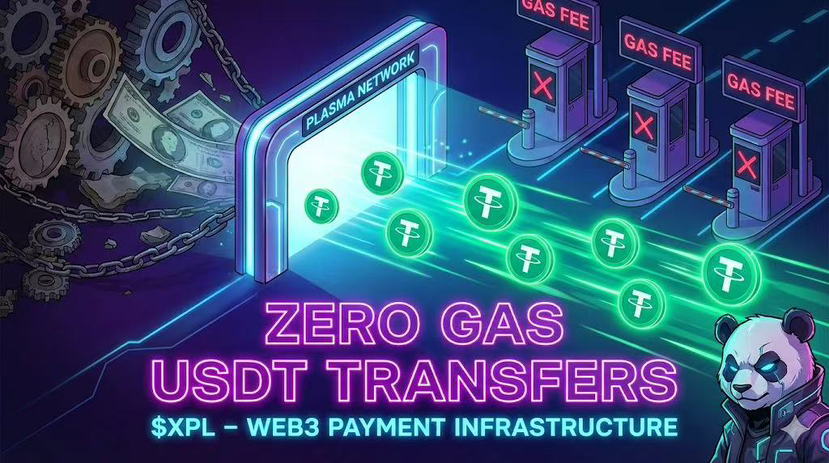
As an old player who has been struggling in the Web3 industry for many years, I have been thinking about a question: why, after shouting 'Mass Adoption' for so many years, have we still not truly achieved it?
The answer is actually very simple: the threshold is too high.
Imagine you are trying to encourage a friend outside your circle to use USDT for a transfer, and not only do you have to teach them what a wallet address is, but the most frustrating part is telling them: 'Oh, you also need to buy some ETH or BNB as Gas fees to make this transfer.' This step directly discourages 90% of people.
This is why I have been closely following Plasma ($XPL) recently. In the current infrastructure race, it is one of the few projects that truly 'understands' user pain points.
1. The 'zero Gas' mechanism that breaks through pain points
The core narrative of Plasma is very sexy: it is designed specifically for stablecoin payments.
On the Plasma network, using stablecoins like USDT for transfers incurs zero Gas fees. This sounds simple, but the technical implementation behind it is a dimensional reduction strike against the logic of existing public chains.
This means that future dApp developers can create applications as smooth as WeChat Pay or Alipay — users do not need to know what Gas is, they just need to focus on how much money is in their account. This is the ticket for Web3 payments to reach 1 billion users.
2. Balancing security and compatibility
Many public chains that emphasize low fees often sacrifice security, but Plasma is very smart. Its underlying consensus mechanism is anchored in the Bitcoin network, using BTC's hash power to ensure ledger security; at the same time, it perfectly compatible with EVM (Ethereum Virtual Machine).
What does this mean? It means that developers on Ethereum can seamlessly migrate over and directly enjoy Bitcoin-level security and zero Gas payment experience. This architecture, which combines the strengths of many, demonstrates the project party's strong engineering implementation capability.
3. The scent of Alpha hunters
From an investment perspective, the current public chain track is extremely crowded, but 'payment vertical public chains' remain a blue ocean.
Recently, the CreatorPad event on Binance Square has refocused many eyes here. I looked at their roadmap, and Q1 2026 will be a very critical quarter; the launch of staking and delegation functions will lock in a large amount of liquidity. For friends who like to ambush early Alpha, the current $XPL has a very high risk-reward ratio from both fundamental and narrative perspectives.
Conclusion
Web3 does not need more 'Ethereum killers,' but absolutely needs a payment network that can be used even by grandma. What Plasma is doing is bridging the 'last mile' between traditional finance and the crypto world.
Don't wait until everyone on the street is using it to scan for payments before remembering that you once read this article.
Follow the project party @Plasma , stay sharp, we will meet on the chain.