
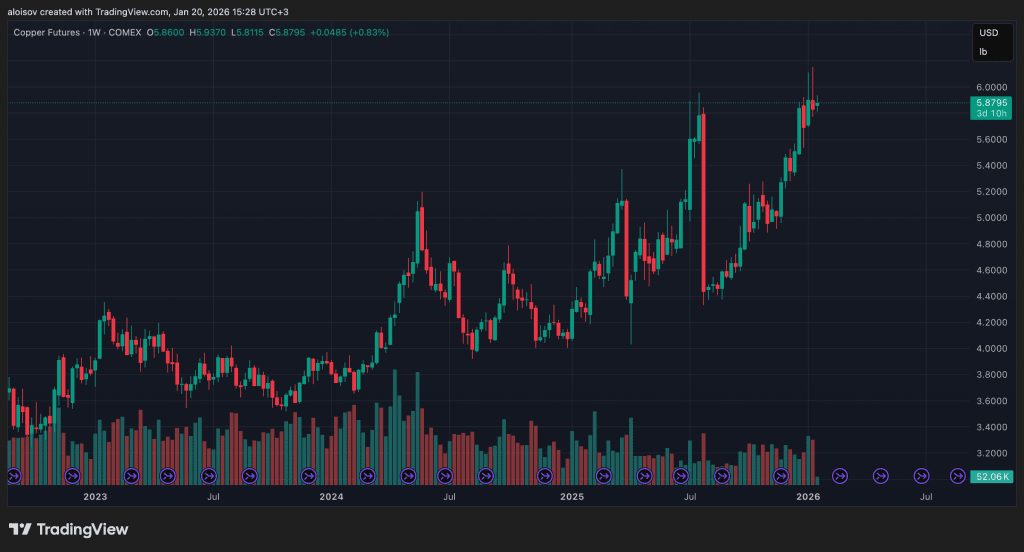
Copper has turned into a real monster of commodity markets, and those who underestimated this unassuming reddish metal are now biting their elbows. In early January 2026, copper futures on the London Metal Exchange (LME) confidently hold above the mark of $13,000 per ton — practically at historical highs. In 2025, the price jumped by more than 40%, showing the strongest growth since the turbulent times of the late 2000s.
What turned a modest industrial metal into a star of trading halls? The answer lies in tectonic shifts in the global economy, where copper has transformed from a quiet worker into a symbol of technological revolution.
From $8,000 to $13,000: the anatomy of a rally
To appreciate the scale of what is happening, just look at the numbers. At the beginning of 2025, copper traded around $8,000–9,000 per ton. Levels that now seem absurdly low were then considered quite adequate. But the market was preparing a surprise.
By mid-year, the price surpassed $12,000, and by the end — soared towards $13,000. This is not just another fluctuation in the commodity market. It is a structural revaluation of one of the most sought-after metals on the planet.
Demand is growing on all fronts. Electric vehicles, charging infrastructure, renewable energy, and modernization of electrical grids — copper is needed everywhere, and in large quantities. But data centers, especially those serving artificial intelligence (AI), have proven to be particularly voracious. A single large data center for AI may require tens of thousands of tons of copper just for wiring and cooling systems.
And what about supply? Here, the picture is bleak. Major mines in Indonesia, Chile, and Peru are facing technical problems, environmental restrictions, and labor conflicts. Giants like Freeport-McMoRan and Codelco are struggling with aging infrastructure and declining ore quality. New large projects take years to launch.
Lessons from history: when copper went crazy
Copper has always known how to put on a show. In the 1990s, a trader from Sumitomo Corporation attempted to monopolize the copper market, temporarily distorting prices and demonstrating how limited supplies can amplify price spikes. During the Great Depression, copper prices collapsed along with industrial production, confirming the metal's reputation as a barometer of economic health.
But the current cycle is fundamentally different. Growth is based on long-term structural changes, not short-term economic expansion. Electrification, renewable energy, and convergence with AI have created demand channels that did not exist a decade ago.
Deficit as the new norm
The imbalance between supply and demand is not a temporary inconvenience. S&P Global forecasts indicate that demand could increase by 50% by 2040 due to electrification and climate investments. Meanwhile, the growth of supply remains constrained by geological, regulatory, and financial barriers.
Stocks on major exchanges are melting away, and the likelihood of a deficit in refined copper remains until 2026 and beyond. The market signals: copper is becoming a strategic resource, not just an industrial metal.
Wall Street celebrates the copper boom
Investors have not stayed on the sidelines. Freeport-McMoRan (NYSE: FCX), one of the largest copper producers in the world, has maximized profits from rising prices and limited supply. Southern Copper Corporation (NYSE: SCCO), with assets in Mexico and Peru, shows impressive cash flow amid the rally.
Diversified mining giants like BHP Group (NYSE: BHP) are also benefiting — copper growth supports their broad resource portfolios. Smaller and more volatile companies, such as Hudbay Minerals (NYSE: HBM), have demonstrated exceptional returns thanks to leverage on production growth.
What’s next: copper in 2026 and beyond
Forecasts for the near future look intriguing. Production growth is expected to be moderate, and the output of refined copper may not keep pace with demand. This supports a deficit and pressure on prices — especially if the expansion of data centers and electrification gain momentum.
Analysts forecast that upward pressure on prices will persist through 2026, although volatility and periodic corrections may occur under the influence of speculative and macroeconomic factors.
Geopolitical factors, trade policies, and investments in mine development will affect the global stability of supply. If obstacles to new capacities persist, tension in copper markets may intensify.
Copper has taken on a new role in the global economy. From a mere indicator of industrial activity, it has transformed into a strategic commodity, central to the energy transition and digital infrastructure. Whether this period marks the beginning of a true long-term supercycle or settles into a high plateau with periodic corrections will be shown by time. But one thing is clear: the role of copper in 2026 and beyond will be under close scrutiny, like any asset shaping the future of technology and energy.
AI's opinion
From a data analytics perspective, copper supercycles of the last 150 years show an interesting pattern: each boom ended with the emergence of technological alternatives or revolutionary extraction methods. Aluminum displaced copper in the 1960s, fiber optics in 1990s telecommunications, and graphene conductors are already demonstrating multiple times better conductivity in labs. Quantum computing, which could replace energy-hungry AI data centers by 2035, requires fundamentally different materials.
Analysis of patent activity reveals a 340% increase in applications for room-temperature superconductors over the last three years. At the same time, China is investing $50 billion in deep-sea mining technologies that could double the world's copper reserves by 2035. History suggests that the shortage of a critically important resource inevitably stimulates breakthrough innovations. Will the current copper boom be a catalyst for a technological revolution or repeat the paths of previous cycles — this is the question of the coming decade.
\u003ct-32/\u003e \u003ct-34/\u003e \u003ct-36/\u003e
\u003cc-25/\u003e
