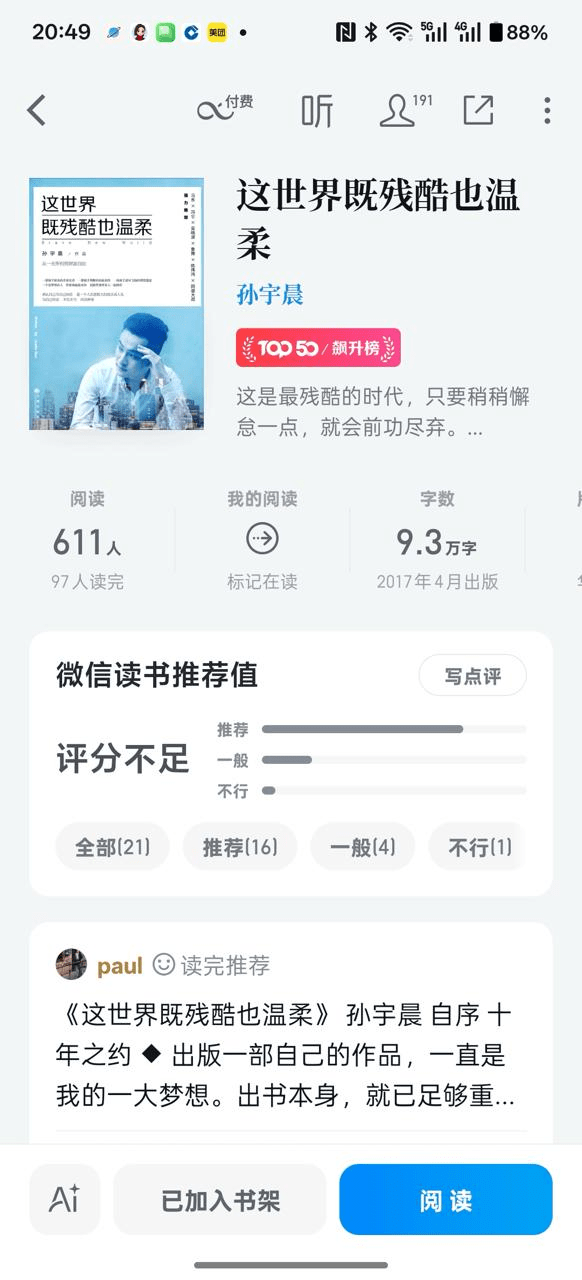
Brother Sun, a graduate of Peking University's History Department, indeed has remarkable writing skills; his new book has just been published and has surged to the top 50 in WeChat Reading's rising list. The fact that a book written by a business leader can enter the popular reading platform's hot list is itself worthy of examination within a longer industry cycle.
Turning the pages, time is pulled back to 2017. It was the peak of the last bull market, and the horn of the 'Battle of a Hundred Chains' was sounded, with grand debates about blockchain technology and ideology flooding the market. At such a noisy juncture, Sun Yuchen's several directions anchored for Tron seem particularly clear and firm today—especially when looking back from the present in 2026. His strategy lacks much metaphysical debate, focusing instead on three extremely pragmatic goals: improving efficiency, ensuring circulation, and maintaining survival.
First, on the technical route, he bet on 'efficiency.' In 2017, Bitcoin's PoW mechanism was undoubtedly the king, with resource consumption and decentralization seen as necessary costs. But Sun Yuchen chose the DPoS consensus mechanism at that time. His judgment was straightforward: the core of future public chain competition would be the competition of high throughput (TPS) and low transaction costs. The subsequent industry evolution validated this, from Ethereum's shift to PoS to the rise of high-performance chains like Solana, where efficiency became the undisputed mainstream pursuit. TRON's early choice on the technical route laid the foundation for its future development in speed and cost.
This efficiency-first technical architecture ultimately served a grander business goal: to become the 'SWIFT of the crypto world.' Sun Yuchen did not challenge the status of traditional banks; instead, he chose to become the underlying pipeline for global capital flow, a cheaper and faster pipeline. This positioning was continuously solidified in the following years. By 2026, the TRON network, with its fees that are nearly negligible and second-level confirmation speed, in fact carried the vast majority of the circulation of the stablecoin USDT globally, especially in developing countries and cross-border payment scenarios. This absolute dominance in 'circulation' is its strongest moat.
The combination of efficiency and circulation ultimately points to a third goal: long-term survival. Among the countless projects that emerged during the wave in 2017, more than 99% have disappeared. TRON not only navigated multiple complete bull and bear cycles but also remained stable among the top global cryptocurrency market capitalizations in 2026, breaking the curse of the 'ICO project cycle law.'
From 2017 to 2026, nine years is enough to verify the resilience of a strategy. The 'gentleness' and 'cruelty' dialectic conveyed by Sun Yuchen in his new book may be a projection of his own experience: in an industry full of variables, what the world ultimately rewards is not the loudest slogan, but the solution that can continuously and cheaply solve real pain points—such as making global transfers as simple and convenient as sending a message. The rapid ascent of this new book to the WeChat Reading TOP 50 can be seen as a realistic reflection of its commercial practice at the public perception level.
@Justin Sun孙宇晨 @TRON DAO #TRONEcoStar #Tron #TronNetwork