
“Utility token” is one of the most misunderstood terms in crypto, yet it sits at the very center of current regulation debates like the CLARITY Act.
So let’s break it down clearly, without legal jargon, and use real, well-known tokens as examples.
What Is a Utility Token?
A utility token is a digital asset whose primary purpose is use, not profit.
In simple terms:
You hold it because you need it to do something, not because someone promised it would go up in price.
Utility tokens are designed to:
Power a network
Pay for transactions or services
Enable access, governance, or settlement
They are not meant to represent:
Ownership
Dividends
Profit-sharing
Guaranteed returns
This distinction is crucial in regulation, because utility tokens are far less likely to be treated as securities.
Key Characteristics of Utility Tokens
A token is more likely to be considered a utility token if:
✅ It is required to use the network
✅ It does not promise yield or income
✅ It does not represent equity or profit rights
✅ Its value comes from network activity, not management efforts
✅ The network is live and functioning
Now let’s look at real-world examples.
Example 1: Litecoin (LTC)
Litecoin is one of the clearest examples of a pure utility token.
Why?
Used primarily for peer-to-peer payments
Fast confirmation times
Low transaction fees
No dividends, no yield, no profit claims
No centralized issuer promising growth
LTC functions as digital cash, similar to Bitcoin but optimized for payments.
👉 Utility: Medium of exchange
Example 2: Dogecoin (DOGE)
Despite its meme origins, Dogecoin also fits the utility token profile.
Why?
Used for low-fee payments and tipping
Actively used for microtransactions
No formal roadmap promising investor returns
Inflationary supply discourages “store of value” narratives
DOGE’s value comes from:
Network usage
Community adoption
Payment utility
👉 Utility: Payments + social transactions
Not every utility token has to be “serious tech.”
Example 3: Bitcoin (BTC)
Bitcoin is often classified as a commodity, but functionally it is also a utility-driven asset.
Why?
Used for settlement
Used as a censorship-resistant payment rail
No issuer
No profit distribution
No central management team
BTC’s utility is not “number go up.”
Its utility is trustless, global value transfer.
👉 Utility: Settlement + monetary network
Example 4: Ethereum (ETH)
Ethereum sits in a hybrid position, but its utility component is undeniable.
Why?
ETH is required to pay gas fees
Without ETH, the network does not function
Used to execute smart contracts
Used to secure the network via staking
The debate exists, but the functional necessity of ETH is what gives it utility-token characteristics.
👉 Utility: Computation + execution layer
Utility Token vs Investment Narrative
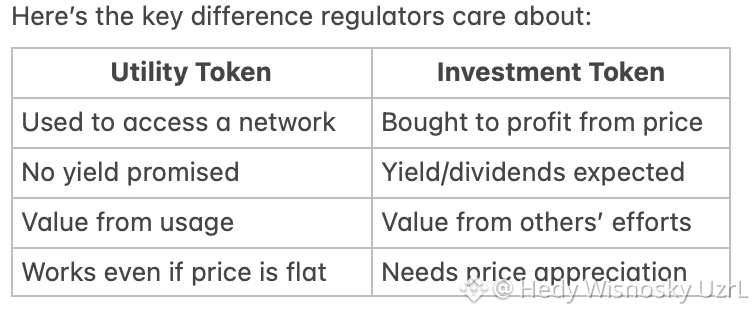
This is why regulation is increasingly pushing markets to:
Separate speculation from functionality
Why This Matters Now
With legislation like the CLARITY Act, the market is moving toward:
Clear definitions
Clear compliance
Clear winners and losers
Tokens with real, provable utility are more likely to:
Survive regulation
Be listed on compliant exchanges
Attract institutional capital
Be repriced based on usage, not hype
Narratives fade.
Utility compounds.
Final Thought
A utility token doesn’t need to promise riches.
It just needs to work.
In the next cycle, price will follow function, not the other way around.
Not financial advice. Always do your own research.


