
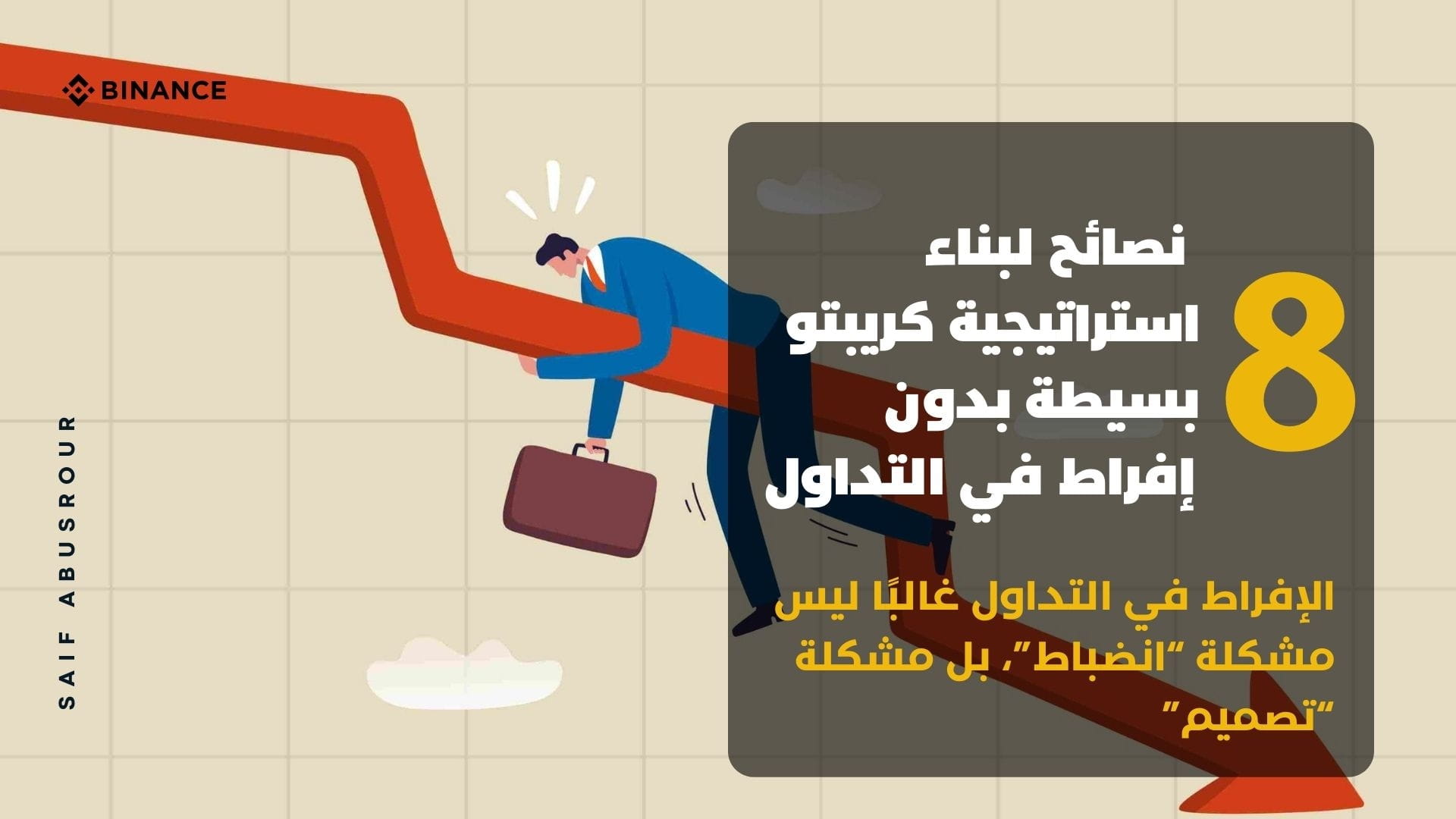
Choose one style: long hold or quick trading—do not mix.
Limit the currencies: Bitcoin + one major currency (or at most two).
Buy on a fixed schedule: weekly or monthly at a set amount.
Do not chase the market: no buying/selling due to momentary “fear” or “greed.”
Reduce time in weakness: if the market is down for a while, reduce buying or focus only on Bitcoin.
Monthly review only: once a month, adjust the portfolio instead of daily decisions.
Keep some cash/USDT: for emergencies and opportunities instead of being 'stressed'.
Remember the hidden tax: high trading volume drains you even if your prediction is correct (commissions + price difference).
Overtrading is often not a lack of discipline, but a flaw in strategy design. When you do not set clear limits for decisions in the plan, the market turns into a series of endless decisions: buy, then sell, then re-enter. With each decision, the likelihood of error increases. Moreover, each trade carries an invisible cost even if you do not notice it: commission, and a difference between buying and selling price, and sometimes execution at a worse price due to haste. Therefore, a good strategy does not aim to 'increase expectations,' but to reduce the decisions that drain you.
Start by clearly defining your time identity: are you an investor holding for weeks and months, or a trader moving within days? Many losses come from mixing the two personalities: a person enters with the intention of investing, then exits quickly due to a short price movement. After that, craft your goal in one clear sentence like: 'I buy regularly and reduce risk when the market weakens.' If you cannot simplify the idea, you are likely reacting to noise rather than to a plan.
For the beginner, keep your portfolio simple: Bitcoin with one or two major currencies only. Too many currencies mean too many decisions, mental pressure, and constant chasing. Rely on a fixed entry through weekly or monthly dollar-cost averaging with a specific amount. This alone reduces over-trading because it shifts the decision from emotion to schedule.
Then set one easy rule to determine when to increase buying and when to reduce it: compare today’s price with the average price over the last six months. If the price is above the average, continue normal buying, and if it is below, reduce buying or focus on Bitcoin only or wait. This way, you do not ask every day, 'Should I sell now?' but ask one question: 'Is the condition still met?'
And make the portfolio a monthly review only: if the weight of a certain currency has inflated too much compared to the rest, sell a small part to rebalance, and if its weight has decreased a lot, increase a little. This prevents you from chasing small movements and makes your decisions few but calculated.
As for the advanced trader, the real difference is not in the 'signal' as much as it is in the size of the trade and the execution method. Do not increase the size because you are 'confident'; rather, make it so that if the price moves against you, it does not harm the account. Set a daily loss limit: if you reach it, stop. Many losses occur when the trader continues under pressure and starts chasing the market.
And the point that most people overlook: your idea may be correct, but you lose because your entry was at a bad price or because trading costs ate into the profit. Therefore, reducing the number of trades sometimes increases results more than improving expectations.
A question: if you were only allowed one decision per month, which rule would you choose to remain disciplined and profitable: dollar-cost averaging, the 'six-month average' rule, or monthly review for rebalancing?
An idea that 99% do not know: the market is like a fast auction; the more your trades increase, the more likely you are to be the one paying the 'execution tax' in favor of those who have faster speed and more accurate information—even if your analysis is excellent.
#Write2Earn
