
Hello everyone:
The Talex content platform recently launched quietly, employing a "pay-per-article + predicted revenue sharing" mechanism, which has generated considerable buzz.
The friends had a blast, spreading the news far and wide, creating quite a stir. Why was everyone reacting so enthusiastically?
First, take a look at a screenshot:
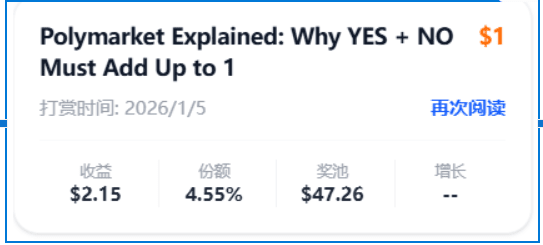
I tipped this article $1, earning $2.15. The return on investment is (2.15 - 1) / 1 × 100% = 1.15 × 100% = 115%.
Who wouldn't be envious of such a rate of return on investment?
What exactly is the workings of the Talex content platform? How exactly does the revenue sharing mechanism of single-article payment + prediction-based profit sharing work?
Let's break this down and discuss it in detail using three case studies.
Without further ado, let's get started and serve the food!
---------------------------------------------------
To avoid confusion, let's start with an overview from a bird's-eye view, clarifying the definitions of "predecessor" and "successor," and the four time windows and four prediction pools:
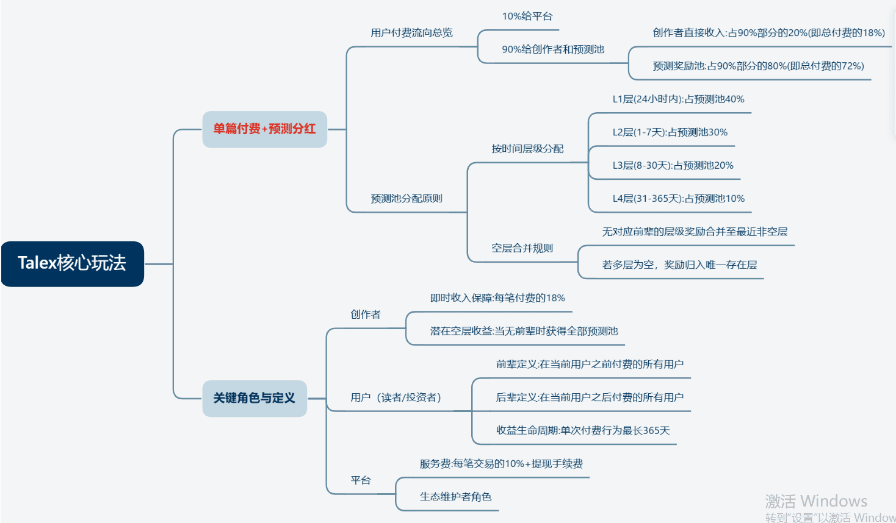
1. The user's payment amount is divided into two main parts:
First, 10% goes to the Talex platform;
Second, 90% is allocated to the author and the prediction pool:
The authors account for 20% of this 90%.
The prediction pool accounts for 80% of this 90% (the prediction pool is further divided into 4 layers according to the time window, and the proportion of each layer is different).
2. Annotations for "senior" and "junior":
When a user becomes the nth person to tip for a piece of content:
Everyone who tipped him before him was called his "senior".
Everyone who tipped him after him was called his "junior".
3. Four time windows and four prediction pools: 1 day / 7 days / 30 days / 365 days (user-centered design)
A key design principle is:
The time window is defined relative to each user's payment behavior, not relative to the content itself.
Each time a user pays to tip content, that action will generate revenue for a maximum of 365 days.
Over these 365 days, users will appear in the "predecessor list" of future supporters with varying weights over time.
For each paid donation from a junior member, the prediction pool amount will be divided into four tiers based on the time window, with each tier having a different proportion, as follows:
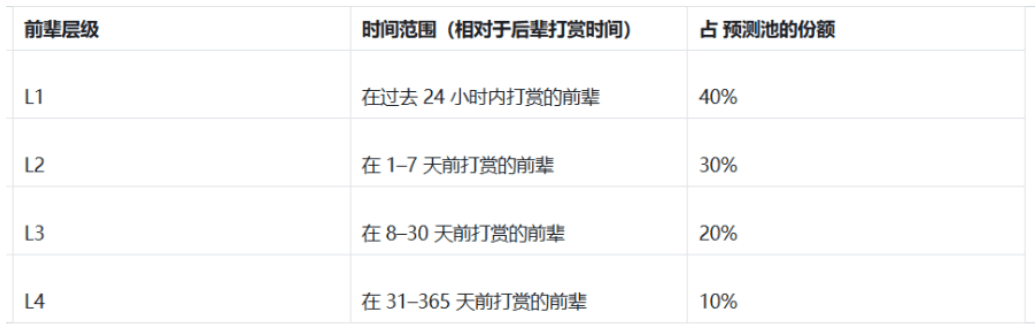
This means:
Those who tipped in the past 24 hours are considered to have the greatest influence on the current spread;
Those who tipped 1-7 days ago represent short-term dissemination;
Those who gave tips 8-30 days ago represent the mid-term dissemination;
Those who tipped 31-365 days ago will enjoy long-tail rewards.
For any single donation:
From the moment a tip is made, a user can receive rewards from future supporters for up to 365 days.
Over time, their hierarchy will naturally transition from L1 → L2 → L3 → L4.
After 365 days, it will no longer participate in new distributions, but the content can still be tipped.
in other words:
The work itself can exist for a long time and continue to receive donations;
What has a lifecycle is each act of tipping, not the content itself.
---------------------------------------------------
Okay, now let's use three cases to analyze in detail how the money is divided.
Case Study 1: Linear Growth and Early Supporter Bonus
This case demonstrates how a piece of content can consistently generate paid subscriptions after publication.
Timeline and Events:
Day 1, 08:00:
User A reads and pays $10, the platform receives $1 (10% of the payment), and the author and "predecessors" receive $9 (90% of the payment).
Calculation: This is the first payment. No predecessors.
distribute:
Creator income = 9 × 20% = $1.8 (20%)
Prediction pool = 9 × 80% = $7.2 (80%)
Since there are no predecessors (L1-L4 are all empty), according to the empty layer processing rules, the entire $7.2 in the prediction pool belongs to the creator.
Result: The creators received a total of $1.8 + $7.2 = $9. User A received no reward.
Day 1, 20:00 (12 hours after A's payment):
User B reads and pays $6, the platform receives $0.6 (10% of the paid content), and the author and "predecessors" receive $5.4 (90% of the paid content).
Calculation: At this point, the only senior user is A, and A's payment time is within 24 hours of B's, which belongs to layer L1.
distribute:
Creator income = 5.4 × 20% = $1.08 (20%)
Prediction pool = 5.4 × 80% = $4.32 (80%), allocated as follows:
L1 pool: 4.32 × 40% = 1.728 (40% of the prediction pool)
L2-L4 pool: Since there is no corresponding predecessor, L2-L4 together account for 60% of the share (4.32 × 60% = 2.592 $), and are merged into the nearest non-empty layer L1 according to the rules.
Therefore, the total reward pool for L1 is 1.728 + 2.592 = 4.32 $.
In layer L1, there is only user A, who receives the full $4.32.
Results: The creator received $1.08. User A, as a senior contributor, received a reward of $4.32.
Day 3, 10:00 (1 day and 14 hours before payment by B, 2 days and 2 hours before payment by A):
User C pays $20, the platform takes $2 (10% of the payment), and the author and "senior" take $18 (90% of the payment).
Calculation: At this time, there are two predecessors: User A (about 2 days ago) and User B (about 1 day ago).
Determine the hierarchy:
User B: Payment within 24 hours of C → L1
User A: Payment within 1-7 days of C → L2
distribute:
Creator income = 18 × 20% = $3.6 (20%)
Prediction pool = 18 × 80% = $14.4 (80%), allocated as follows:
L1 pool: 14.4 × 40% = $5.76 (accounting for 40% of the prediction pool), exclusively awarded to user B.
L2 pool: 14.4 × 30% = $4.32 (accounting for 30% of the prediction pool), exclusively awarded to user A.
L3 Pool: 14.4 × 20% = $2.88 (20% of the prediction pool) (Empty, merged into L2)
L4 Pool: 14.4 × 10% = $1.44 (10% of the prediction pool) (Empty, merged into L2)
Therefore, the actual total reward pool for L2 is $4.32 + $2.88 + $1.44 = $8.64, which is exclusively awarded to user A.
Results: The creator received $3.60. User B received $5.76, and User A received $8.64.
Day 10, 15:00 (7 days and 5 hours after C's payment):
User D pays $15, the platform receives $1.5 (10% of the payment), and the author and "senior" receive $13.5 (90% of the payment).
Calculation: There are three predecessors at this time: A (about 9 days ago), B (about 8 days ago), and C (about 7 days ago).
Determine the hierarchy:
User C: Payment was made within 7 days of D's payment but exceeded 1 day → L2
User B: Payment within 8-30 days of D → L3
User A: Payment within 8-30 days of D → L3
distribute:
Creator income = 13.5 × 20% = $2.7 (20%)
The prediction pool = 13.5 × 80% = $10.8 (accounting for 80%), allocated as follows:
L1 Pool: 13.5 × 40% = $5.4 (40% of the prediction pool) (Empty, merged into L2)
L2 pool: 13.5 × 30% = 4.05 $ (accounting for 30% of the prediction pool), exclusively for user C.
L3 Pool: 13.5 × 20% = 2.7 (accounting for 20% of the prediction pool), to be allocated between users A and B according to their initial payment amounts.
L4 Pool: 13.5 × 10% = $1.35 (10% of the prediction pool) (Empty, merged into L3)
Therefore, the L2 layer actually receives $5.4 + $4.05 = $9.45, which goes to user C.
The actual prize pool for L3 is $2.7 + 1.35 = $4.05. User A receives $4.05 × 10 / (10 + 6) = $2.53125, and User B receives $4.05 × 6 / (10 + 6) = $1.51875.
Results: The creator received $2.70. User C received $9.45, User A received $2.53125, and User B each received $1.51875.
summary:
In this case, the earliest supporter, user A, received a total reward of $4.32 + $8.64 + $2.53125 = $15.49125 through three subsequent payments, far exceeding his initial payment of $10, thus realizing the reward for "predicting correctly".
The creator earned a total of $1.8 + $1.08 + $3.6 + $2.7 = $9.18 from these four payments.
Case Study 2: Explosive Propagation and Hierarchical Leap
This case demonstrates how content can suddenly go viral after a period of silence.
Day 1: User E pays $10. (Same as Day 1 in Case 1, the creator receives $1.80, and E receives no reward.)
Day 2-30: No new payments.
Day 31: This content was recommended by a prominent influencer for some reason, and suddenly a large number of paid subscriptions flooded in.
Let's take one example to calculate: User F pays $50, the platform takes $5 (accounting for 10% of the payment), and the author and "senior" take $45 (accounting for 90% of the payment).
Calculation: At this point, the only predecessor is user E, whose payment time was 31-365 days ago, belonging to layer L4.
distribute:
Creator income = 45 × 20% = $9 (20%)
Prediction pool = 45 × 80% = 36 (80%), allocated as follows:
Pools L1, L2, and L3: Completely empty.
According to the rules, if three layers are empty, all rewards are allocated to the remaining layer.
Therefore, the L4 layer receives all 36 $, which is exclusively allocated to user E.
Results: The creator received $9. User E received a reward of $36.
Summary: This case demonstrates the long-tail effect of the mechanism and the power of the "empty layer merging" rule. Even if the content only became popular a month after its release, the earliest and only supporter, E, was still able to capture the vast majority of the subsequent explosive revenue, which greatly incentivized users to discover and support potentially high-quality content early on.
Case Study 3: Complex Multi-Node Allocation
Suppose that four creators (A, B, C, and D) have already paid for a piece of content at different times. Now, user E pays $30. The platform receives $3 (10% of the payment), and the author and the "predecessors" split $27 (90% of the payment). The timeline is as follows:
A: 5 hours ago (L1)
B: 3 days ago (L2)
C: 10 days ago (L3)
D: 50 days ago (L4)
Allocation calculation:
Creator income = 27 × 20% = $5.4 (20%)
Prediction pool = 27 × 80% = $21.6 (80%), stratified according to the original proportions:
L1 pool: 21.6 × 40% = 8.64 (40% of the prediction pool) → Only A is in, A wins alone.
L2 pool: 21.6 × 30% = 6.48 (accounting for 30% of the prediction pool) → Only B is present, B receives the reward alone.
L3 pool: 21.6 × 20% = 4.32 $ (accounting for 20% of the prediction pool) → Only C is present, C wins alone.
L4 pool: 21.6 × 10% = 2.16 $ (accounting for 10% of the prediction pool) → Only D is present, D wins alone.
Results: The creator received $5.40. A received $8.64, B received $6.48, C received $4.32, and D received $2.16. All levels had participants, so no merging was necessary.
---------------------------------------------------
Summary and implications of core rules
Through the above deduction, we can clearly see the core logic of Talex reward calculation:
Instant Creator Guarantee: Regardless of content performance, creators always receive 20% of 90% of each paid transaction as a stable income.
Dynamic Predecessor Rewards: The remaining 90% is used as a prediction pool to form a dynamic, time-decreasing reward pool, which is awarded to earlier discoverers.
The time tier is key: the division from L1 (24h) to L4 (365d) allows the reward allocation to precisely reflect the timeliness of the "spread contribution". The closer the supporter, the greater their direct contribution to the current spread is considered, and therefore the higher their reward weight (L1 accounts for 40% of the prediction pool).
Empty layer merging mechanism: This design ensures that funds are never wasted and allows the remaining early supporters to receive excess rewards when content unexpectedly spreads (as in Case 2), which enhances the gamification of "value discovery".
The benefits and risks go hand in hand: Of the 90% of user payments, 20% are pure consumption, while 80% are "investments" with a predictive element. If no one pays for the content after you pay, your investment will not yield a return; however, if the content is disseminated and people pay, you, as a senior contributor, can receive continuous dividends.
This mechanism ingeniously combines paid content, incentive-based dissemination, and predictive games. It encourages users to move beyond being passive consumers and become active value discoverers and dissemination nodes, growing alongside creators and thus systematically solving the motivation problem for high-quality content in its initial launch and sustained dissemination.
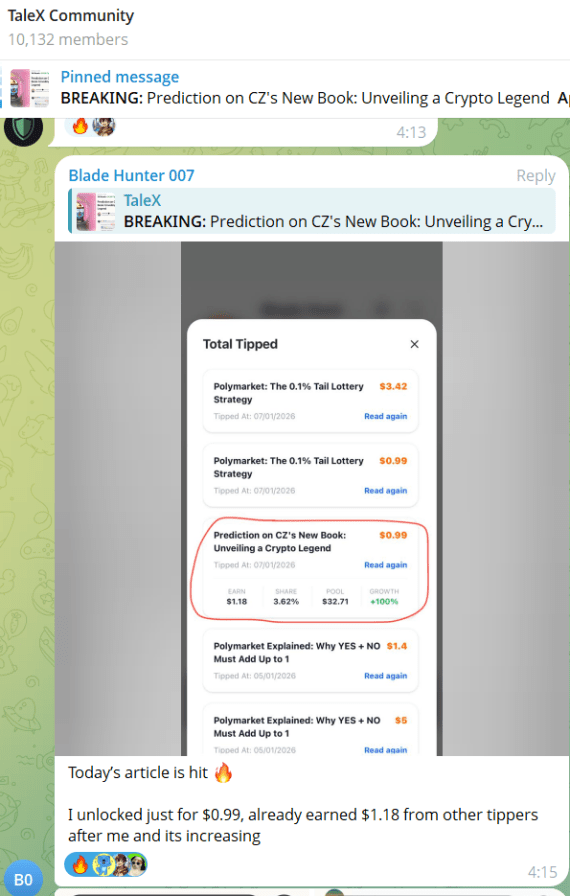
Finally, let's share this friend's joy. He paid $0.99 and has already earned $1.18. If more people continue to pay, he will continue to earn money.
I hope that everyone reading this article will also have a keen eye for detail and the ability to spot great articles, reward, share, and earn money quickly.
Note: This article is for informational purposes only and does not constitute financial advice. Please conduct your own research (DYOR).