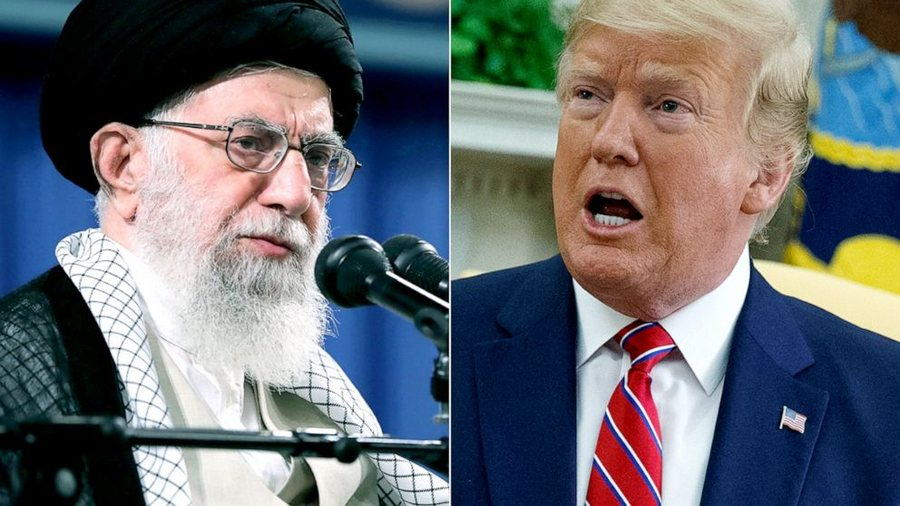
In an unprecedented escalation of geopolitical tensions, Iran has unequivocally declared that any US military attack on its territory will be met with an immediate counterattack targeting US bases in the region, and even extending beyond them to include Israel and vital shipping facilities. These statements, made by senior Iranian officials, are not mere verbal threats, but reflect a sophisticated military doctrine and a multifaceted deterrence strategy that could be a game-changer in the Middle East.
Explosive context: Internal protests ✊ and external threats ⚔️
These threats come amid a highly complex regional and international context. On one hand, Iran is experiencing widespread internal protests, described by some as teetering on the brink of revolution. On the other hand, the administration of US President Donald Trump has repeatedly warned Tehran against suppressing the protesters, asserting that assistance is forthcoming. Intelligence reports have revealed preliminary discussions within the US administration regarding a potential attack on the Iranian regime, including large-scale airstrikes targeting military sites. Meanwhile, Israel has placed itself on high alert and is maintaining constant coordination with Washington in anticipation of any escalation.
American bases: Legitimate targets in the line of fire 🔥
American bases in the Middle East are no longer merely strategic deployment points, but have become, according to Iranian statements, legitimate targets in the event of any confrontation. These vital targets include:
Al Udeid Air Base (Qatar): 🇶🇦 The largest US military base in the Middle East, and the forward headquarters of US Central Command (CENTCOM), housing approximately 10,000 troops.
Naval Support Base (Bahrain): 🇧🇭 Home of the US Fifth Fleet, which controls vital waterways such as the Strait of Hormuz 🚢
Ali Al Salem Air Base and Camp Arifjan (Kuwait): 🇰🇼 Major logistics hubs hosting approximately 13,500 US troops
Al Dhafra Air Base (UAE): 🇦🇪 Houses advanced fighter jets and reconnaissance aircraft ✈️
Bases in Iraq and Syria such as Ain al-Asad and al-Tanf: 🇮🇶🇸🇾 have previously been targeted by Iranian missile attacks
Iran's arsenal: Hypersonic missiles 🚀 and unconventional drones 🛸
Iran's deterrence strategy relies on a sophisticated military arsenal that has undergone significant development in recent years, and includes weapons that could surprise adversaries:
Hypersonic Missiles: Iran possesses missiles such as the Fatah-1 and Fatah-2, capable of reaching speeds between Mach 13 and Mach 15, with high maneuverability mid-flight. These speeds and the ability to change course make interception by conventional air defense systems like the Patriot extremely difficult, and could pose a significant challenge to US and Israeli defenses. 🛡️
Long-range ballistic missiles: Iran has developed new missiles with a range of up to 3,000 kilometers, capable of carrying various warheads, putting most US bases in the region and Israel within their target range.
Drones: Iranian drones, such as the Shahed-136 suicide drone, have proven effective in depleting air defenses. Iran is also developing new versions equipped with air-to-air missiles and man-portable air defense systems (MANPADS), and relies on secret underground drone bases like Base 313 to ensure their survivability and effectiveness. 🛰️
Advanced air defense systems: Iran possesses systems such as the Bavar-373, the Iranian version of the S-300/S-400, capable of tracking and targeting stealth aircraft, as well as the 9-Dey system, which specializes in countering cruise missiles and low-flying drones. 📡
Beyond official statements, in-depth analyses reveal Iranian strategies that may be more complex and dangerous:
Underground Missile Cities: Iran possesses a vast and complex network of fortified missile bases deep within the mountains, known as missile cities. Iranian military leaders have stated that these bases remained untouched even after previous confrontations, and that Tehran has not yet opened the gates of a single missile city, indicating the existence of a massive, unutilized strategic stockpile capable of launching continuous attacks. ⛰️
Simultaneous Retaliation Strategy: 🔄 The Iranian plan relies not only on missiles launched from within its territory but also on activating a unified front. This means coordinated and simultaneous attacks by allied militias in Iraq, Syria, Lebanon, and Yemen at the exact moment US or Israeli bases are targeted. The goal is to create an information overload for radar and air defense systems, and to disperse enemy forces across multiple fronts. 🌐
Electronic and Cyber Warfare: 💻 There are serious concerns about Iran's ability to carry out sophisticated cyberattacks targeting US drone control systems or disrupting C4ISR military communication networks at the moment of an attack, potentially crippling coordination between US bases and creating operational chaos. 🔌
The principle of offensive defense and preemptive strikes: 💥 Iranian Parliament Speaker Mohammad Bagher Ghalibaf's statements regarding not being bound by the principle of responding only after an action has been taken indicate the adoption of a preemptive strike doctrine. This means that Iran may consider any American movements that suggest an imminent attack as justification for launching a preemptive strike, a radical shift in Iranian military doctrine from defense to initiative. ⚔️
The overarching strategic objective: Expelling America from the region: 🇺🇸➡️🌍 In-depth analysis indicates that Iran seeks not only to repel an attack, but also to exploit any confrontation to raise the cost of the American presence in the region to an untenable level, forcing Washington into a complete withdrawal. This broader strategic objective is the primary driver behind Iranian escalation.
Edge of the abyss 📉
Recent Iranian threats, backed by advanced military capabilities and unconventional deterrence strategies, are pushing the region to the brink. Amid internal tensions and mounting external pressures, Tehran appears willing to risk a major escalation to impose its terms and protect its interests. The question now is not whether Iran will respond, but how and when, and what unforeseen consequences might arise from this potential conflict, which could reshape the entire Middle East map.