
By @orangelgilcrypto
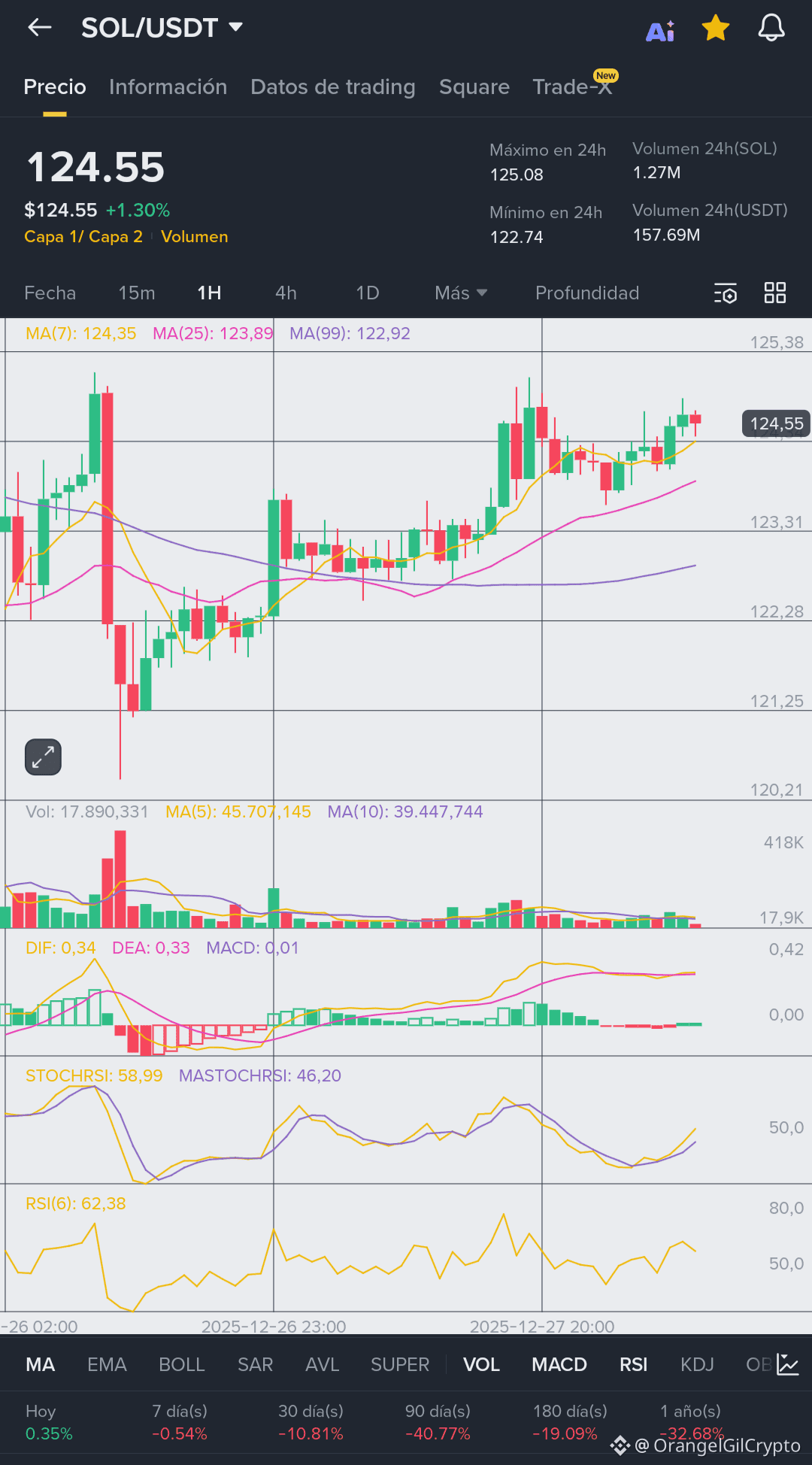
Solana’s latest price movement has captured the attention of traders and macro-driven investors alike. With SOL pushing toward the $125 range amid strengthening intraday liquidity and renewed interest from institutional desks, the market is signaling a structural shift toward networks built for speed, scalability, and capital efficiency.
This trend is not emerging in isolation. It coincides with a broader rotation in digital markets, driven by geopolitical realignments, regulatory tightening, and the search for alternative rails capable of supporting global settlement under stress. Solana is positioning itself as a beneficiary of this transition.
A Technical Rebound That Speaks to Market Confidence
SOL’s upward pressure is supported by a well-defined alignment of short- and mid-range moving averages, with the MA(7), MA(25) and MA(99) converging into a classic liquidity compression pattern. The hourly MACD has crossed into positive territory, signaling the beginning of a potential short-term continuation trend.
The Stochastic RSI hovering near 59 and a rising RSI(6) above 62 indicate moderate strength without entering overheated conditions, a zone typically favored by momentum traders.
According to Noelle Acheson, macro analyst and author of Crypto Is Macro Now, “Solana remains one of the most reactive assets to liquidity pulses. When global risk appetite widens, SOL responds first, and often with stronger amplitude than its peers.”
That dynamic is visible again.
Solana’s Unique Position in a Fragmenting Global Economy
Beyond charts, Solana’s attraction is increasingly geopolitical. As settlement rails come under pressure due to sanctions, currency controls, and rising friction in cross-border payment networks, fast, neutral blockchains are gaining strategic value.
Federal Reserve Governor Christopher Waller recently emphasized the potential of high-throughput blockchain architectures to “support real-time settlement ecosystems with global relevance,” noting that some networks are achieving performance levels that rival traditional infrastructures.
In this environment, Solana’s execution speed and ecosystem growth make it a clear candidate for capital seeking operational resilience under challenging macro conditions.
DeFi, Payments and Real-World Assets: The Expanding Utility Layer
Solana is no longer a single-narrative chain. Its ecosystem is evolving around three core drivers:
DeFi Liquidity Expansion – Protocols such as Jupiter, MarginFi and Orca continue absorbing flows from traders seeking low fees and deep liquidity.
Payments Infrastructure – Networks like Helio and Solana Pay are accelerating adoption for micro-transactions and merchant routes.
Real-World Asset Integration – Tokenized treasuries and synthetic commodities are increasingly being tested on Solana due to its speed-to-finality ratio.
This multi-sector growth supports a more stable long-term valuation model, unlike earlier cycles where Solana’s appeal relied almost entirely on speculation.
CoinShares Head of Research James Butterfill recently noted that institutional inflows into high-performance chains “correlate strongly with macro hedging activity rather than retail-driven narratives,” a trend that Solana is benefiting from directly.
A Critical Question for Traders and Analysts
If Solana continues to absorb liquidity from both macro and technical flows, is the market witnessing the early foundation of a long-term rotational cycle toward high-speed settlement chains?
Disclaimer: This article is for educational purposes only and does not constitute financial advice. Always conduct your own research before making investment decisions.
