I have always been quite concerned about and optimistic about DoubleZero @doublezero project. DoubleZero itself is a high-performance global network built for blockchain and distributed systems. It consists of a dual-ring architecture made up of independently contributed links, addressing several core pain points in current decentralized communication: such as high latency, jitter issues, and the dependence of blockchain nodes on congested public internet. The existing network lacks mechanisms to incentivize quality bandwidth contributions and is prone to duplicate and garbage transactions. The 2Z network optimizes physical infrastructure to provide low-latency direct routing, significantly enhancing validator performance. For example, as of October 3, 2025, 24.85% of the staked assets on the Solana mainnet are already running on the DoubleZero mainnet beta. This adoption rate is quite impressive for a project that has just gone live on the mainnet.
Not long ago, DoubleZero (2Z) allocated 35 million 2Z through Binance's HODLer airdrop, and an additional 5 million will be used for market activities after the spot listing. The retrospective mechanism of Binance's HODLer airdrop is indeed quite enjoyable, as it does not require users to take extra actions, purely distributing rewards based on holding snapshots, continuously creating passive 'sleeping' income for BNB holders.
For BNB holders, this airdrop is more like a low-threshold early layout opportunity. The HODLer airdrop adopts a retrospective mechanism, where the system randomly selects historical snapshots to calculate rewards, and users do not need to operate continuously. For example, for this DoubleZero (2Z) airdrop, as long as you hold BNB and participate in financial management between September 26 and 29, 2025, you automatically qualify. Binance will take multiple snapshots of BNB holdings every hour to ensure fair distribution. Airdrop rewards are sent to spot wallets within 24 hours after the announcement, and the process is smooth. If you haven't participated yet, open the Binance APP's financial management page now to ambush the next airdrop, or visit here directly: https://cf-workers-proxy-exu.pages.dev/zh-CN/bnb
$2Z has a total supply of 1 billion tokens, with a circulating supply of 347.1 million at the time of listing, accounting for 34.71% of the total. This circulation ratio is not low among early projects, which can somewhat alleviate concerns about concentrated selling pressure. The token is issued based on the Solana chain, with the smart contract address being J6pQQ3FAcJQeWPPGppWRb4nM8jU3wLyYbRrLh7feMfvd. From the financing background, the project has completed four rounds of token sales, raising approximately $50 million in total, with the latest round reaching a fully diluted valuation of $750 million. This scale of funding is above average for infrastructure projects, and it is evident that institutional recognition is not low.
The economic model design of the 2Z token is very pragmatic. 2Z serves as a payment medium for network resources and an incentive tool for contributors. Users can use it to purchase connection services, while contributors earn tokens by providing fiber links and edge hardware. In addition, staking and delegation features further enhance the utility of the tokens. Contributors can stake 2Z to enhance network security, and ordinary holders can share profits through delegation. This design deeply binds the token to the use and governance of the network, which is beneficial for value accumulation in the long run.
From the development route, the project advancement pace is tight. In the first quarter of 2025, the test network covered 7 locations globally, expanded to over 25 in the second quarter, and completed internal cluster upgrades with the launch of the mainnet test version with token functionality in the third quarter. The next plan includes launching direct routing coordination, custom FPGA hardware packet filtering, and introducing a permissionless bandwidth contribution mechanism. If these upgrades are realized, it should further consolidate the network's advantages in low-latency areas.
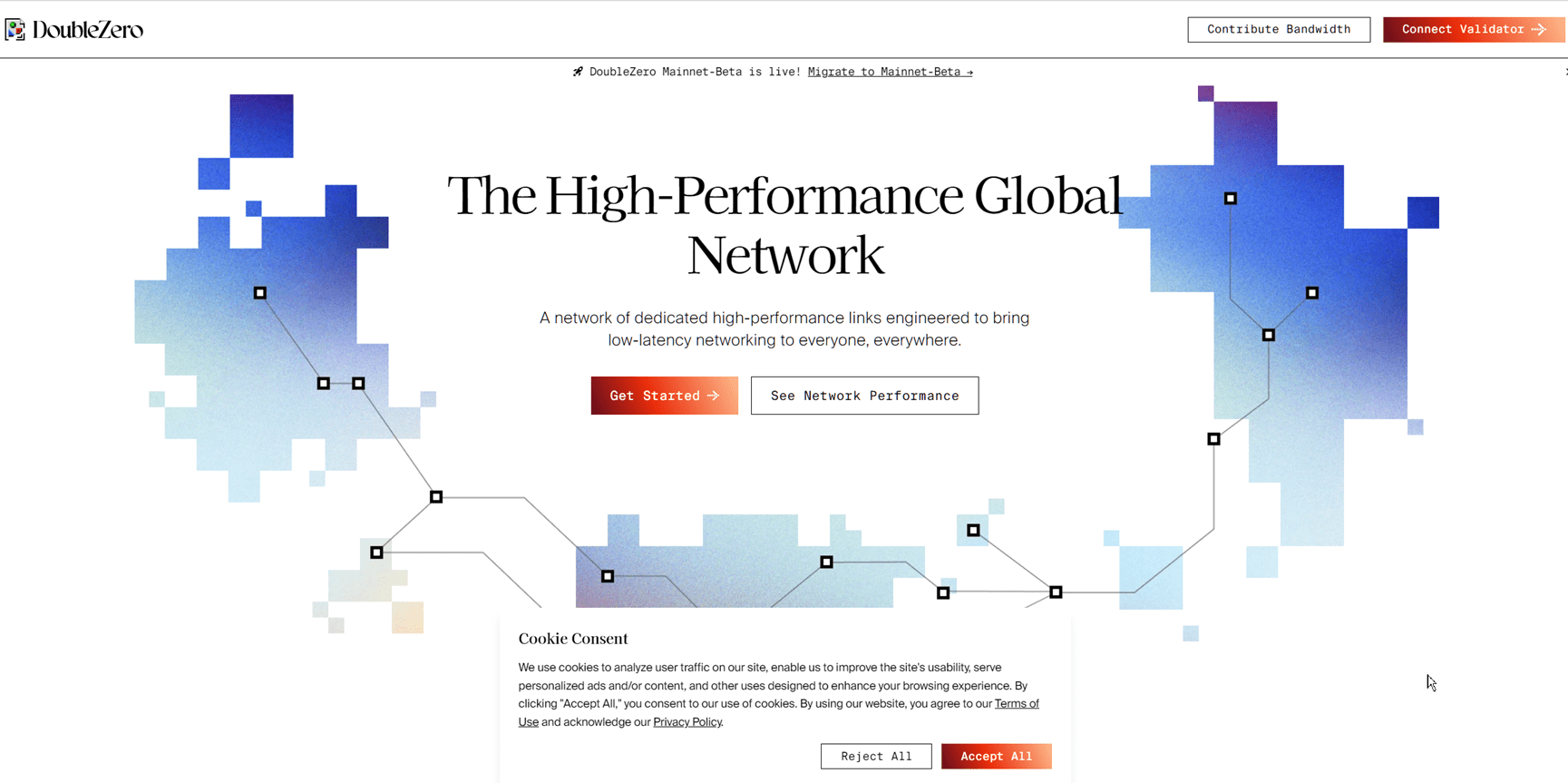
I believe one key value of DoubleZero (2Z) lies in its focus on the hard demands of blockchain scalability. As on-chain transactions, block production, and re-staking applications increase, the demand for dedicated bandwidth and low-latency routing will only grow. The programmable decentralized infrastructure provided by DoubleZero has the potential to become the foundational layer for these applications. The current network can already support high-demand scenarios such as real-time oracles, and the potential for expansion to more blockchains in the future is even greater.
In the initial circulation of the 2Z token, the portion that can be publicly traded is about 7.2% of the total supply, which is relatively healthy and reduces the pressure caused by a large unlock in the early stages. Additionally, the project has real adoption data to support it—nearly a quarter of Solana's staked assets are already using its network—providing fundamental support for the token's value.
Overall, DoubleZero has entered a niche but crucial market in the blockchain infrastructure field. Its technical solution is targeted, its token model has a practical basis, and with the support of airdrops and listings on Binance, it has good highlights in both the short and medium term. For BNB holders, they have once again gained opportunities to participate early in new projects through airdrops, while the ecological development of 2Z itself, if smooth, may bring returns beyond expectations. After all, in the blockchain world, high-quality infrastructure projects are always scarce resources.
Binance has listed 2Z on October 02, 2025, at 21:00 (UTC+8), and opened trading pairs against USDT, USDC, BNB, FDUSD, and TRY. If you are optimistic about this project, register on Binance now to ambush: https://cf-workers-proxy-exu.pages.dev/join?ref=YOU59
#DoubleZero #2Z #BNBHolder #Binance $2Z