
Plasma isn’t chasing the next hype cycle or trying to win attention with flashy demos. It’s focused on something much less exciting, but far more important: making stablecoin settlement behave like real infrastructure. Predictable. Boring. Dependable at scale. And that focus feels right for where the market actually is today.
Look at the data. CoinMarketCap’s stablecoin board alone shows roughly $163.8B in 24-hour volume. That’s not speculative frenzy — that’s dollar plumbing quietly moving value around the crypto economy. Visa’s crypto lead has also highlighted that more than $270B in stablecoins are now circulating, with Tether’s USDT around $187B by itself. Yet only a small fraction of that supply is being used for true, everyday payments. Most of it still lives in transfers, trading, and parking value.
Bridging that gap isn’t about better marketing. It’s about reliability engineering. Deterministic finality so merchants know when a payment is truly done. Stablecoin-first fee models so costs don’t spike at the worst possible moment. And failure modes designed around checkout reality — where a single failed transaction can permanently lose a user — not idealized demo conditions.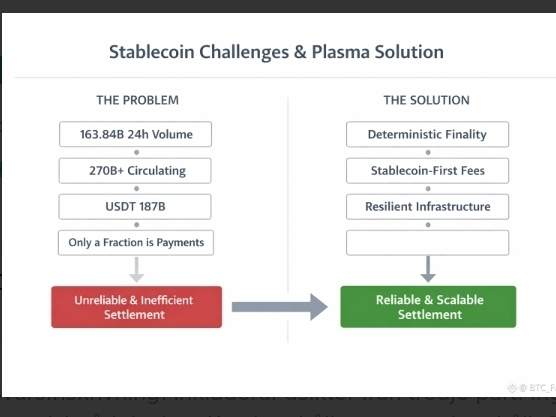
If Plasma gets those fundamentals right, “global scale” stops being a slogan you see in pitch decks and starts looking like something payments teams can actually trust.

