
Once, Azu helped a friend review a "On-chain Compliance Report" for their company, and the scene was a bit magical. In the conference room, four large screens displayed K-line, TVL, address distribution, and risk scores flashing, and everyone looked very professional. The risk control supervisor suddenly asked a particularly simple question:
"Which batch of wallets last week transferred over 1 million dollars to L2? What was the reason for that?"
The entire room was silent for three seconds.
Next came a set of traditional skills you are definitely familiar with: the data colleague opened SQL and BI to start checking tables; the product colleague sifted through historical Slack and documents, recalling what operational activities were carried out at that time; the compliance colleague opened a stack of regulatory PDFs from different countries, searching for keywords page by page with CTRL+F.
Half an hour passed, and everyone barely pieced together a list of 'these addresses are probably it', but no one dared to sign the report. It wasn't that it couldn't be calculated, but no one could guarantee: have we missed any addresses? Have we accidentally tripped over any regulations regarding anti-money laundering or reporting obligations in any jurisdiction?
At that moment, I suddenly realized something.
Today, the vast majority of public chains actually only do two things: account for transactions and execute actions. They can calculate quickly and remember accurately, but they cannot think and cannot provide a 'why'.
You can check every transaction on the chain, and see all historical actions of a certain address, but when the question escalates from 'what happened' to 'what patterns are behind these actions, what rules were triggered, and should it be reported', most chains fall silent.
If what you truly care about is the money from RWA, PayFi, and compliance institutions, a chain that can only account and cannot think is essentially just a high-level ledger, far from being an 'infrastructure-level intelligent system'.

It is precisely because of this that I have recently been looking at the component called Kayon in Vanar Chain, and I find myself a bit captivated. What it is trying to do, in one sentence, is to attempt to squeeze a 'brain that can reason, explain, and audit its own decisions' into the entire blockchain stack.
Vanar's official label is quite arrogant, calling itself 'The Chain That Thinks'. If you look at the architecture, it is a five-layer stack. At the bottom is Vanar L1, responsible for consensus and settlement; above that is Neutron, handling semantic memory; then comes today's protagonist Kayon, defined as Layer 3: Contextual AI Reasoning; further up are Axon for automation and execution, and an application layer called Flows.
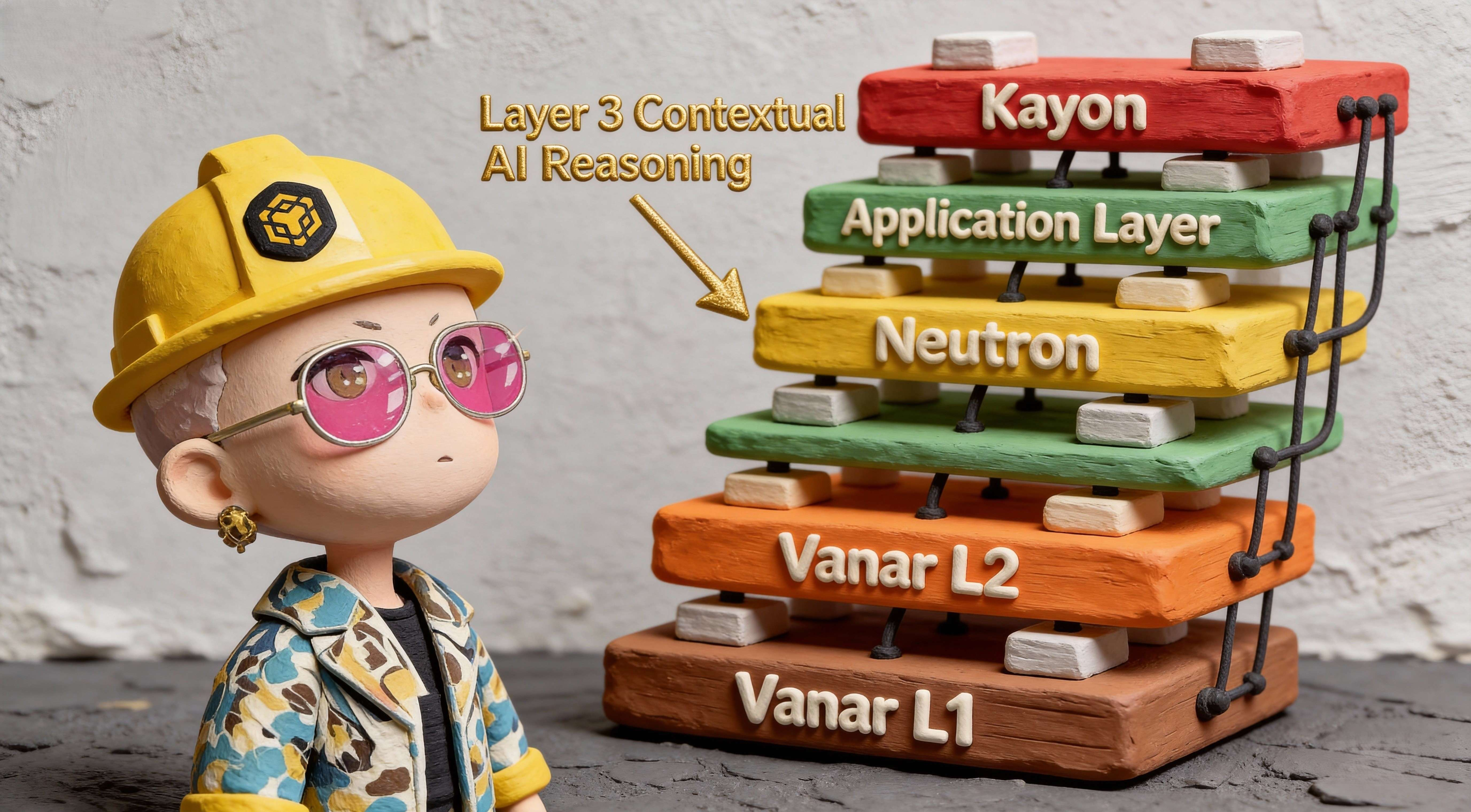
A rough translation. Vanar Chain is the foundation, responsible for honestly recording transactions and states; Neutron is responsible for compressing chaotic information such as documents, conversations, and business flows into semantic Seeds that AI can understand and are suitable for cross-system transfer, which is equivalent to the long-term memory of this chain; Kayon stands above these Seeds and the data on the original chain, specifically responsible for listening to questions, making inferences, and providing explanations, serving as the 'brain' of the entire system.
Today we only discuss this brain.
First, let's clarify a misconception: just because a large model gives you an output that looks intelligent, it doesn’t mean it’s suitable for on-chain use, nor does it mean you can use its conclusions for compliance decisions.
Of course, you can have AI summarize a fifty-page contract, or even help you generate a set of risk control rules; but as long as its reasoning process is a black box, regulatory and auditing departments will instinctively take a step back. When disputes arise, who will be responsible? Is it 'the model speaks for itself'? This statement holds no ground in any regulated industry.
Kayon's approach is exactly the opposite; it does not 'move the large model onto the chain' but rather performs 'auditable reasoning' on the chain.
You can directly ask it very complex questions in natural language. The question from that conference room, in Kayon’s words, is: 'Which wallets bridged >$1M last week?' Behind it, it isn’t just running a query randomly; it is simultaneously scanning the compressed Seeds from Neutron, real-time on-chain transaction data, and even data from external business systems, mixing this information into a contextual answer.
Moreover, it is not the kind of one-time Q&A that disperses after a temporary check. You can turn this question into a long-term view or a continuously running alert. After asking today, you can recalculate it every day or every hour; if there are changes, it pushes them, and if there are anomalies, it triggers the risk control process. This is more like a 'thinking, on-duty' on-chain analyst.
More critically, every conclusion is not a sentence that appears out of thin air, but a reasoning path that can be replayed and verified. You can ask it to compress 'why this judgment' into a verifiable proof, equivalent to an on-chain attestation of the reasoning result, allowing others to take this proof and verify it on-chain themselves.
This is completely different from the one-question-one-answer interaction we are used to with ChatGPT. The latter is like a polished-talking consultant, while the former is more akin to embedding the entire risk control and analysis department's SOP into the chain for the protocol to execute.
For this to work, reasoning alone is not enough; memory must keep up.
What Neutron does can be understood as transforming all useful information into AI-friendly 'Seeds'. Documents, emails, contract clauses, DAO proposals, transaction flows, regulatory documents—these items originally scattered across different systems are unified into small Seeds. They are lightweight enough to be transported across systems, yet structurally retain sufficient semantic information for the subsequent reasoning engine to call directly.
Kayon just happens to stand at this intersection, holding onto these Seeds in one hand and the original chain data in the other.
It first transforms 'queries' back into a form familiar to humans, no longer forcing you to write SQL or directly sift through event logs, but rather allowing you to pose questions as if you were speaking to an analyst. You can ask about money, behavior patterns, or even questions with value judgments, such as 'Which wallets frequently hedged on a certain chain in the past three months while also participating in governance votes against their counterparties?'
It then processes these questions within context, not just looking at a single source, but bringing in Seeds, current market conditions, governance records, and even internal ERP and CRM data to participate in the reasoning together. The final output is not a cold result, but an explanation with 'background and context'.
Finally, it can turn these reasoning conclusions into rules or even executable actions. You can have Kayon do more than just 'answer'; it can also trigger a process, such as generating risk control alerts, locking a certain amount, opening a compliance work order, or even automating the entire operational process through higher-level Axon and Flows. At this stage, the intelligence on the chain has evolved from 'capable of querying' to 'capable of understanding and executing tasks'.
For me, the most interesting part is actually that phrase 'compliance by design' in Kayon.
Many projects, when it comes to compliance, start adding a line to their roadmap: 'We will do KYC in the future' or 'We will apply for certain licenses in the future', which seems more like a tactic to appease investors.
Kayon's roadmap is much more straightforward. It writes the goals directly into the product design: monitor rule changes in over forty judicial jurisdictions, automatically generate corresponding reports, and transform compliance execution itself into an on-chain verifiable and repeatable process.

Imagine a more concrete scenario.
A European bank is doing RWA on Vanar and wants to tokenize a batch of bonds. It first transforms its structured information on client KYC, risk scores, regional restrictions, and investor categories into Seeds through Neutron. Then, Kayon regularly runs rules based on different national and regional regulatory requirements.
It can check daily which addresses are on the latest sanctions list, which transaction amounts exceed a certain jurisdiction's mandatory reporting threshold, which assets cannot be sold to a certain category of investors, and which holding periods trigger new disclosure obligations.
In a traditional framework, these tasks would rely on compliance teams monitoring a pile of Excel sheets and system interfaces, manually cross-checking to complete. Now, Kayon can directly provide a conclusion: 'These 27 transactions triggered the anti-money laundering reporting requirements for a certain region; a draft report has been generated. Would you like to review and submit it?'
More importantly, the entire process does not occur on some invisible internal server; rather, it is built on Neutron Seeds and on-chain data, creating a reasoning link that can be replayed and regulated. If something goes wrong, regulators can require you to provide the state of the Seeds and the reasoning proof at that time, walking through that path from the beginning, rather than just hearing you say 'the model said this at that time.'
For institutions truly engaging in RWA, this kind of 'interpretation power' and 'audit power' is often more critical than TPS or gas fees.
From a broader perspective, Kayon plays a very rare role in the AI × blockchain landscape.
If we consider Neutron as the memory layer, Kayon is the reasoning layer. Its task is not to make itself appear intelligent, but to ensure that the concept of 'intelligence' itself can be verified, reused, and accepted by regulatory authorities.
Currently, many so-called 'AI chains' are essentially doing two things: adding a few prompt concepts to the white paper and placing a few Bot dApps in the ecosystem, treating them as AI applications. This storytelling works well in the short term, but in the long run, such things are hard to enter scenarios where legal liability is truly at stake.
The ambition of the Vanar stack is much more realistic. Neutron addresses the issue of AI's significant forgetfulness, helping it transform context into a transferable, persistent 'memory module'; Kayon tackles the problem of 'outputting without accountability', making the reasoning process itself an auditable, compliant intermediate layer; and the subsequent Axon and Flows turn these judgments into automated workflows running in real business scenarios.
You might not like this kind of 'slow-burning' narrative; it indeed doesn't fit the dream of getting rich overnight. But if you seriously lay RWA, PayFi, and enterprise-level workflows on the table, you'll find that what is truly lacking is a middleware that can think, take responsibility, and be audited.
From an investor's perspective, Kayon is somewhat like that least sexy but most critical screw.
In the short term, it won't give you that social media-style thrill. It’s not the type of project that churns out twenty memes a day or constantly hosts Spaces; it's friendly to real AI users and institutions but extremely unfriendly to those looking to make a quick buck.
However, if you agree with one premise: that by 2026, on-chain intelligent agents need not only to provide answers but also to be able to clearly explain 'why they are doing this' and withstand scrutiny in dozens of judicial jurisdictions, you will eventually find your way to Kayon. You might come from Neutron's semantic memory or start from a compliance definition of an RWA product, but in the end, you will loop back to this reasoning hub.
My own judgment is quite simple.
In this round of chaotic battles between AI and blockchain, there will be many chatty projects, but not many that can take long-term responsibility. Those selling computing power, storage, and bandwidth will likely have to compete in a homogenous market in the future. The projects that take real business data, compliance needs, and long-cycle workflows to gradually write 'memory, reasoning, execution' into the protocol stack are the ones that will likely leave a real moat in the next round.
Neutron has nailed memory to the chain, while Kayon attempts to nail down 'why' into the block.
If one day, you can not only see 'this transaction succeeded' on the block explorer but also expand with one click to view the underlying reasoning path, compliance checks, and risk assessments, that would likely mean something like Kayon has quietly completed the work.
By that time, you probably won't be as concerned with how many transactions a chain can process in a second, but rather want to ask: how much can this chain truly understand?
And this is the answer Vanar hopes to provide with Kayon.
@Vanarchain $VANRY #Vanar
