
ZEC, a well-established privacy coin in the cryptocurrency space, has seen a decline that has left us holders feeling overwhelmed! Since reaching a high of $449 in mid-January, the price has continuously dropped, now hovering around $360, just a step away from the crucial support at $326. Institutions have stated that if this support level is broken, ZEC will enter a new phase of sharp decline, potentially dropping by 35%, with a target price of $266!
However, the market is showing extremely fragmented signals: on one side, many of us are cutting losses and hesitating to act during rebounds, while on the other side, large on-chain holders are quietly accumulating, with their positions continuing to increase. More importantly, to reverse this downward trend, ZEC must reclaim the resistance levels of $402 and $449, but does the current market really have the confidence to do so?
Today, I will analyze ZEC's current situation from four dimensions: the root of the decline, the battle between bulls and bears, key price levels, and operational strategies. I won't discuss the abstract; all will be practical insights and my own judgments. Let's not be swayed by market emotions and step into the wrong pits!
One, ZEC's continuous decline is not the market's fault but rather its own 'rotten roots'.
Many people attribute ZEC's decline to the overall adjustment in the crypto market, which is fundamentally incorrect. The core of this decline is that ZEC itself has significant problems with its fundamentals, compounded by fund diversion within the space and the fermentation of bearish sentiment. Under threefold pressure, the price is difficult to avoid a drop.
Firstly, the governance crisis of the core development team is the first straw that broke the camel's back for ZEC. In early January, the core development team ECC of ZEC collectively resigned due to differences in ideology with the board, which directly severed ZEC's technical lifeline. The value of cryptocurrencies ultimately depends on technology and implementation; if the development team disbands, even if the original team claims to establish a new company to continue development, our trust in the market has already collapsed – who knows when the new team will be able to deliver results? Will technical upgrades stagnate? This uncertainty has caused long-term funds to flee, which is more detrimental than any technical breakdown.
Secondly, funds have been diverted within the privacy coin space, and ZEC has been abandoned. While ZEC has been declining, its counterparts in the same space, DASH, surged over 100% in a week, XMR also steadily rose, and even the small-cap DUSK quadrupled in a month. Why? Because these coins either resolved compliance issues or implemented real payment scenarios, while ZEC remains trapped in a governance crisis, causing funds to vote with their feet. The incremental funds that originally belonged to privacy coins have all gone to better-performing assets, leaving ZEC as a 'discarded child' in the space. Without funding support, the price can only decline continuously.
Finally, the bearish sentiment in the derivatives market has reached a peak, forming negative feedback for the decline. On-chain data shows that ZEC's funding rate has maintained negative values for a week, indicating that bears are willing to spend money to hold short positions, highlighting the intensity of bearish sentiment. What’s more critical is that once the price dips to around 352 dollars, there are 4.7 million dollars in long positions facing liquidation. Once triggered, it will inevitably lead to a chain reaction of selling, further driving down the price. Additionally, the ZEC balance on exchanges continues to increase, indicating that selling pressure is persistently being released, and the bulls have no power to fight back.
In simple terms, ZEC's recent decline is the result of 'internal and external troubles': problems with internal governance, external funds being diverted, and the assistance of short positions in the derivatives market. Once a downward trend forms, it is very difficult to reverse it easily.
Two, the extreme division between bulls and bears: large holders' accumulation is not about catching the bottom but rather 'shearing our wool' through arbitrage.
The most confusing point in the market right now is the extreme contradiction between large holders' accumulation and our caution: on-chain data shows that in the past week, large holders with balances over 1000 ZEC have increased their holdings by about 5%, while small addresses (less than 10 ZEC) held by ordinary holders have decreased by 8%. Why is this happening? Did large holders see opportunities that we did not?
My answer is very straightforward: large holders are currently accumulating, but they are not bullish on ZEC's long-term value; rather, they are engaging in short-term arbitrage through oversold rebounds, in plain terms, they are just shearing our wool.
First, let's look at the logic of large holders' operations: ZEC has dropped from over 500 dollars in early January to over 360 dollars now, a drop of nearly 30%, which is a typical overselling that requires technical restoration. The 326 dollar position is the rebound low point from last December and also a dense area of chips for many of us, offering natural support strength. Large holders can buy low at this position; as long as they slightly push the price up and sell near the resistance levels of 380-402 dollars, they can make significant profits. Moreover, large holders have substantial capital and can withstand volatility; even if it falls below 326 dollars, they can still average down, while we simply lack the courage.
Looking at our caution, it is actually a form of 'self-protection' born from the fear of being cut off. In this decline, ZEC has repeatedly shown a pattern of 'small rebounds followed by continued declines', and we have been stuck once for every time we chased the high. We have now formed a conditioned reflex: any rebound is an opportunity to escape, not a signal to enter. Our 'opportunism' is actually the most rational choice in a downward trend – avoiding any rebounds during the decline until the trend becomes clear, preventing ourselves from becoming the exit buyers for large holders.
There is another key detail: the buying volume of large holders is not actually high, it's just a 'relative increase' rather than a 'major accumulation'. If they really believe in the long-term potential of ZEC, they would continue to increase their positions, rather than making small purchases now. In simple terms, large holders are just betting on a short-term technical rebound, taking profits and leaving, and they won't stick around to endure the hardship of ZEC's governance crisis.
Three, key price level breakdown: 326 is the life and death line, 402 is the rebound ceiling, don’t hold any illusions.
To understand ZEC's future trend, there is no need to look at too many complex indicators. Just understand these four price levels: 326, 266, 402, and 449. These four levels embody the struggle between chips, funds, and market sentiment; each one determines ZEC's next step and relates to the safety of our holdings.
326 dollars: the last support level, dropping below it means heading towards 266.
This price level is ZEC's 'life and death line', with no way out. On one hand, this is the rebound low point from December of last year and also a recent area of dense transactions; the cost price for many ordinary holders is concentrated at this position. Once it falls below, it means this part of the chips is completely trapped, inevitably triggering a new round of panic selling, forming a negative feedback loop of 'selling when it drops, dropping more when sold'. On the other hand, below 326 dollars, ZEC has no strong support levels, and the technical picture is completely bearish. The target price of 266 dollars set by institutions is based on this logic – a decline without support will only lead to continuous downward pressure.
266 dollars: the bearish target set by institutions, it is just a 'psychological bottom' rather than an 'actual bottom'.
Many people think that 266 dollars is the bottom for ZEC, but this is not the case. This price is merely an estimate by institutions based on a 35% drop, essentially a 'psychological bottom', rather than a 'real bottom' supported by chips and funds. If ZEC's governance crisis is not resolved, even if it drops to 266 dollars, it may continue to drop further, even testing the lower point of 256 dollars in 2024. Simply put, without improvement in the fundamentals, any price cannot be considered a bottom; we must not blindly try to catch the bottom.
402 dollars: the ceiling for short-term rebounds, also the watershed for trends.
To reverse the downward trend, ZEC must first reclaim 402 dollars, but this is almost an 'impossible task' at this stage. This price level is the previous rebound high and has a dense trapped position; to break through requires a large influx of funds. However, the current ZEC has neither positive news to stimulate it nor incremental funds entering; large holders are merely engaging in low-buy arbitrage and will not spend money to free trapped positions. More critically, 402 dollars is also the watershed for ZEC's medium-term trend; if it cannot surpass this level, any rebound will only be a 'continuation of the decline' and cannot reverse the trend.
449 dollars: the previous high point, don't even think about it in the short term.
449 dollars is the high point from mid-January and also the starting point of this decline for ZEC. The trapped positions at this level are denser than at 402 dollars. To break through, it not only requires funds but also a complete reversal of market sentiment and favorable fundamentals. Given ZEC's current state, let alone 449 dollars, even 402 dollars cannot be touched; we can ignore this price level in the short term.
Four, my core judgment: short-term rebounds are traps, long-term recovery depends entirely on these two points.
Combining fundamentals, liquidity, and technical analysis, I have three clear judgments about ZEC's trend, with no ambiguity, all are my genuine views. Let's keep our eyes wide open: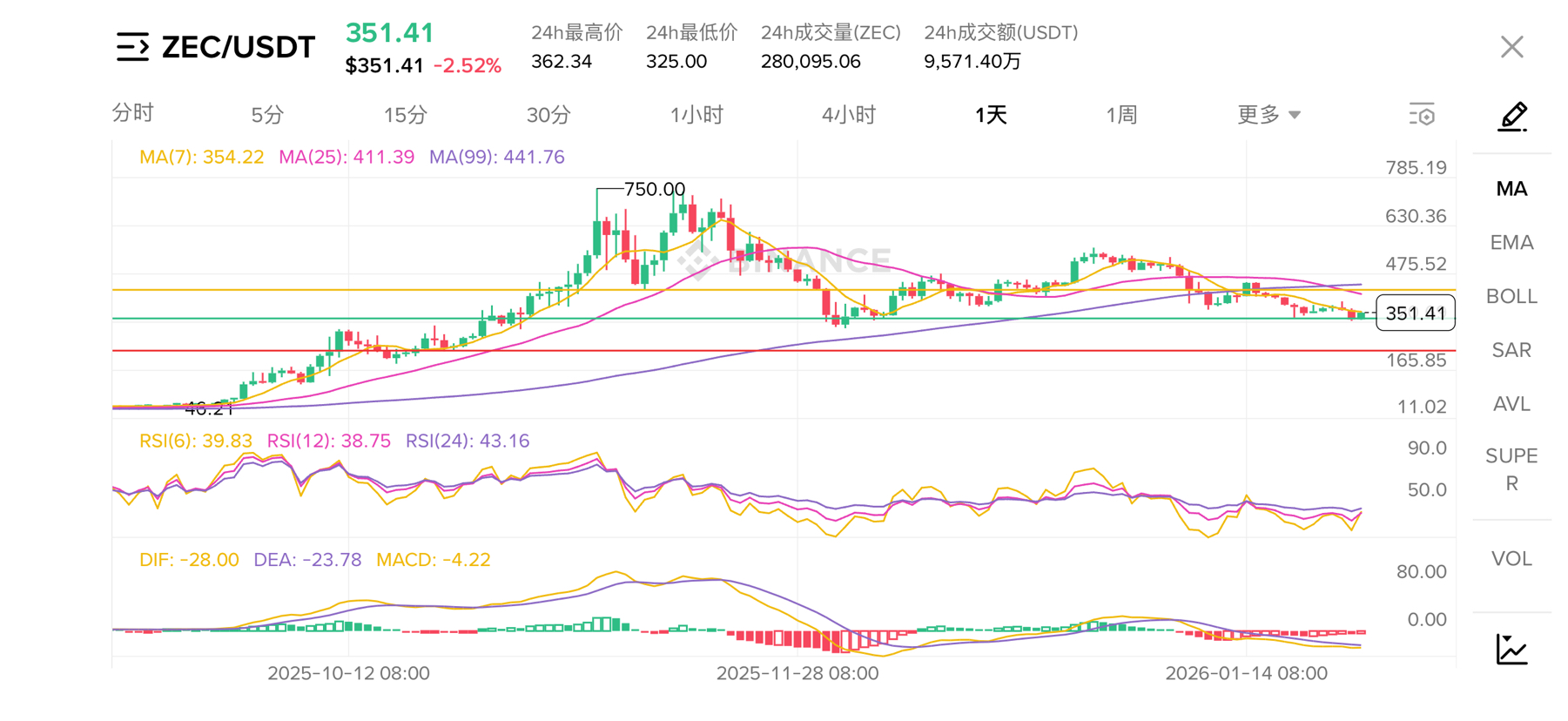
Short term: there is a rebound, but it is just a continuation of the decline; don’t chase highs.
ZEC will likely trigger a small rebound around 326 dollars, with the rebound height likely between 380-402 dollars. The reason is simple: large holders need to push the price up for selling, and after being oversold, the technical situation also needs to be repaired. However, this rebound is definitely a 'trap', without the support of volume and positive news. Once it reaches the resistance level of 402 dollars, it will inevitably continue to decline. We must not mistakenly think this is a reversal; chasing highs will only leave us trapped halfway up the hill.
Medium term: breaking below 326 is highly probable, expect to see 266 dollars.
From the current market situation, it is very likely that ZEC will fall below 326 dollars. On one hand, selling pressure continues to be released, and the bulls have no power to fight back; on the other hand, there are no signs of improvement in the governance crisis, and long-term funds will not enter. Once it falls below 326, ZEC will head straight for 266 dollars, and this process may be quick, leaving us with little opportunity to escape.
Long term: to turn things around, focus on these two key signals.
ZEC's long-term trend is unrelated to price; it is only related to fundamentals. To truly emerge from a downward trend, two conditions must be met: first, the governance crisis must be resolved, and the new development team must present a real technical upgrade plan to restore our trust in the market; second, ZEC must find its positioning within the privacy coin space, either by resolving compliance issues or by implementing practical application scenarios to attract funds back. If these two conditions are not met, even if it falls to 266 dollars, ZEC will just be a 'soul-less air coin', with little chance of recovery.
One more thing to remind everyone: the future of privacy coins will inevitably be dominated by 'compliance and privacy'. Coins that rely solely on anonymity will eventually be eliminated by regulation. If ZEC cannot find a balance between compliance and privacy, even if the governance crisis is resolved, it will be difficult to establish itself in the market.
Five, how should we operate? Don’t be an exit buyer, this approach is the safest.
Finally, I offer the most straightforward operational advice: don’t engage in the virtual, follow this and you won’t step on a major landmine:
For those of us holding ZEC: set stop-losses, don’t hold positions.
If our cost is above 326 dollars, set 326 dollars as the stop-loss level. Once it falls below, directly cut losses and leave, without any fantasies – holding positions in a downward trend will only deepen the losses. If our cost is below 326 dollars, and it rebounds to between 380-402 dollars, decisively reduce holdings at high prices to lock in some profits, and also set stop-losses for the remaining positions to avoid profit erosion.
For those of us wanting to catch the bottom: don’t reach out, wait for two signals.
Now is absolutely not the time to catch the bottom; even if the price drops to 326 dollars, do not reach out easily. If you truly want to catch the bottom, wait for two signals: first, a clear solution to ZEC's governance crisis, with the new team presenting a technical upgrade plan; second, the price must stabilize above 402 dollars, and the volume must continue to increase to confirm a trend reversal. Both signals are essential; otherwise, catching the bottom is just taking the bait.
For those of us who are observing: stay away, don’t be tempted by the rebound.
For those of us who haven't entered the market, my advice is to stay away from ZEC. The current ZEC has a poor fundamental outlook, weak liquidity, and is technically bearish. Even if there is a rebound, it is just a trap for large holders to arbitrage, and we simply cannot compete. Instead of wasting time on ZEC, it is better to focus on better-performing assets in the privacy coin space or return to mainstream coins, where at least the risks are more controllable.
In conclusion: the value of cryptocurrencies is never based on the short-term speculation of large holders.
This recent decline of ZEC actually serves as a wake-up call for all of us crypto investors: the value of cryptocurrencies is never based on the short-term buying and speculation of large holders, but rather on the underlying technology, implementation, and fundamentals. A cryptocurrency without fundamental support, no matter how much large holders buy, will only experience a fleeting rebound and ultimately cannot escape the fate of decline.
In the market, we are most easily swayed by market emotions and the operations of large holders. Seeing large holders accumulate can make one think it's an opportunity, and seeing a rebound can lead to the belief that it's a reversal, resulting in repeated losses. In fact, the simplest principle for surviving in the crypto space is: do not catch falling knives in a downward trend, do not touch coins with rotten fundamentals, and do not participate in markets we do not understand.
The future of ZEC depends entirely on whether it can solve its own problems. What we can do is to remain rational, not be swayed by emotions, because in the crypto space, surviving is more important than anything else.
