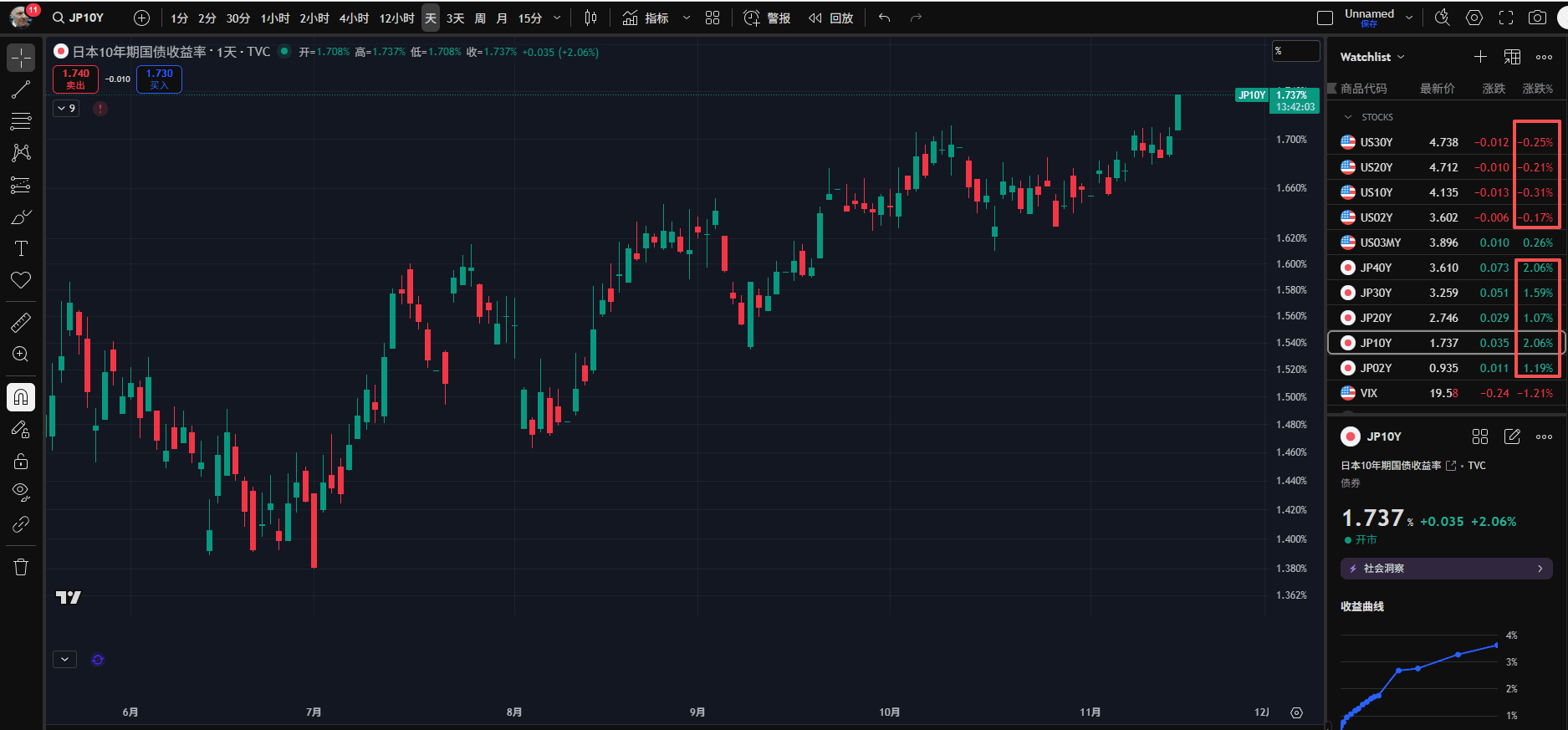
When scanning news and the market, I found that the 10y Japanese government bond yield has reached another ATH, and I haven't seen a single report about it. This is also a key factor in tightening liquidity.
The repatriation of yen funds + changes in the demand structure for dollar financial products + the disintegration of arbitrage trading is a very scary thing. When U.S. treasury yields decline and Japanese interest rates rise, it will reverse the cross-border arbitrage structure, which has a significant impact on global liquidity.
Currently, all eyes are focused on whether the U.S. will cut interest rates. If the U.S. opens the faucet wider and Japan tightens it, there will be no change in liquidity. Global liquidity is transitioning from 'extremely abundant' to 'marginal contraction', and the first to be hit will be various risk assets, especially those with high leverage.
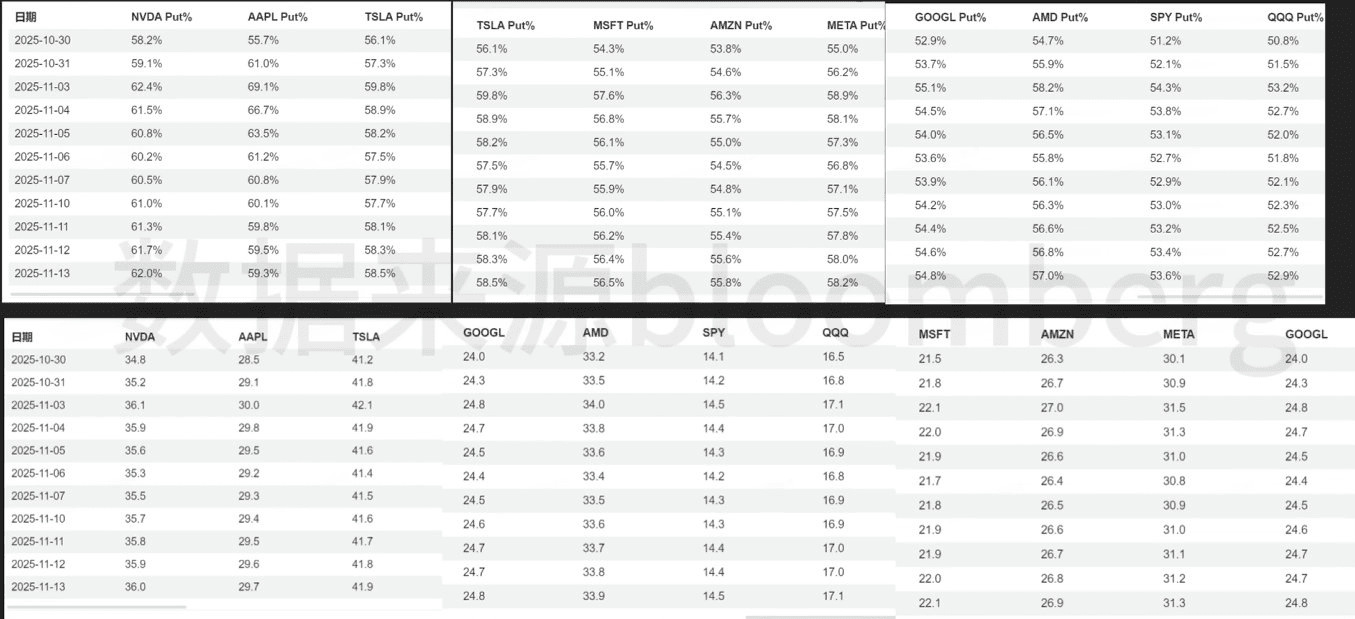
With the recent surge in technology-weighted stock puts, it seems that there is unknown information spreading at the top level. Based on past experience, the long whip effect of information typically takes about 3 weeks to 3 months to reach ordinary investors. Perhaps some clues can be captured in December.
Historically, there have been many instances where smart money exits first. They do not directly sell stocks but instead buy put options for hedging, which includes:
On the eve of the 2000 internet bubble burst, major tech giants like Cisco, Microsoft, and Intel had a put ratio generally exceeding 65%. At this moment, the Nasdaq index was still around the average, and the party was not stopping. No one realized that danger was about to arrive. In the next 3 weeks, the internet bubble burst, and the index dropped by 78%.
Before the subprime mortgage crisis in October 2007, the put ratio of financial stocks surged dramatically. Lehman Brothers and Bear Stearns had a put ratio of 70%. At this time, the VIX was below 20, and the entire market seemed oblivious. Six weeks later, the bubble burst, and the entire S&P 500 index dropped by 58%.
Before the Chinese stock market crash in August 2015, Chinese concept stocks in the U.S. undertook extensive hedging operations, with Alibaba, Baidu, and others experiencing a surge in put ratios. Two weeks later, on Black Monday, the Dow Jones plummeted by 1000 points.
During the COVID-19 pandemic in 2020, China was the first to experience an outbreak, and the put ratios of cruise stocks and hotel stocks also surged. However, the U.S. stock market was still reaching new highs until a rare stock market crash occurred in March. Buffett stated that he witnessed history four times, with multiple circuit breakers.
Now everyone can observe some leading indicators. At the moment real disaster strikes, only the insightful can avoid harm. We are all ordinary investors without first-hand information sources, and can only observe what smart money is doing.