

The year is 2026, and the digital landscape is undergoing a silent but profound revolution. While much of the blockchain world has focused on scaling transaction speeds and optimizing smart contract execution, a fundamental shift is occurring beneath the surface: the rise of programmable storage. This isn't just about storing data on a blockchain; it's about making that data active, intelligent, and capable of executing logic directly at the storage layer. At the forefront of this revolution stands the Walrus Protocol, poised to redefine how we interact with and utilize digital information.
For years, decentralized storage solutions have grappled with a core limitation: they were largely passive. Data was stored, replicated, and made redundant, but it lacked intrinsic functionality. Imagine a vast, secure library where the books are meticulously cataloged but can't be read or cross-referenced without being physically retrieved and processed by an external system. This is the paradigm programmable storage seeks to dismantle.
What is Programmable Storage?
Programmable storage imbues data with computational capabilities. Instead of merely being a static repository, data becomes an active participant in decentralized applications. This means:
On-chain Logic at the Storage Layer: Smart contracts can directly interact with and modify data stored within the protocol, triggering actions or computations based on data states.
Data-Driven Automation: Imagine a supply chain where each product's journey is recorded on-chain, and when a certain condition is met (e.g., arrival at a new port), the data itself triggers a payment or updates inventory.
Enhanced Data Privacy and Sovereignty: Users can define granular access controls and even enforce computational policies directly on their stored data, ensuring only authorized operations are performed.
Reduced Gas Costs and Network Congestion: By moving certain computations to the storage layer, the need for expensive and resource-intensive on-chain transactions can be significantly reduced.
Enter the Walrus Protocol: The Catalyst for Change
The Walrus Protocol is a groundbreaking layer-1 solution specifically designed to facilitate programmable storage. It achieves this through several innovative mechanisms:
State-Aware Storage Units (SASUs): Unlike traditional data blocks, Walrus introduces SASUs that can embed small, efficient smart contracts directly alongside the data they contain. These micro-contracts can perform basic operations, validation, and even trigger events based on data interactions.
Decentralized Data Oracles with Built-in Computation: Walrus integrates a robust oracle network that not only fetches external data but can also perform pre-defined computations on that data before it's even stored or presented to a dApp. This greatly enhances data utility and reduces latency.
Adaptive Consensus Mechanism for Storage Transactions: The protocol utilizes a novel consensus mechanism optimized for storage-centric operations, allowing for rapid and secure updates to programmable data without compromising decentralization.
Developer-Friendly SDK and Tooling: Walrus is launching with a comprehensive Software Development Kit (SDK) that simplifies the creation of dApps leveraging programmable storage, complete with easy-to-use APIs and robust documentation.
Why 2026? The Perfect Storm
Several factors converge in 2026 to make it the tipping point for programmable storage and the Walrus Protocol:
Maturation of Blockchain Infrastructure: Core blockchain technologies are reaching a level of stability and scalability that can finally support the demands of sophisticated programmable storage.
Explosion of Data-Intensive dApps: The next wave of decentralized applications—from advanced AI models to complex metaverse environments—will require more than just static data storage. They will demand intelligent, active data.
Growing Demand for Data Sovereignty: As concerns around data privacy and corporate control escalate, programmable storage offers a powerful solution for users to truly own and control their digital assets.
Walrus Protocol's Mainnet Launch and Ecosystem Growth: With its mainnet scheduled for early 2026, Walrus Protocol is poised to attract a significant developer community and foster a vibrant ecosystem of dApps built on programmable storage.
The Future is Programmable
The implications of programmable storage are vast. Imagine a world where:
Your health records securely stored on-chain can automatically alert your doctor to critical changes based on pre-defined parameters.
NFTs evolve beyond static images, becoming dynamic assets that change and interact based on external data feeds or user input.
Decentralized autonomous organizations (DAOs) can manage and execute complex financial operations directly on their stored assets without manual intervention.
The Walrus Protocol is not just building a new storage solution; it's laying the foundation for a new era of decentralized applications where data is not merely stored but truly lives, breathes, and interacts with the digital world. 2026 will be remembered as the year we collectively realized the true potential of programmable storage, and the Walrus Protocol will be leading the charge.
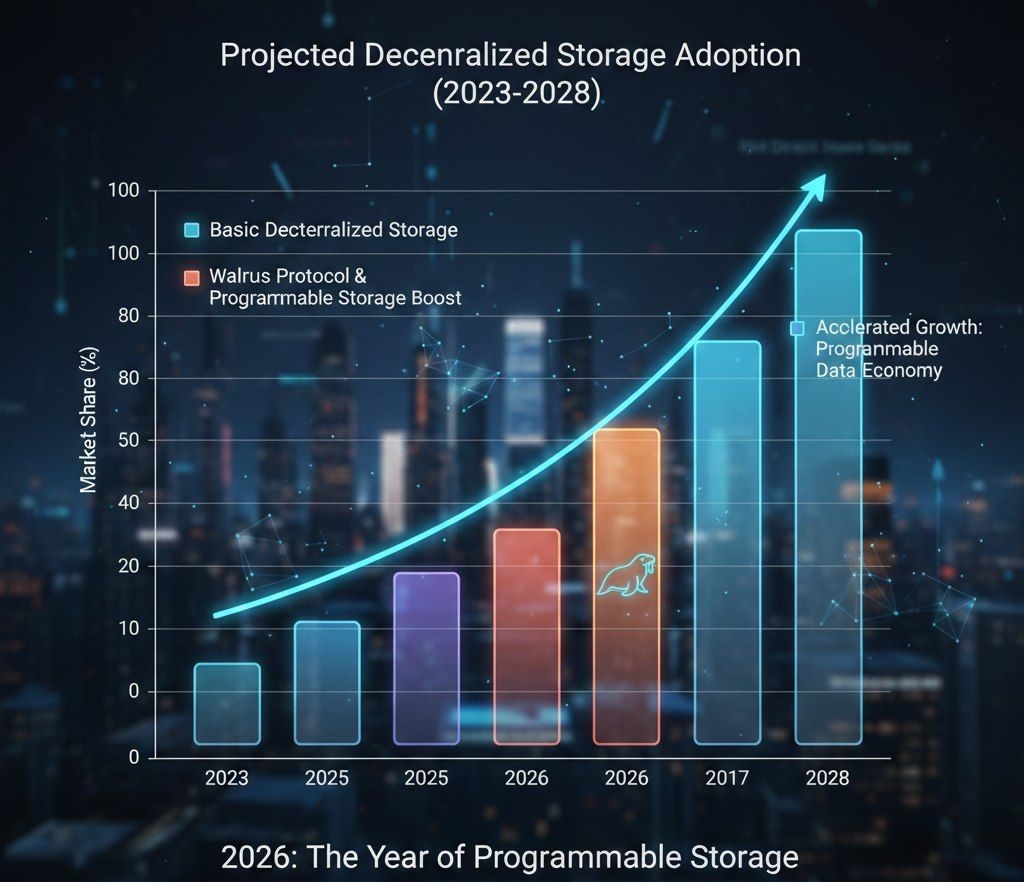
Here's a visual representation of the projected growth in decentralized storage adoption, highlighting the impact of programmable storage solutions like Walrus Protocol.


