
The image represents Walrus Protocol, a decentralized data infrastructure designed to power the next generation of Web3 applications. At the center of the visual is a walrus, symbolizing strength, stability, and reliability—key qualities needed for large-scale decentralized storage.
Decentralized Data Infrastructure
Walrus Protocol focuses on decentralized data availability, allowing applications to store and access large files securely without relying on centralized servers. The glowing data cube in the image represents on-chain and off-chain data storage, where information is distributed across a network of nodes to ensure security, transparency, and uptime.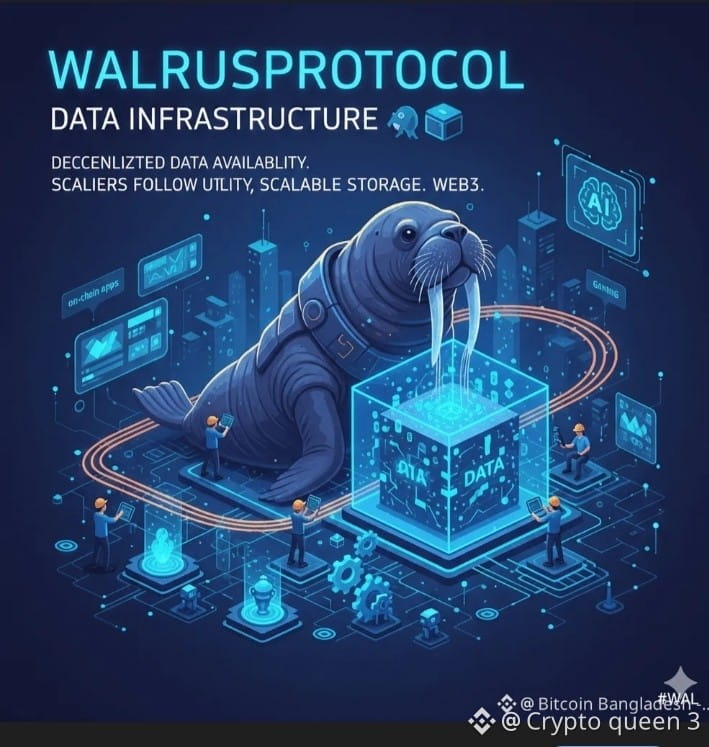
Role of the $WAL Token
The WAL token is the engine that keeps the Walrus ecosystem running:
Used to pay for storage and network services
Incentivizes node operators to maintain and secure data
Supports governance, allowing the community to guide future upgrades
This makes WALmore than just a tradable token—it is a utility asset essential to the network’s operation.
Built for Web3, Gaming, and AI
The futuristic interfaces and connected nodes shown in the image highlight Walrus Protocol’s compatibility with Web3 apps, NFTs, gaming platforms, and AI-driven systems. Its architecture is optimized for high scalability, making it ideal for applications that require fast access to large datasets.
Why Walrus Protocol Stands Out
As Web3 adoption grows, demand for decentralized storage continues to rise. Walrus Protocol stands out due to:
Scalable storage for large files
Strong integration with blockchain ecosystems
Reliable data availability for next-gen applications.
Final Thoughts
Walrus Protocol positions itself as a core data layer for Web3, and the WALtoken plays a vital role in sustaining this ecosystem. As decentralized applications expand, Walrus Protocol could become a foundational pillar in the future of blockchain infrastructure.

