
The blockchain industry has reached a critical stage. While early networks focused mainly on decentralization and censorship resistance, the next era of innovation demands something deeper: privacy, compliance, and real-world usability working together. This is exactly where the vision of @Dusk becomes important. Instead of choosing between transparency or privacy, Dusk Network is building an infrastructure where confidential financial activity can exist alongside regulatory frameworks. At the center of this ecosystem stands $DUSK , the native token that powers a new approach to decentralized finance and digital securities.
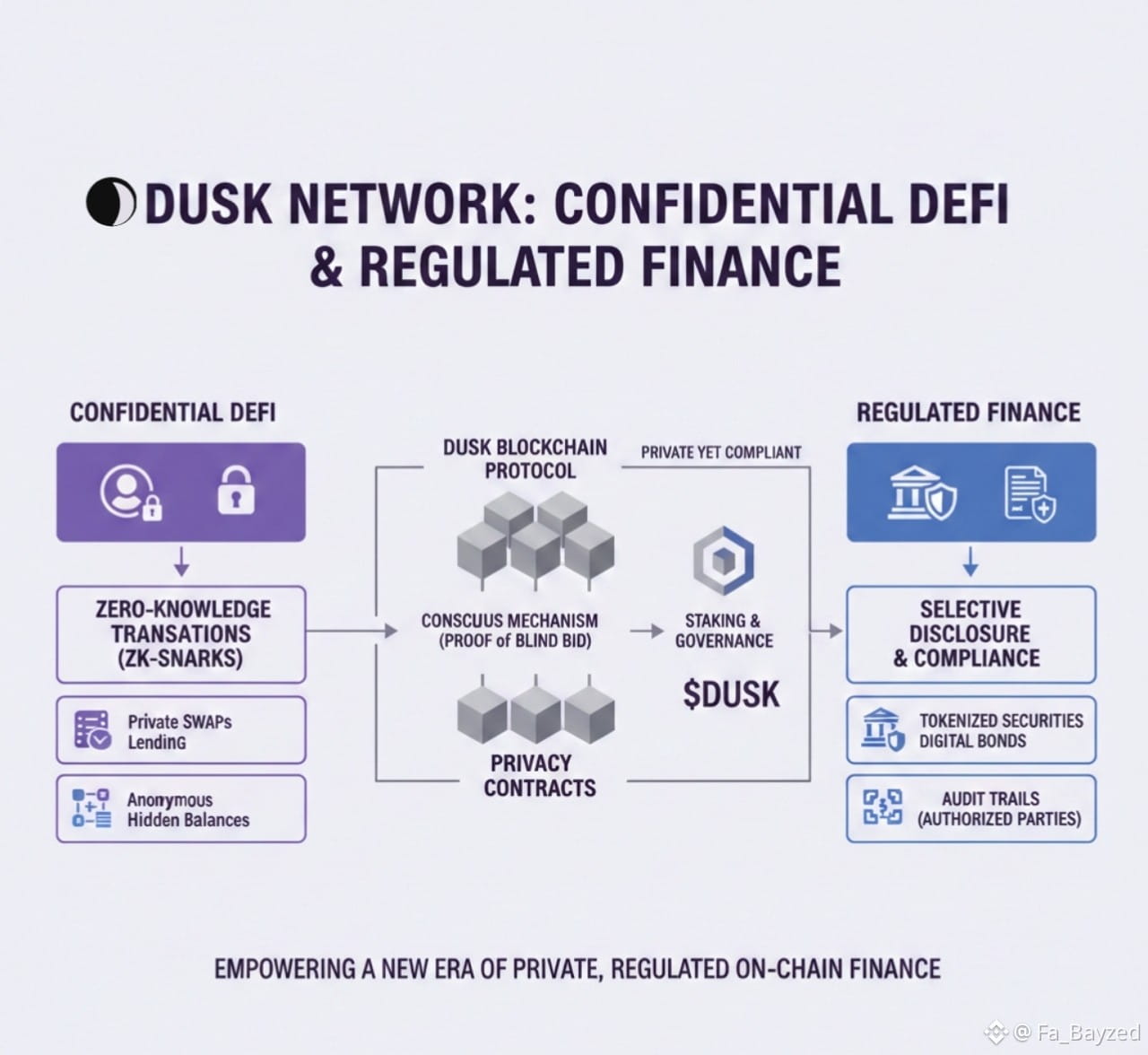
Most blockchains today operate on radical transparency. Every transaction, wallet balance, and interaction can be inspected by anyone. Although this openness helped bootstrap trust in early crypto systems, it also created a major limitation. Traditional financial institutions, enterprises, and even everyday users do not want their financial activity permanently exposed on a public ledger. Businesses require confidentiality. Investors demand discretion. Regulators require oversight. The challenge is to satisfy all three without returning to centralized systems. Dusk Network addresses this challenge by embedding zero-knowledge cryptography directly into its base layer, enabling transactions and smart contracts to be verified without revealing sensitive information.
What makes Dusk particularly interesting is that it does not pursue privacy in isolation. Many privacy-focused blockchains prioritize anonymity at the cost of compliance, which limits their ability to work with regulated markets. Dusk takes a different path. It is designed from the ground up to support regulated financial instruments such as tokenized securities, bonds, and other real-world assets. This means institutions can issue, trade, and settle assets on-chain while still complying with regulatory standards. Privacy is preserved for users, while selective disclosure ensures that authorized parties can audit or verify transactions when required.
This balanced approach positions Dusk as a bridge between traditional finance and decentralized technology. Instead of attempting to replace existing financial infrastructure overnight, Dusk aims to upgrade it. Through its decentralized market infrastructure, financial products can become programmable, interoperable, and globally accessible without sacrificing confidentiality. This creates an environment where banks, fintech companies, asset issuers, and developers can experiment with blockchain solutions that are actually suitable for real-world deployment.
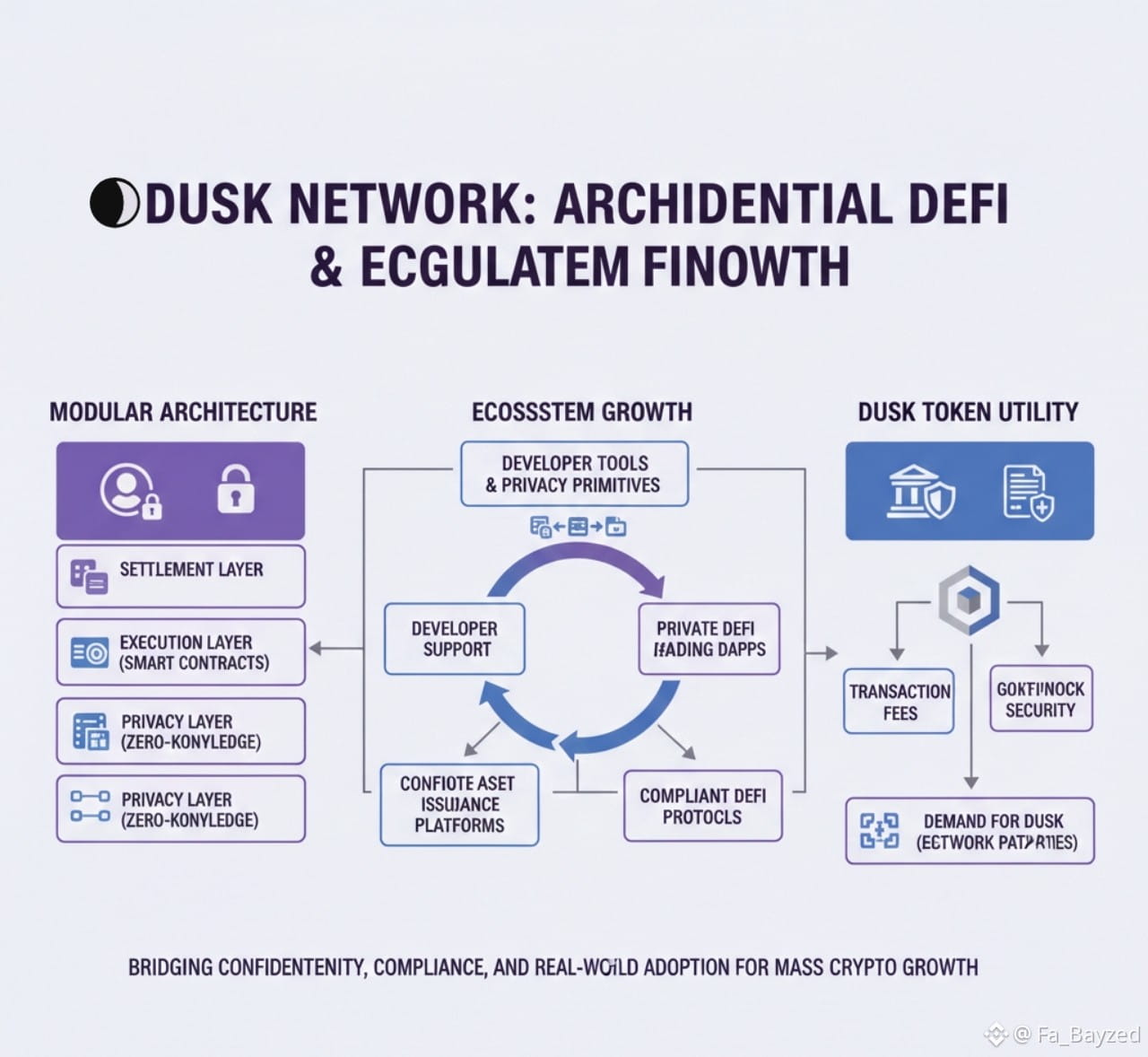
From a technical perspective, Dusk’s architecture is modular and purpose-built. The network separates settlement, execution, and privacy layers, allowing each component to evolve independently while maintaining high performance. Developers can build applications using familiar tools, while also gaining access to native privacy primitives. This lowers the barrier to entry and accelerates ecosystem growth. Instead of forcing developers to learn entirely new paradigms, Dusk integrates privacy into environments that already resemble modern smart contract platforms.
Another important element is the growing ecosystem around the network. Funding initiatives, developer support programs, and partnerships with industry players indicate that Dusk is not just a theoretical project. Applications are being built that explore confidential trading, private asset issuance, and compliant DeFi. Each new product strengthens the feedback loop between infrastructure and adoption. As more developers build, more users arrive. As more users participate, network value and utility increase.
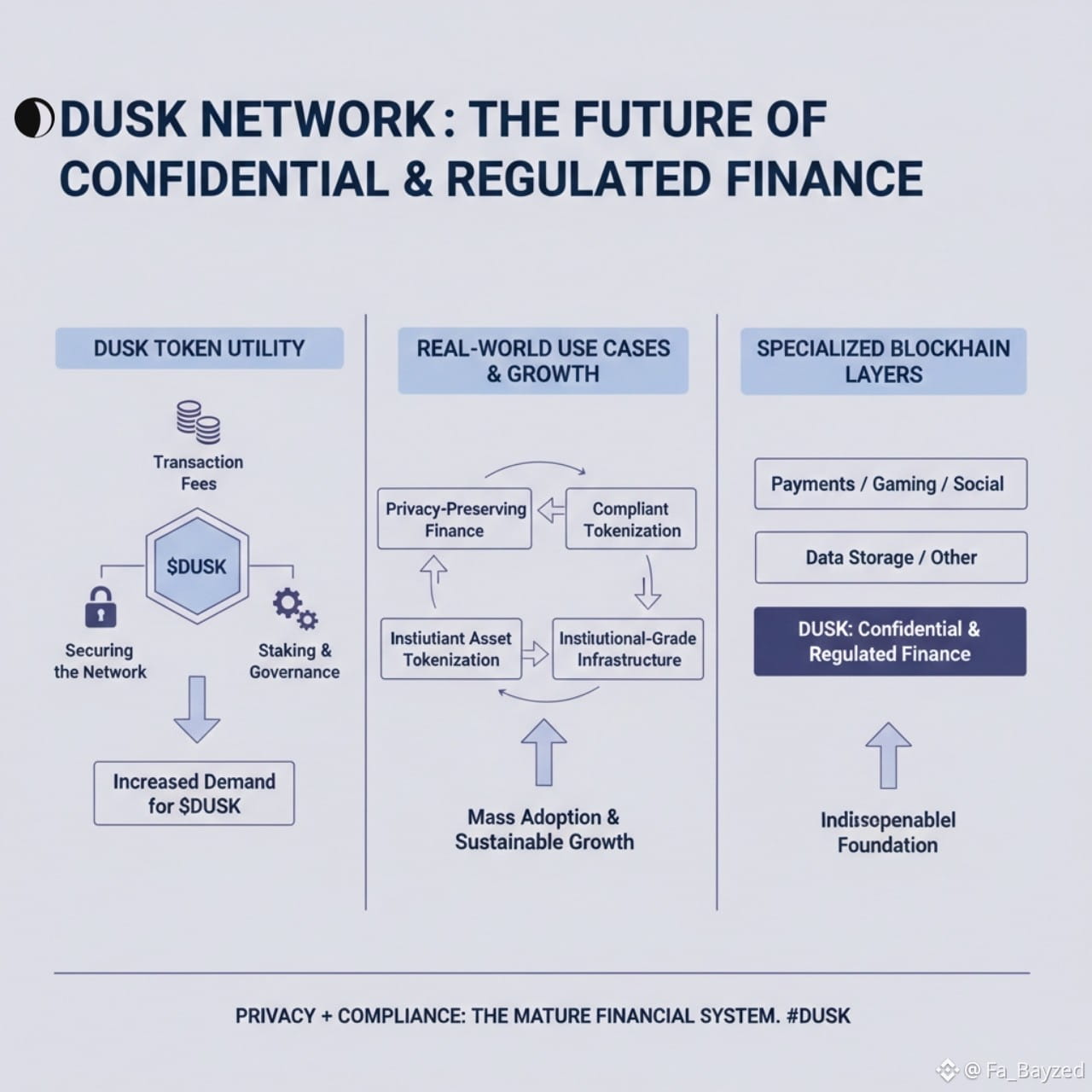
The role of the DUSK token extends beyond simple transfers. It is used for transaction fees, staking, and securing the network. Validators are incentivized to act honestly, while token holders can participate in maintaining consensus. This aligns the economic interests of participants with the long-term health of the ecosystem. Over time, as on-chain activity grows, demand for the token naturally increases, reinforcing its position within the network.
Looking at the broader crypto landscape, it is becoming clear that mass adoption will not come from speculation alone. Sustainable growth depends on real use cases that solve real problems. Privacy-preserving finance, compliant asset tokenization, and institutional-grade infrastructure are among the most important of these problems. Dusk is one of the few projects attempting to tackle all of them simultaneously.
The future of blockchain will likely be multi-layered. Some networks will specialize in payments. Others will focus on gaming, social platforms, or data storage. Dusk is carving out a specialized role as the foundation for confidential and regulated financial applications. This specialization is not a weakness; it is a strength. By focusing deeply on one of the most complex areas of blockchain, Dusk increases its chances of becoming indispensable.
In conclusion, Dusk Network represents a shift in how we think about decentralization. It acknowledges that privacy and compliance are not enemies. They are complementary requirements for a mature financial system. With strong cryptographic foundations, thoughtful design, and an expanding ecosystem, Dusk is positioning itself as a serious contender in the race to build the next generation of financial infrastructure.
