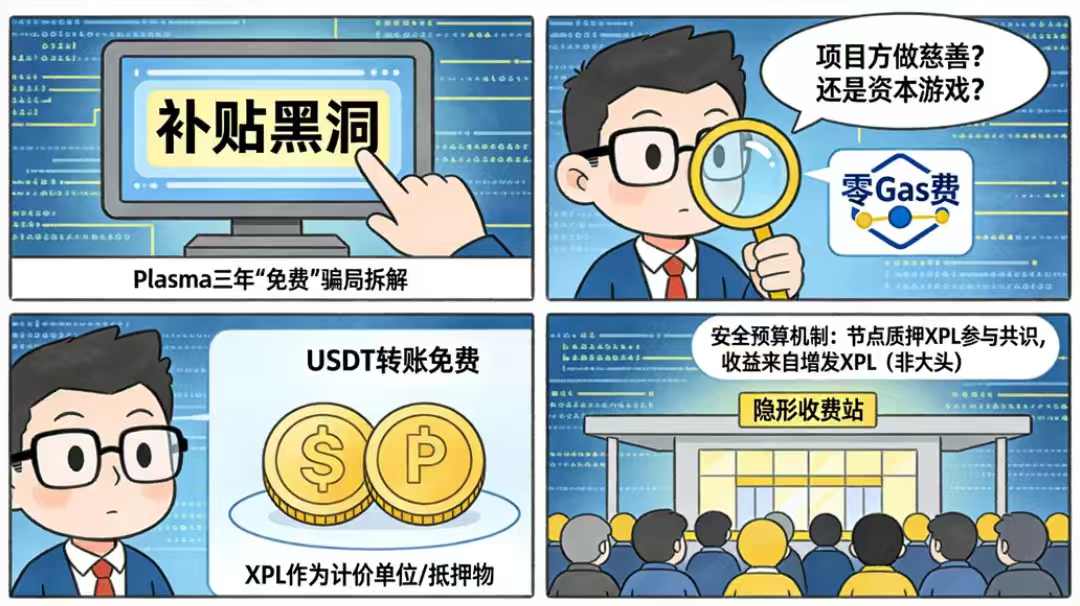
Brothers, let's talk about something that might shatter our worldviews today. Have you ever thought about what a public chain claiming to have 'zero Gas fees' forever is really after? Is the project team doing charity? Or is it just a more advanced capital game dressed in a subsidy disguise? I've been watching Plasma (XPL) for almost two years, especially the subtle shifts in their mainnet data over the past month, which have made me increasingly convinced of one thing: we have all underestimated this economic model. It is not about making payments; it is using 'free' as bait, quietly building an 'invisible toll booth' for future digital transactions. And the shareholders of this toll booth are not the project team, but those early entrants who understand the game, the node operators.
Let’s return to the most fundamental question: who guarantees the security of the blockchain? The answer is consensus nodes. What do nodes work for? The answer is incentives, usually derived from transaction fees and inflation rewards. So, if a chain announces 'transfers are free', how does it support the nodes and ensure security? Most people's logic gets stuck here, leading them either to believe it's a scam or to think it's an unsustainable mirage.
#Plasma 's answer lies in its dual-token model and the often overlooked 'security budget' mechanism. On the surface, users transfer USDT without spending a dime. However, the native token of this chain, XPL, has not disappeared. It is designed to be the 'pricing unit' and 'collateral' for the entire network's security and finality. Nodes need to stake XPL to participate in consensus and maintain the network. Their earnings come from the XPL issued by the system (inflation), right? Not entirely, or rather, that's not the main point.
In the past month, I started digging through the interaction records of some core contracts on their chain like an accountant. I discovered an interesting pattern: although users are unaware, contract calls related to 'payment channel relaying', 'batch transaction settlement', and 'state proof verification' are continuously and subtly consuming a type of 'resource', and the settlement of this resource is ultimately linked to the value of XPL. What is that like? It's like you get water for free, but the water company charges the government and pipeline maintenance companies based on 'the stability and cleanliness of the water supply', not by the tonnage of your water meter.
The cunning of Plasma lies in that it makes 'transactions' themselves free, but turns the service of 'ensuring that this transaction is absolutely reliable, irreversible, and quickly concluded' into a priced commodity. This commodity is 'sub-second finality'. For an ordinary user transferring 10U, this value is negligible. But for a payment processor that handles tens of thousands of merchant transactions daily, or a lending protocol that requires instant collateral liquidation, the value of this 'certainty' far exceeds a small amount of gas fees. The network, through a complex mechanism, transforms this collective demand for 'certainty' into a requirement for the overall network security budget (i.e., the staked value of XPL).
Node operators are the 'tax officers' and 'infrastructure maintainers' of this system. They stake XPL, provide computing power and bandwidth, and ensure that the commodity of 'certainty' can be stably produced. Their returns come from the total value increase of the entire network's 'certainty demand'. As more real commercial payment flows and asset settlement flows converge onto Plasma, even if each transaction is free, the total value of this 'certainty demand pool' is expanding. It’s like having the only authorized gas station, repair shop, and logistics center next to a free highway. The road is free, and as traffic increases, your associated business becomes more profitable.
The recent steady growth in the number of nodes (despite stagnant coin prices) is clear evidence. These nodes are not fools; they are savvy investors. They’re not betting on how much XPL will rise tomorrow; they are betting that 'the total demand for payment certainty in the future digital world will grow exponentially, and Plasma is currently the only protocol that can achieve this certainty to the fullest and package it as a “free experience”.' They are buying into the future 'certainty tax revenue' rights by staking XPL.
So, when you see the promotion of 'Plasma transfers are free' again, don’t think with a consumer’s logic of 'taking advantage'. Change your perspective and imagine yourself as an early infrastructure investor. What this chain is doing is using short-term sacrifices (no gas fees) to crazily absorb payment traffic and expand the base of 'certainty demand'. Once this base forms a network effect, and users accustomed to this frictionless experience can never go back, then the 'security value' and 'certainty premium' supported by this huge base will become an almost monopolistic, continuous source of income for the nodes (XPL stakers).
Where is the subsidy? This is a meticulously designed, years-long 'hunting' game. The prey is the total future global digital payment flow; the hunting ground is this seemingly free chain; and the ticket for hunters is the often overlooked XPL. When the hunting ground is crowded with prey, who cares about the initial cost of bait? What the nodes are quietly waiting for is the roar of the prey entering the field. And we, are we the prey, or the onlookers who understand the hunting ground?