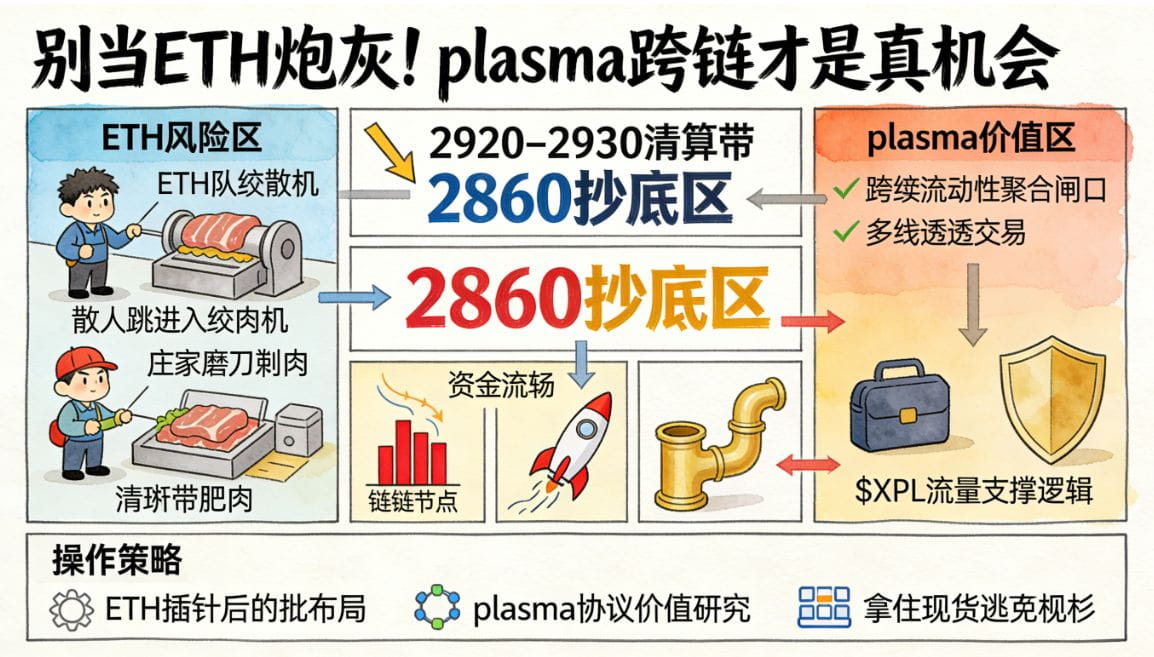
Don't rush to be a martyr! Do you know who is shouting to buy the dip at 2950 now? It's not the big shots, it's a group of 'suicide squads' that have already half stepped into the liquidation line. I'm telling you, the operators have sharpened their knives, just waiting for you to reach out and catch the flying knives.
In the past few days, ETH has not been declining gently; it has been like a dull knife cutting flesh. Looking at the heat map, that bright yellow liquidation zone at 2920–2930 is like a piece of fat hanging by a wolf's mouth—do you think the main force will let it go? Coupled with the obvious bad news of a 'government shutdown,' if they don't kill off this wave of long positions, where will the main force get their cheap chips? Buying the dip now? It's like jumping into a meat grinder as a lubricant.
Looking at the capital flow (CVD), with red all the way down, what does it indicate? Smart Money hasn't moved at all; they are all waiting. They are waiting for the market to panic and dip down to 2920 or even 2860, cleaning out that batch of leverage completely, which is the time to pick up bloodied chips. Remember, a bull market is about who makes the most, while a bear market is about who survives the longest.
But if you're only focused on ETH, you might have already lost the second half. Those who really know how to play have long been laying out the next narrative amidst the ups and downs—especially those underlying protocols that can withstand systemic risks. For example, I recently dug up something called @plasma, which doesn't even engage in leverage games but directly addresses the most painful pain points of public chains: fragmented cross-chain liquidity.
Simply put, there are so many chains now, and funds are trapped like on a deserted island. @plasma aggregates liquidity through its underlying protocol layer, allowing you to execute a transaction that simultaneously penetrates multiple chains, almost seamlessly cross-chain. What does this mean? When the market is volatile, funds can hedge in seconds; when opportunities arise, they can chase gains with one click—no longer drained by the friction between chains.
What's even more ruthless is that its node network is driven by XPL, which not only governs staking but also captures the value of transactions across the entire chain. This design is like building a dam at the most critical point of a river; no matter how fast the water flows, it has to pass through it. So even if the market crashes, as long as there is demand for multi-chain interaction, its fundamentals remain intact. The value of XPL is not just speculative but backed by real traffic.
So don't just focus on the few hundred points of fluctuation in ETH. Those that really change the game rules are often the protocols that continue to build quietly during bear markets. Like @plasma, which reconstructs cross-chain efficiency from the ground up, once the next cycle arrives and multi-chain explodes, it could very well be the biggest plumber—collecting fees until its hands are sore.
Wait for ETH to hit the target before gradually positioning yourself; don't be cannon fodder in the liquidation zone. As for new opportunities? Research those protocols that solve real industry problems, such as cross-chain liquidity aggregation. Hold onto the spot, stay away from leverage, and you will be alive to see the next spring.
It's not scary when the price drops; what's scary is that after the drop, you only have scraps left. Focus on value, not just price.