

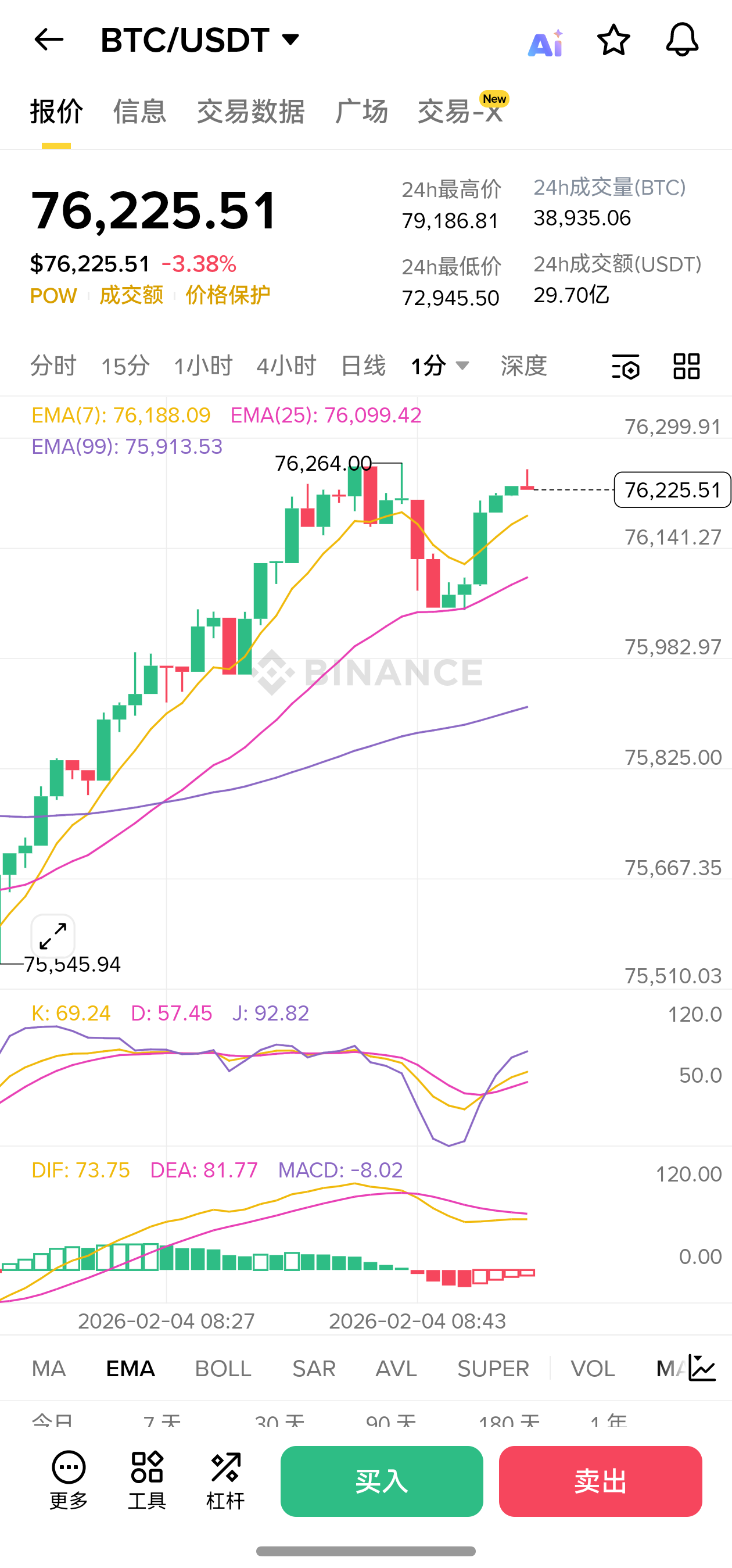
Woken up early by the market alarm, I glanced at the candlestick chart and was directly stunned—BTC broke 73,000 in one minute, and ETH almost returned to the 'ancient era' of 2,100. My coffee instantly lost its appeal, and my mind was filled with: 'Is my position still good? Has the leverage exploded?' This market really knows how to challenge various doubts; just yesterday, people were shouting 'eternal bull market,' and today they were pressed down on the ground. But upon regaining my composure and taking a closer look, wow, it actually reversed back to V! What kind of play is this?
Let's break down this wave of 'immortal market':
1. There are reasons for the decline, but the V-shaped reversal is more worthy of appreciation.
Why did the flash crash happen? The direct reason: concentrated profit-taking sold off. Bitcoin surged from over 30,000 at the beginning of the year to over 70,000; how many people doubled their profits? As soon as there’s a slight movement, they run faster than anyone else. Coupled with the fact that PayPal in the U.S. stock market crashed by 20% and tech stocks plummeted, crypto-related stocks (like Coinbase and MSTR) all turned red, and the sentiment transmitted over, causing an instant crash.
But here comes the key: why could it bounce back? This indicates that the buying funds below are not fake at all. In a bull market, such a sharp drop is often the 'golden pit for washing out leveraged longs,' and large funds take the opportunity to buy at low prices. The fact that BTC quickly rebounded above 75,000 is proof—according to market consensus, the bull is not dead yet.
2. The tragedy of altcoins: the most real 'risk education' during a bull market.
ZAMA dropped 22% in one day, EUL fell 15%… You might not have heard of these names, but they are falling sharply without hesitation. This conveys a signal: the market's risk appetite has contracted in the short term. When funds tighten, altcoins are the first to be sacrificed. In contrast, BTC and ETH have relatively controllable declines (3-4%), which is why seasoned investors always say 'in a bull market, cling tightly to core assets.' Altcoins can be played, but you must be mentally prepared for a complete loss—volatility is not risk; ignorance is.
3. Is the U.S. stock market linked? The crypto market is not so 'obedient' anymore.
Previously, when U.S. stocks fell, the crypto market had to follow, but now it seems: BTC's V-shaped rebound is much stronger than that of U.S. stocks. This indicates that the independence of the crypto market is increasing. However, if U.S. stocks continue to decline (for example, if the Fed turns hawkish), it will be difficult for the crypto market to stand alone. In the short term, this looks more like an emotional release rather than a trend reversal.
I was still bragging last night that 'a pullback is an opportunity to get in,' but when I opened my account in the morning, the floating loss was enough to eat instant noodles for a month. But to be honest, I’ve seen this kind of fluctuation a lot—bull markets are not a straight line, but a spiral ascent. Being slapped in the face by the market is not scary; what’s scary is the joy when it rises and the despair when it falls. Staying calm is the way to survive.

The bull is still around, but it may have shifted from 'mad bull' to 'slow bull mode.' In terms of operations, hold onto your BTC/ETH base and don’t let go; don’t let your altcoin positions exceed 10%. In today's market, I will watch more and act less, waiting for market sentiment to stabilize before making decisions.
Friends, were you scared by this wave of V-shaped recovery? Did you buy the dip or cut your losses? Let’s chat in the comments! If likes exceed 300, I will reveal my painful experience of being shaken out in the last bull market…💸#BTC何时反弹? #牛市到来 $BTC
