
President Donald Trump and Prime Minister Narendra Modi sealed an agreement that not only alters bilateral trade but also seeks to suffocate Russia's war economy and stabilize global energy supply following the U.S. intervention in Venezuela.
1. The Pillars of the India-U.S. Agreement.
After months of tensions and punitive tariffs, Washington and New Delhi have reached a consensus:
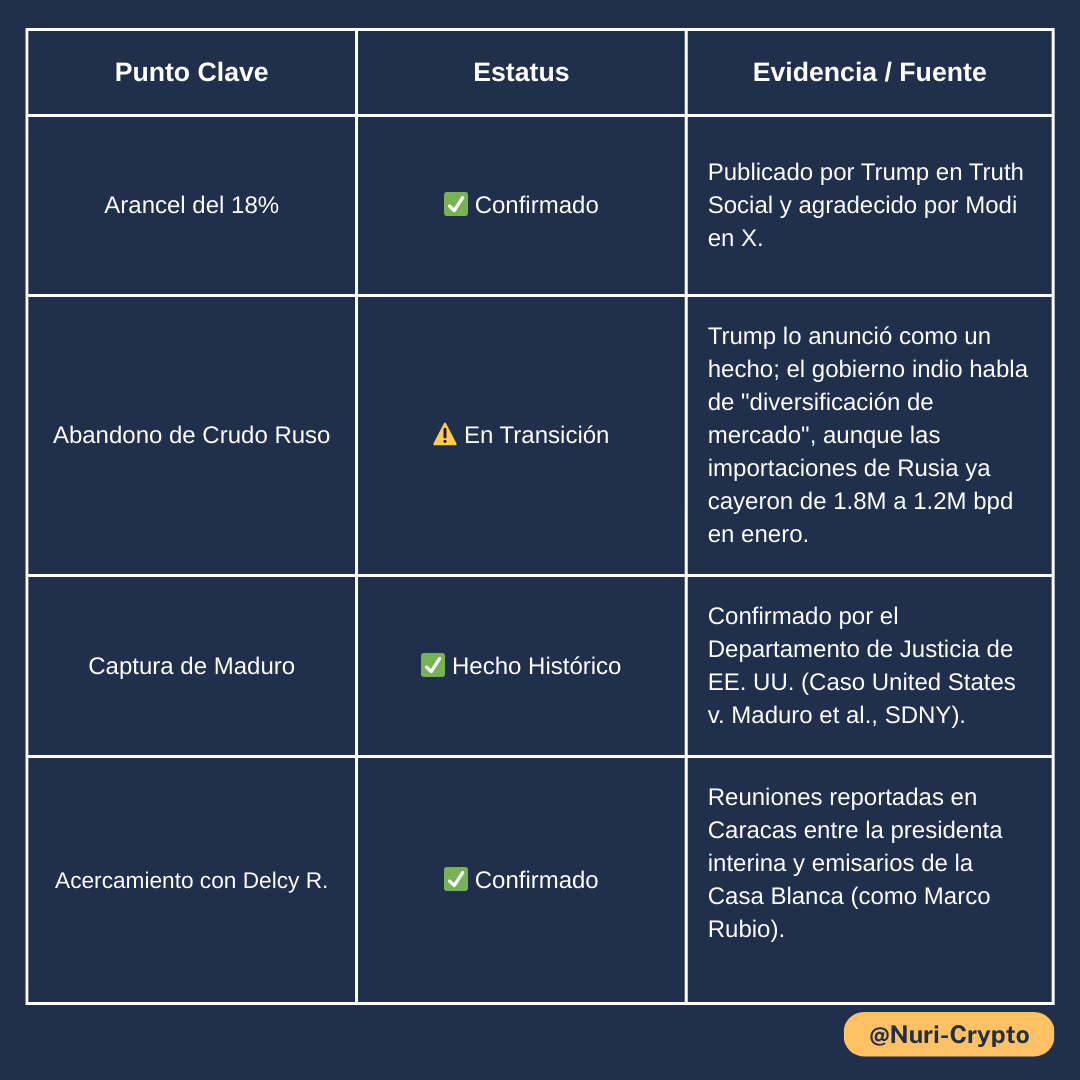
Tariff Reduction: The U.S. has cut the reciprocal tariff on Indian products from 25% to 18%. Additionally, a further 25% tariff that Trump had imposed on India specifically as punishment for continuing to purchase Russian crude has been eliminated.
India's commitment: Modi's government committed to reducing its tariff barriers for U.S. products to zero and to make massive purchases of goods (energy, technology, and agriculture) worth over $500 billion.
2. The "Venezuela Factor": Replacement of Russia
The most critical point for global geopolitics is Russia's exit from the Indian market.
Goodbye to Russian oil: Trump announced that India will stop buying crude from Moscow to "help end the war in Ukraine." India, which was the largest buyer of Russian oil after the sanctions, will now shift its demand towards the Western Hemisphere.
Venezuela as a new supplier: With the reactivation of the Venezuelan oil industry under U.S. supervision, India will begin to import crude from the United States and Venezuela. This guarantees India a stable supply without the ethical and financial complications of Russian sanctions.
3. Political Context: The New Reality in Caracas
The agreement is possible thanks to the unprecedented events that occurred in January 2026:
Capture of Nicolás Maduro: In early January, U.S. forces carried out "Operation Absolute Resolution," capturing Maduro and transporting him to the U.S. to face charges of narcoterrorism.
Interim Government of Delcy Rodríguez: After the capture, Delcy Rodríguez assumed an interim presidency with the aim of preventing a total collapse. Washington has established direct diplomatic channels with this government to reform the Hydrocarbons Law, allowing Venezuelan oil to flow massively again to strategic allies like India.
Important note: Although the agreement is political, economic success will depend on PDVSA's ability to increase production, which currently hovers around 900,000 barrels per day, a figure insufficient to cover the gap left by Russia on its own.
#Noticia #Trump #DonaldTrump #USDT #USDC
