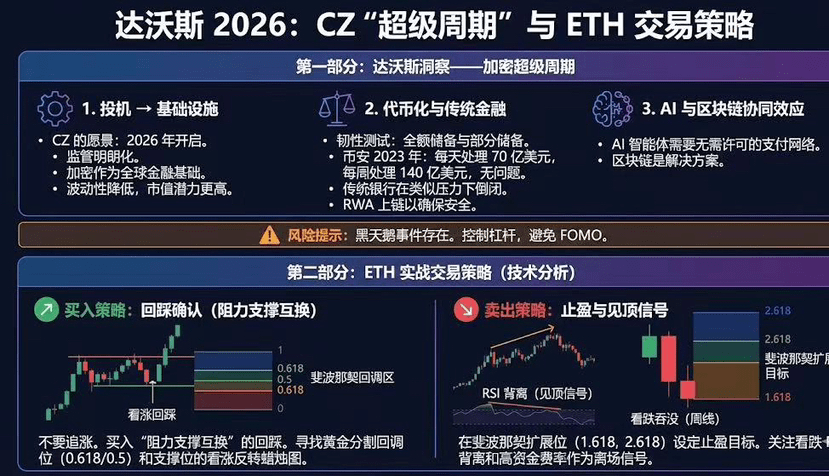
Part One: Davos Frontier - Why 2026 is the starting point of the 'Supercycle'?
According to the latest on-site report from the Davos World Economic Forum (WEF) 2026, Binance founder CZ's speech set the tone for the upcoming crypto market. This is not just a routine industry outlook, but a signal of the power handover between traditional finance (TradFi) and decentralized finance (DeFi).
The following is a breakdown of the core logic based on on-site information:
1. Paradigm shift from 'speculation' to 'infrastructure'
CZ clearly pointed out that 2026 is the starting point for cryptocurrency to truly enter the 'Crypto Supercycle'.
• In-Depth Interpretation: Past market cycles have often been dominated by Bitcoin halving (every 4 years), characterized by explosive rises and falls. However, the 'super cycle' means that as the regulatory environment becomes clearer, crypto assets will no longer just be highly volatile speculative tools, but will transform into core components of global financial infrastructure.
• Impact: Market volatility may gradually decrease, but the overall market cap 'ceiling' will be completely opened.
2. Asset Tokenization vs. Traditional Finance's 'Stress Test'
CZ presented a highly impactful comparative case: all-weather programmable finance vs. fractional reserve banking.
• Empirical Data: The report cited Binance's stress test faced in December 2023—processing a maximum of $7 billion in withdrawals in a single day, a total of $14 billion in a week, with no liquidity crunch issues during this period.
• Comparative Analysis: In contrast, traditional banks using 'fractional reserve banking' (like the Silicon Valley Bank incident) are almost certain to collapse under equivalent pressure of a bank run. This proves the resilience of a full reserve, on-chain transparent financial system under extreme market conditions. In 2026, we will see more traditional assets (RWA) forced onto the chain to seek this safety.
3. The 'Singularity' of AI and Blockchain
Although some content is not fully displayed, CZ mentioned the synergy between AI and blockchain. In the era of the AI Agent explosion, AI needs a permissionless payment network, and blockchain is the only solution.
Part Two: Practical Tutorial—Market Simulation and ETH Precision Point Strategy
Since the 'super cycle' has been set, we cannot just be theorists. Here are practical trading strategies based on the current market logic, focusing on the buying and selling logic of Ethereum (ETH).
1. Core Trading Logic: Why focus on the ETH/BTC exchange rate?
In the early stages of the super cycle, Bitcoin (BTC) usually breaks through old highs, draining market liquidity. But when BTC stabilizes, true excess returns (Alpha) come from ETH and its ecosystem.
2. Practical Teaching: Fibonacci + Key Patterns (with Practical Case Studies)
【Buying Strategy: Pullback Confirmation Method】
• Technical Principles: The buying point in a bull market is never about chasing prices but about the pullback to 'resistance turning into support (S/R Flip).'
• Practical Case Studies Prove:
Review ETH's performance in the last bull market (2020-2021). When ETH first broke through the $400-$500 range (the top of a long-term consolidation), it did not immediately surge to $4000 but pulled back to confirm support before starting the main bullish wave.
• 2026 Cycle Operation Guide:
1. Observation Points: Use Fibonacci retracement lines from the lowest point of this round to the recent high. Focus on the golden ratio levels of 0.618 and 0.5.
2. Right-Side Signal: When the price falls back to key support levels (such as the daily MA120 or the top of the previous range) and a K-line pattern with a shrinking long lower shadow appears, it is solid evidence of institutional accumulation.
3. Specific ETH Layout Points (Hypothetical Model): If the recent high for ETH is A and it pulls back to B. If the price at point B is at a critical integer level (such as the $2800-$3200 range) and holds, this will be the long-term holding cost area for the 'super cycle.'
【Selling Strategy: Gradual Profit Taking and Emotional Anchors】
• Technical Principles: This is how to escape the peak. In a 'super cycle,' simply relying on technical indicators can lead to missing out; it is necessary to consider 'emotional bubbles.'
• Practical Case Studies Prove:
Refer to the peaks of ETH in May and November 2021. At that time, the RSI indicator consistently showed 'divergence at the top' (new price highs but no new RSI highs) on a weekly basis, while the overall contract funding rate was extremely high (Funding Rate > 0.1%), which is a typical signal of a market top.
• 2026 Cycle Operation Guide:
1. Left-Side Orders: Based on the Fibonacci extension line (Fib Extension), set the positions of 1.618 and 2.618 as the first and second profit-taking points.
2. Right-Side Liquidation: When you observe a weekly bearish engulfing pattern in the ETH/BTC exchange rate or when even 'taxi drivers' at the Davos Forum are discussing how ETH can surpass BTC, it is a signal to exit.
3. Summary Recommendations
The signals from Davos 2026 are very clear: the industry is shifting from virtual to real.
• For Large Funds: Refer to the asset tokenization trend mentioned by CZ, allocating BTC and ETH as foundational anchor assets.
• For Traders: Do not try to predict every short-term wave. Utilize the S/R Flip strategy to build ETH positions in batches during pullbacks and enjoy the beta returns brought by the 'super cycle.'