

When people talk about blockchains, the discussion almost always starts with decentralization of assets or execution. Who holds the keys? Where does custody live? How fast can transactions settle?
But when I step back and look at how real financial markets operate, I keep arriving at a quieter conclusion: assets don’t matter without authoritative data.
Capital markets do not run on tokens alone. They run on official prices, verified trade data, auditable records, and legally defensible sources of truth. And this is where most Web3 systems quietly fall apart. @Dusk Network stands out not because it promises higher throughput or flashier DeFi, but because it treats regulated financial data as first-class infrastructure, not as an afterthought.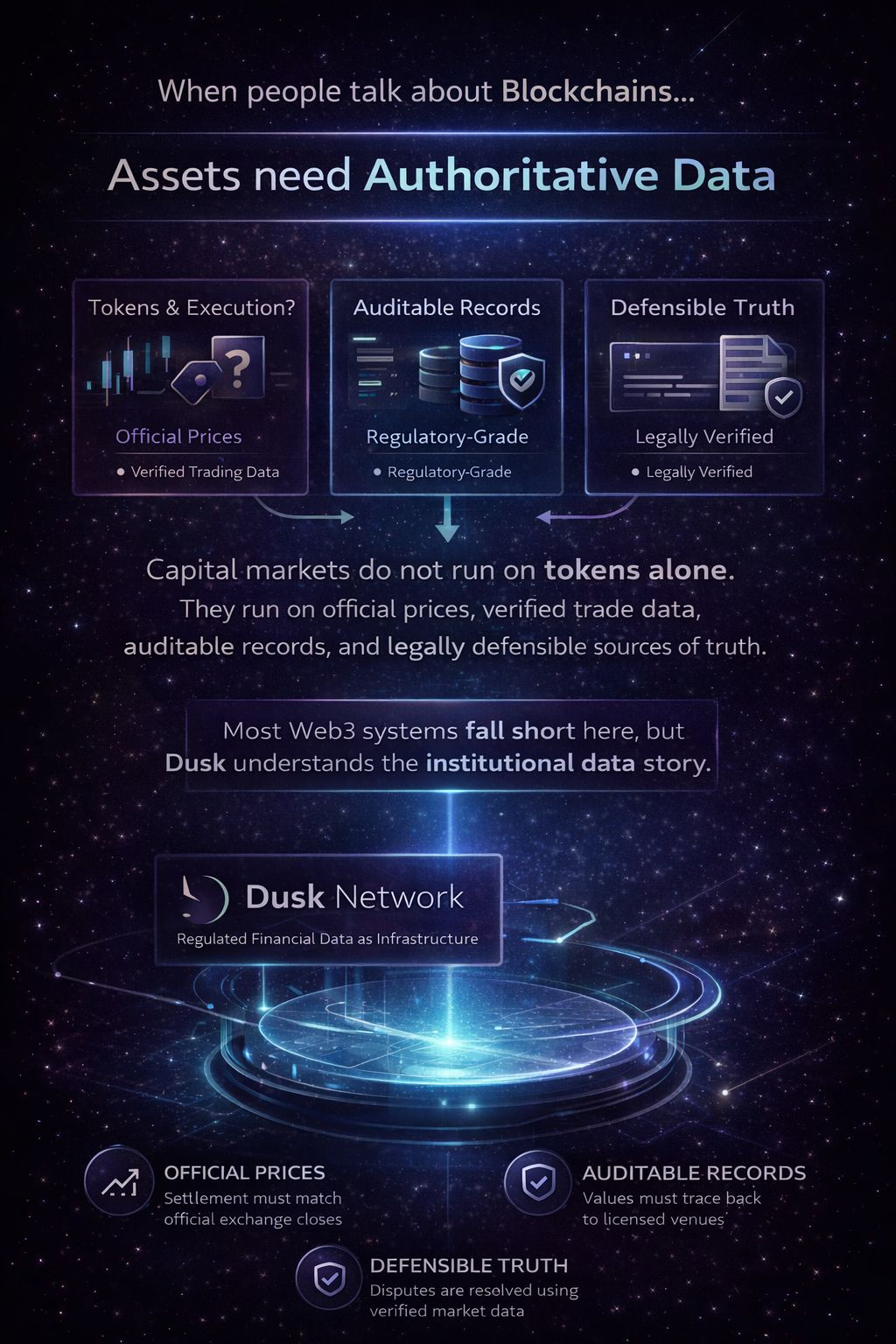
The Core Problem: Blockchains Can Settle Value, But They Don’t Own Truth
Most blockchains rely on oracle systems that aggregate prices from multiple sources. That works well for crypto-native markets where approximation is acceptable and risk is socialized. But regulated finance does not work that way.
In traditional markets:
Settlement prices must match official exchange closes
Corporate actions must be calculated from authorized data
Audits must trace values back to licensed venues
Disputes are resolved using verifiable market records, not probabilistic feeds
A mispriced asset is not just an error it is a legal liability.
This is why institutions hesitate to move meaningful financial activity on-chain. It’s not that blockchains can’t execute logic. It’s that they often cannot prove that the data driving that logic is institution-grade.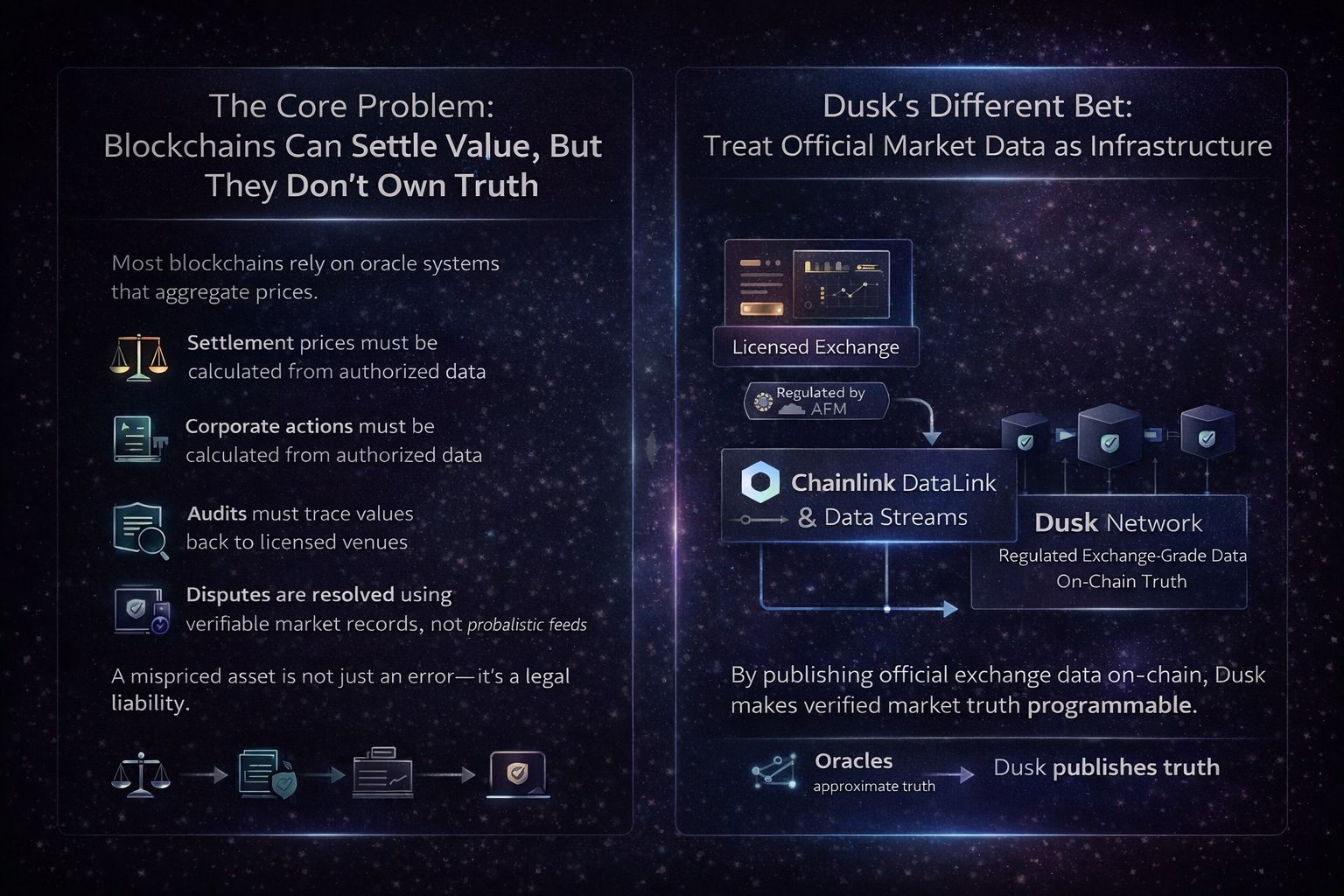
Dusk’s Different Bet: Treat Official Market Data as Infrastructure
Dusk approaches this problem from a fundamentally different angle. Instead of asking, “How do we bring prices on-chain?”, it asks:
“How do we make on-chain data as authoritative as the systems institutions already trust?”
To do this, Dusk is working with NPEX, a licensed exchange regulated by the Dutch Authority for the Financial Markets (AFM). This is not a symbolic partnership. It changes the role of data on the blockchain.
Rather than relying on third-party aggregators alone, @Dusk integrates official exchange-grade market data directly into its on-chain environment using **Chainlink DataLink and Data Streams standards.
The distinction here matters:
Oracles usually approximate market truth
Dusk aims to publish market truth
That difference is what makes regulated on-chain finance possible.
How It Works in Practice: From Exchange to Smart Contract ?
Using Chainlink institutional tooling, Dusk enables regulated venues like NPEX to publish verifiable, low-latency market data directly on-chain. This includes:
Official price feeds
Time-stamped trade data
Provenance tied to licensed venues
Audit-ready historical records
This data is not just readable by humans it is programmable.
A smart contract on Dusk can reference this data with the same confidence a traditional clearing system would reference its internal databases. That means:
Bond redemptions can use official close prices
Yield calculations can rely on authorized market data
Compliance logic can execute automatically
Audit trails exist by design, not after reconciliation
In this model, the blockchain stops being a passive settlement layer and becomes a shared, regulated data surface.
Why This Changes Tokenized Assets Entirely
Tokenized securities are not just “tokens with rules.” They are financial instruments with:
Jurisdictional constraints
Transfer restrictions
Pricing obligations
Reporting requirements
All of these depend on credible data.
Dusk’s architecture allows regulated assets to:
Settle automatically using official exchange data
Calculate dividends and yields without off-chain reconciliation
Produce audit-friendly records that regulators can inspect
Reduce reliance on intermediaries without sacrificing oversight
This is not theoretical. It is exactly how regulated markets operate just with logic encoded directly into contracts.
Dusk vs Traditional Oracle Models
Most oracle systems aggregate prices from multiple exchanges to reduce manipulation. That’s valuable, but it solves a different problem.
Dusk’s approach focuses on:
Source integrity, not just redundancy
Regulatory provenance, not just decentralization
Auditability, not just availability
By allowing licensed exchanges to act as on-chain data publishers, Dusk elevates market data from a utility to an asset class.
This is a subtle shift, but it’s the shift institutions care about.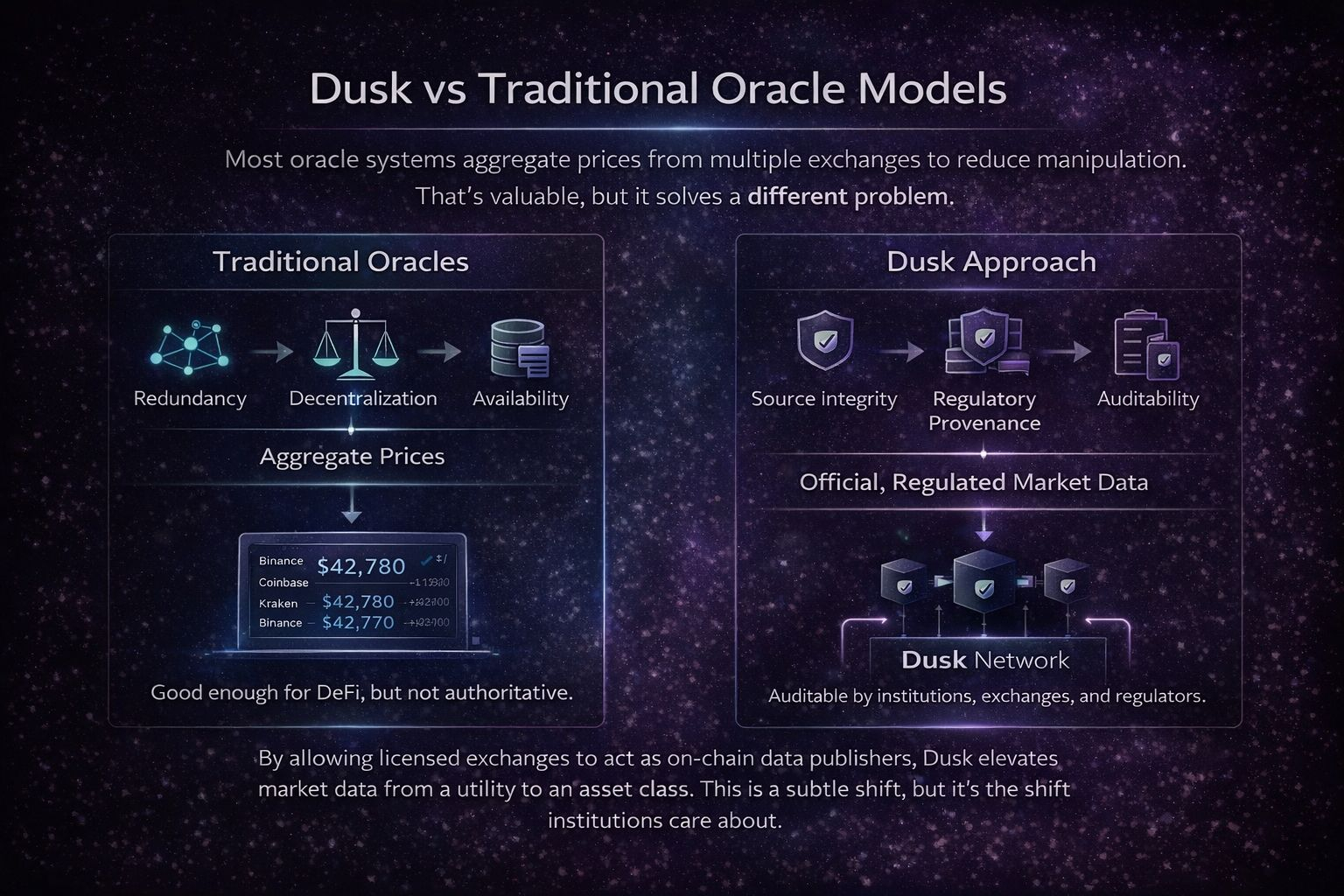
Cross-Chain Implications: Data That Travels With Trust
Dusk also integrates Chainlink CCIP, enabling regulated data to move across chains while preserving its provenance. This means:
A tokenized asset on Dusk can reference the same official price feed on Ethereum
The data retains its regulatory signature across ecosystems
Interoperability no longer breaks compliance assumptions
In the future, this could allow regulated financial data to travel with assets, not be re-interpreted on every chain.
Why I Think This Matters More Than Most Narratives
Settlement and custody get most of the attention in blockchain discourse. But the real bottleneck has always been data trust.
Without authoritative data:
Smart contracts can’t fully replace legacy systems
Institutions can’t automate compliance
Regulators can’t rely on on-chain records
Dusk’s work suggests a different future one where truth itself becomes programmable, verifiable, and shared.
Conclusion: Data Is the Next Layer of Financial Infrastructure
The first wave of blockchains decentralized custody.
The second wave optimized execution.
The next wave will decentralize verifiable truth.
Dusk is positioning itself at that layer where official market data is not an add-on, but a protocol-level primitive. If this model succeeds, it won’t just enable regulated DeFi. It will enable regulated, auditable, legally defensible on-chain finance.
That is not loud innovation.
It is the kind of infrastructure real markets quietly adopt and then never leave.
And that is why Dusk data story matters far more than most people realize.
