

This question becomes increasingly clear as the crypto ecosystem witnesses a slew of multi-purpose chains emerging, each trying to become a platform for everything: DeFi, NFT, gaming, social, AI. Narratively, this approach creates a sense of rapid growth. But systematically, it also brings about liquidity fragmentation, unstable usage levels, and a heavy reliance on incentives.
Many chains seem 'busy' in the short term, but activity declines sharply as rewards dwindle. This reflects a familiar confusion in the market: we often confuse application activity with transaction value. Not every transaction has the same economic significance, and not every crowded ecosystem can sustain a viable cash flow.
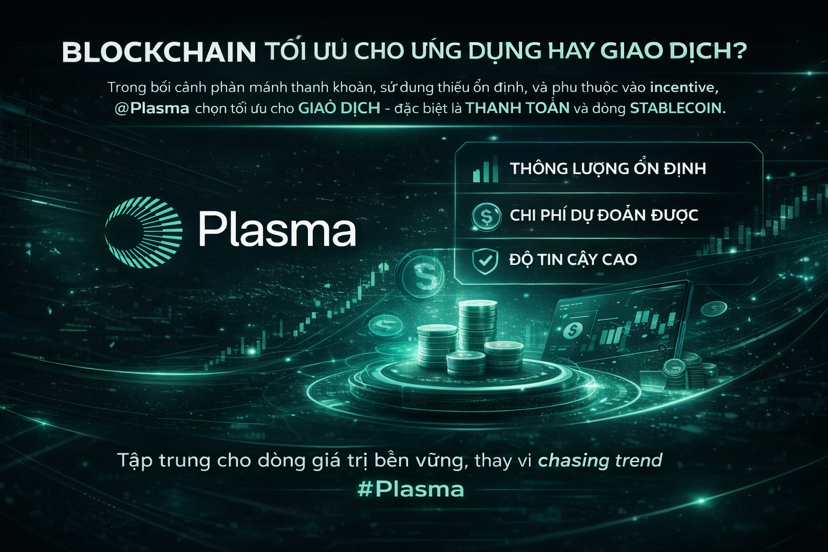
In that context, @Plasma represents a distinct intent. This distinction does not lie in the technology being superior but in the design goals. Plasma does not strive to become a catch-all platform for every type of application. Instead, it optimizes for transactions—especially payments and stablecoin flows—where the primary requirement is not high composability but stable throughput, reliability, and predictable costs.
This approach comes with a clear trade-off. Plasma is not suitable for use cases requiring complex logic, dense cross-interaction, or rapid testing. DeFi models that heavily rely on the free combination of smart contracts will struggle to leverage advantages from such architecture. Yet, this 'lack of flexibility' becomes an advantage in other segments.
Payment channels, settlement systems for stablecoins, treasury management, or cash flows linked to RWA do not require constant innovation in applications. Once integrated, they prioritize stability and repeatability. These systems rarely make big headlines but are very hard to replace once they become part of the financial process.
From this perspective, the role of token $XPL is no longer entirely dependent on market sentiment or short-term speculation but has the potential to be linked to the actual usage level of the network if transaction volumes grow steadily. Plasma may never look as 'noisy' as chains chasing every trend, but the quiet consistency of value flow could be a more noteworthy systemic signal.
Returning to the initial question: should blockchain optimize for applications or transactions? Perhaps the issue is not about choosing one over the other, but that we need to evaluate each architecture based on its original intent rather than applying the same measure to all systems. Plasma, in that picture, raises the question of what value flow blockchain is truly serving.

