
1/ Currently, we are in the explosive first year of the Agentic Economy.
We are at a critical juncture in the transition from 'AI tools' to 'AI agents.' The recent explosive growth of @openclaw is not only a technical dividend but has also significantly lowered the entry barrier to the Agentic Economy.
In this system, AI is no longer just a tool (like a search box or chatbot), but an entity capable of independent decision-making, executing tasks, and conducting transactions.
The recent explosive growth of @openclaw has directly lowered the entry barrier to the Agentic Economy.
2/ Shift in payment paradigms
In the payment sector, it marks a paradigm shift from 'human payment' to 'machine autonomous decision-making payment.'
In the traditional Web2 payment field, AI Agents mainly play the role of 'butler', solving the automation of complex processes.
For example: businesses no longer need to manually reconcile accounts; Agents can autonomously identify invoices, audit compliance, and choose the optimal payment timing based on cash flow forecasts.In the Web3 payment field, we have entered M2M Payments (machine economy).
Through smart contracts, Agents can complete value exchanges without human intervention.
3/ Computing is currency: The evolution of Tokenized Compute
In the Web3 payment scenario, payments are no longer just currency; Tokenized Compute is becoming a new type of 'hard currency' between agents.
Recently, a popular project in the circle, @hodlai_bsc, is an excellent 'Web3 payment model innovation' case.
Payment paradigm shift
4/ Breakdown: HODL AI's 'Hold to Access' model
Is it Tokenized Compute?
Traditional Tokenized Compute (such as io.net) focuses on the tokenization of underlying hardware resources (GPU/CPU), which is 'buying and selling computing time'.
The logic of HODL AI is the tokenization of 'computing results (inference services)'.
Its model: Holding tokens $HODLAI = receiving free API inference credits.
Essentially: Holding $HODLAI = receiving free API inference credits. It transforms the complex costs of AI inference into a form of on-chain equity. Users are not purchasing a one-time service, but a 'permanent access' to the computing pool.
For developers and Agents, this native Web3 solution addresses the payment pain points of Web2:
Web2 pain points: Developers using OpenAI or Anthropic must bind credit cards, facing budget uncertainties brought by pay-as-you-go pricing, as well as cross-border payment fees.
Web3 solution (HODL AI): Offsetting payment actions through token economics. Users are not 'paying', but proving their contributions to the ecosystem by 'holding tokens', thereby obtaining computing resources allocated by the protocol.
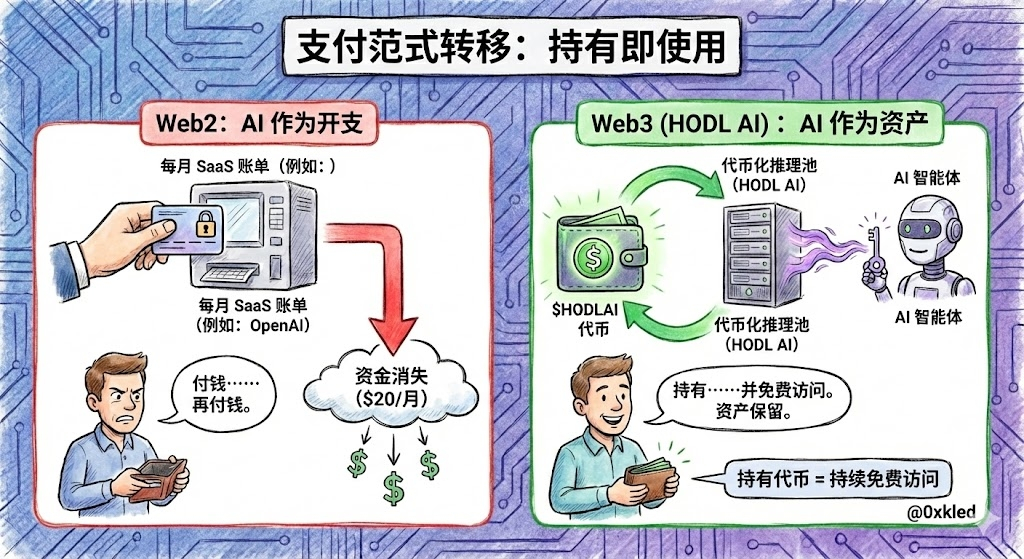
This model eliminates the small transaction fees per minute and per token, solving the settlement friction of micropayments in the Web2 system.
5/ Conclusion
In the past, using AI was like paying utility bills; the money spent was purely an expense. In the future, using AI will be like being a 'minor shareholder'; the tokens you hold are your tickets to computing, representing assets.
The true sign of AI Agents being 'weaned' is no longer scouring for credit cards to bind, but learning to sustain themselves with the assets they hold. This revolution is not about who can write the best prompts, but who first gets the 'ticket' to the machine economy.