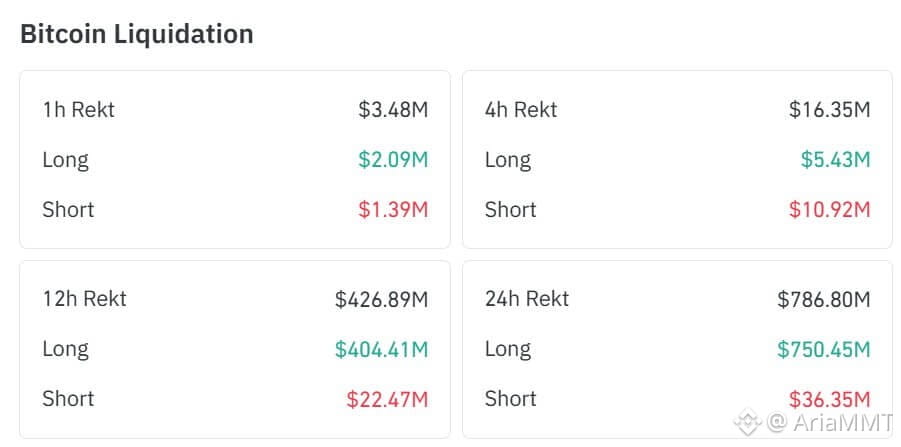
Bitcoin in dropped below $82,513 in the last 24 hours. That's a 7% decline that wiped out over $750 million in long positions. It's the worst liquidation event for bullish traders since November.
And it's not just one bad day. Bitcoin is about to close its fourth straight red month. Down 5% in January. Down 3.99% in December. Down 17% in November. Down 4% in October.
Four months of losses. No recovery in sight.
The 2-year moving average just broke
Bitcoin fell below its 2-year moving average for the first time since 2022. The last time this happened was October 2023.
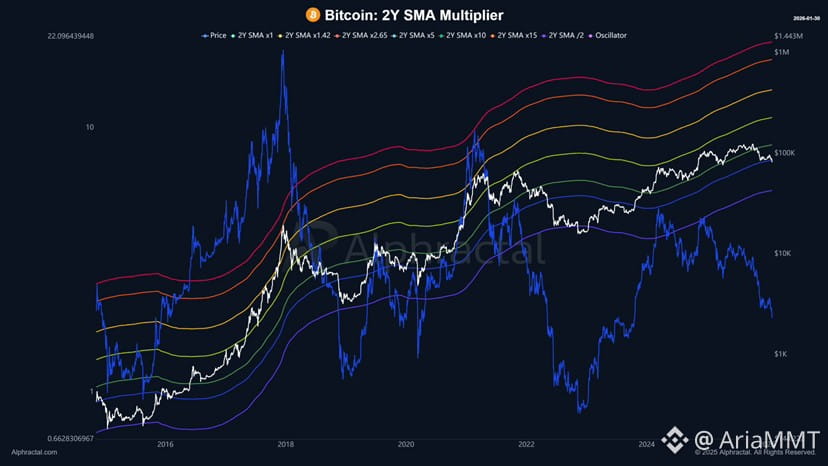
This isn't some random technical line. Historically, when Bitcoin loses this level, the market either crashes harder or enters a long accumulation phase before the next bull run starts.
Analyst Joe Consorti said Bitcoin also lost the November 2025 lows and is now 7% away from losing the 2025 yearly low.
Translation? The floor keeps falling out.
October changed everything
Go back to October 10, 2025. Bitcoin hit an all-time high above $126,000 earlier that month. Then Washington dropped tariff and export-control news. The market unraveled.
Liquidations totaled more than $19 billion. It was one of the largest forced unwinds on record. The entire rally got exposed as leverage-driven speculation instead of real demand.
Bitcoin never bounced back the way it should have. No sharp recovery. No confidence-restoring rally. Just a slow grind down with every attempt to recover getting slapped back down.
The market shifted from expansion to consolidation. And it hasn't shifted back.
ETF flows went quiet
US spot Bitcoin ETFs helped drive earlier price action. They were buying aggressively. Now? Net flows are back to zero.
Glassnode reported the 30-day moving average for ETF flows is hovering near zero after sustained outflows. The selling pressure stopped but the buying pressure didn't return.
Short-term holders bought Bitcoin at an average cost basis of $96,500. That level keeps capping every recovery attempt. Below that, Glassnode identified stressed support around $83,400. If that breaks, the next real floor is around $80,700.
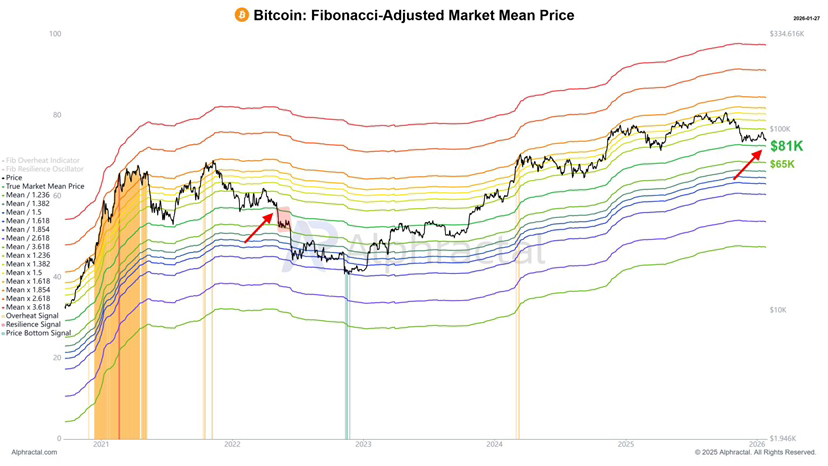
Alphractal CEO Joao Wedson was more direct. He said Bitcoin cannot lose $81,000 under any circumstances. If it does, expect a capitulation event like 2022. The next major support after that? Around $65,500.
Bitcoin was supposed to be the digital version of that trade. Instead, it's grinding sideways or lower while metals moon.
Washington isn't helping. Senators introduced a draft market-structure bill in mid-January to clarify crypto oversight. Sounds good on paper. But Coinbase CEO Brian Armstrong said the company couldn't support the bill in its current form. That delayed Senate discussions and made investors more cautious.
Bitwise CIO Matt Hougan laid out two scenarios. If the bill passes, the market rallies sharply because investors finally get regulatory clarity. If it fails, Bitcoin has to prove real-world adoption before prices move higher.
Right now, neither scenario is playing out. The market is just stuck.
Liquidity signals are flashing red
The Coinbase Bitcoin premium index stayed negative for most of January. Recent readings show around -0.16%. That means US spot pricing is weaker than the global average. American investors aren't buying.
Stablecoin supply is contracting too. CryptoQuant data shows aggregate stablecoin balances shrinking. Stablecoin growth usually correlates with buying power in the crypto market. When supply drops, it means less dry powder sitting on the sidelines ready to buy dips.
Order book depth across major exchanges is still weak. Even modest selling triggers massive price swings because there aren't enough buy orders stacked up to absorb pressure.
Some analysts argue this looks more like a cyclical reset than a structural breakdown. Glassnode described it as a consolidation regime driven by absorption instead of expansion. Leverage already got flushed out in some markets. Spot participation is still muted.
That's the optimistic take. The recent lows came from leveraged positions getting forced out instead of long-term holders giving up.
But the near-term setup is uncomfortable.
Two paths forward
The bull case is simple. Sustained spot demand returns. Bitcoin climbs back above $96,500 and short-term holders go green again. Confidence rebuilds. The market shifts back into expansion mode.
The bear case is uglier. Consolidation continues. Liquidity stays weak. The $83,400 to $80,700 support band gets tested. If $81,000 breaks, defensive positioning kicks in and Bitcoin falls toward the mid-$60,000 range.
Right now, neither path has clear momentum. The market is waiting for something to tip the scale.
Four red months. A broken 2-year moving average. Quiet ETF flows. Shrinking stablecoin supply. Weak liquidity.
Bitcoin is at a decision point. And $81,000 is the line that matters most.