
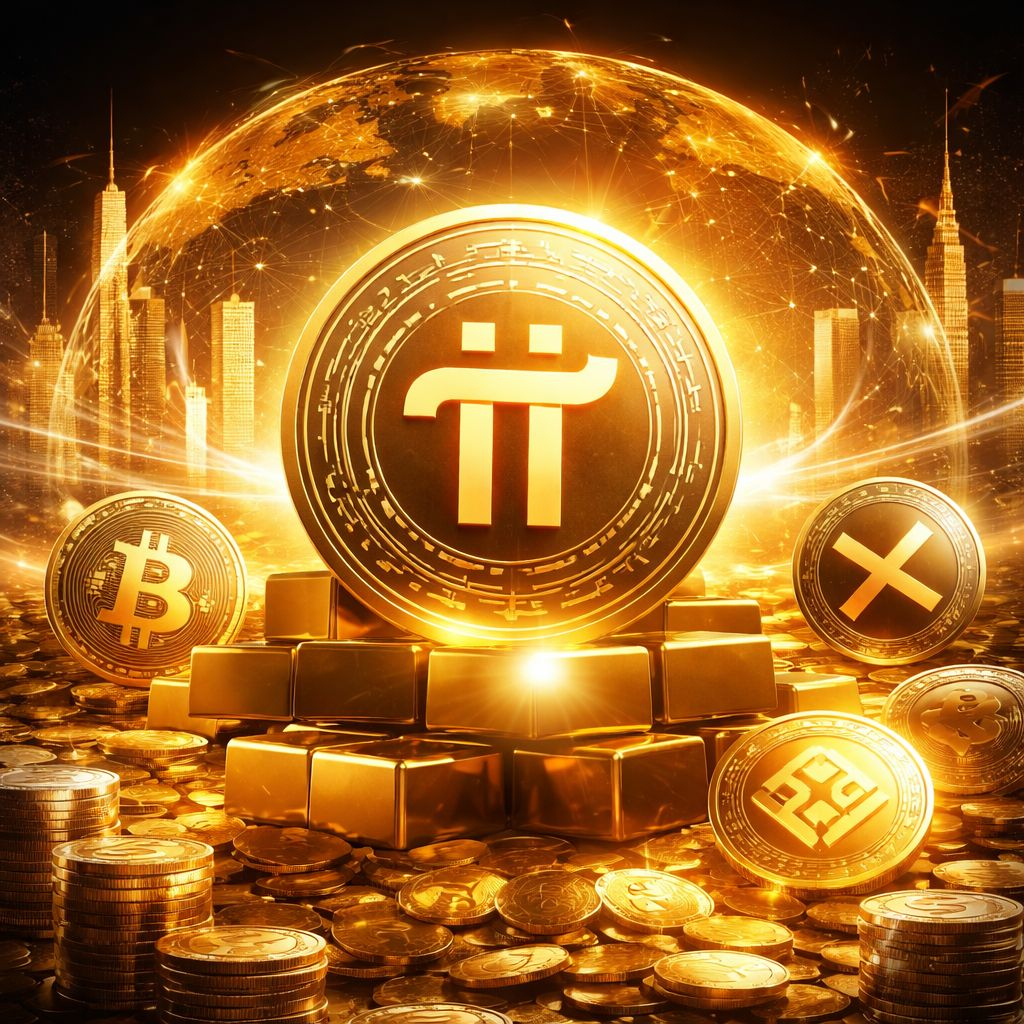
Are we witnessing the birth of a new global monetary system that redistributes wealth and breaks the logic of debt?
In a world changing at an unprecedented pace 🌍, money is no longer what we once knew.
Gold is rising strongly 🟡, sovereign debt is ballooning 📉, paper currencies are losing their luster, while digital currencies are moving from the margins to the heart of global discussion.
Amid this complex scene, the Pi project emerges as one of the most controversial projects, not because of its price, but because of the idea behind it.
This article does not provide price predictions or investment promises ❌, but an in-depth analytical reading that attempts to answer a fundamental question:
💡 Can a community-driven digital project like Pi Network become part of the reengineering of the global financial system?
🟡 First: Why is gold the key to the next phase?
Throughout history, gold has been a mirror of global fear.
Whenever confidence in monetary systems shakes, gold returns to the forefront.
Today, we witness:
📈 Historic highs in gold prices
🏦 Intensive purchases by central banks
💸 Unprecedented monetary expansion
📊 Global debts exceed realistic repayment capacity
Gold here is not bought for speculation, but as a refuge for value.
And here the turning point appears:
What if a digital system tried to draw inspiration from the logic of gold… without being gold?
🧠 Pi Network: Monetary project or economic experiment?
Viewing Pi as a 'mining currency from the phone' is a very superficial reading.
Deeper analysis reveals that mining was a tool, not an end.
🎯 The real goal was:
Building a huge user base
Distributing currency before pricing it
Breaking the monopoly of capital in the founding stage
This approach contradicts the traditional logic that says:
Money first… then people.
Pi turned the equation upside down:
People first… then money.
🔗 Pi and gold: the smart indirect connection
It is very important to clarify ⚠️: There is no official announcement linking Pi directly to gold.
But economic analysis reveals a similarity in philosophy, not form:
Gold
Pi Network
Natural scarcity
Planned digital scarcity
Historical trust
Community trust
Not subject to a state
Not subject to a single authority
Value over time
Value through usage
🔍 Pi does not say: I am backed by gold
But it tries to say:
I understand why gold has value… and I try to build a similar logic digitally.
📉 From speculation to function: the most dangerous shift
Most digital currencies failed because they:
Relying on speculation only
Did not build real demand
Flooding the market with supply
The positive scenario for Pi is based on:
🔒 Gradual lock on liquidity
🛒 Actual use within an ecosystem
🤝 Transforming currency into a tool of exchange, not just a stored asset
And here we reach the golden rule:
Price is a result… not a cause.
If usage is achieved, value is achieved.
And if value is achieved, big numbers come — quietly, not with noise.
🌐 Pi within a multi-currency system: Intelligence without conflict
The next financial system will not be unipolar.
The realistic vision sees that Pi:
Do not compete $BTC as a store of value 🟠
And do not compete $XRP in the settlement infrastructure ⚡
And do not oppose $BNB as a liquidity system and platforms 🟡
Rather, it may play a role:
The social currency for everyday use within a global digital economy.
And this is a void that has not been filled yet.
🏭 China: Why might it care quietly?
China is not looking for media noise, but for:
Reducing reliance on the dollar
Facilitating international trade
Flexible and scalable payment systems
Any digital system has:
Huge user base 👥
Non-elitist distribution
Commercial integration capability
It may attract the attention of major institutions like Ali Express, not through an official announcement, but through a gradual smart integration into the ecosystem.
China historically:
Monitoring for a long time… then moving with weight.
🇺🇸 The United States and debt: A dilemma with no traditional solutions
American debts are no longer an economic number, but a structural challenge.
Among the proposed global scenarios:
Redefining the concept of value
Integrating the digital economy with the real economy
Support for global settlement systems that alleviate pressure on the dollar
In this context, global projects not subject to a single state — such as Pi — become:
Factors that cannot be ignored, even if not officially embraced.
🌍 Pi as an international settlement currency: the conditional dream
For Pi to become an international settlement tool, it must achieve:
🧊 Relative stability
📈 High scalability
🏛️ Institutional acceptance
⚖️ Political neutrality
Is Pi there now? ❌
Is the road closed? ❌
All major monetary systems started as provocative ideas.
🚀 Elon Musk: the indirect impact
It does not promote, but affects.
Just:
Hint
Interaction
Philosophical harmony
It may ignite global waves of interest 🌊.
Recent history of digital currencies has proven that:
The symbolic effect is sometimes stronger than formal partnerships.
⚖️ Social justice: the most dangerous dimension in Pi
Perhaps the most controversial thing is: the idea of digital social justice.
Pi — theoretically — offers:
🚪 Entry without capital
🌍 Wide global distribution
⏳ Time-based sharing, not wealth
If this model succeeds, we may witness:
The first financial experiment attempts to redistribute opportunities before redistributing profits.
And this explains:
Intense enthusiasm
Intense criticisms
And the unspoken fear of the project
Because money… is power.
🧩 The big summary
Pi Network is not just a digital currency.
It is a long-term experiment attempting to answer a deep question:
Can a global financial system be built
More equitable 🤝
Less centralization 🌐
And closer to humans 👤?
The answer will not come quickly.
Rather, it will be written by: time ⏳, execution 🛠️, and real demand 📊.


