


Traditional blockchains’ radical transparency leaks sensitive data, while Dusk offers a Layer 1 solution for the European regulatory landscape with ‘selective disclosure’, protecting trade secrets while satisfying auditors.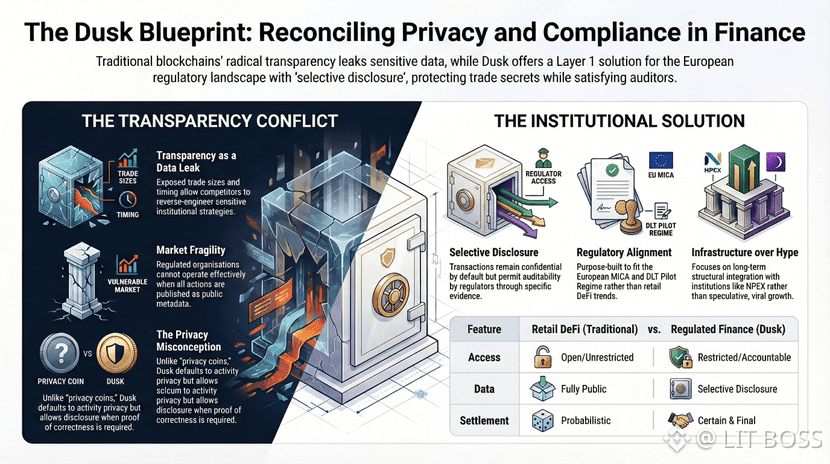
The Transparency Conflict
Transparency as a Data Leak: Exposed trade sizes and timing allow competitors to reverse-engineer sensitive institutional strategies. In traditional finance, this information is carefully guarded; on public blockchains, it’s a free data feed for anyone watching.
Market Fragility: Regulated organizations cannot act effectively when all actions are published as public metadata. Real-time transparency of institutional moves creates front-running opportunities and undermines strategic execution.
The Privacy Misconception: Unlike “privacy coins,” Dusk defaults to activity privacy but allows selective activity privacy disclosure when proof of correctness is required. This isn’t hiding transactions—it’s controlling who sees what, when.
The Institutional Solution
Selective Disclosure: Transactions remain confidential by default but permit auditability by regulators through specific evidence. Privacy for the market, transparency for compliance—the best of both worlds.
Regulatory Alignment: Purpose-built to fit the European MiCA and DLT Pilot Regime rather than chasing retail DeFi trends. Dusk recognizes that institutional adoption requires regulatory compatibility from day one, not as an afterthought.
Infrastructure over Hype: Focuses on long-term structural integration with institutions like NPEX rather than speculative, viral growth. Building real financial infrastructure takes years of unglamorous work—Dusk is playing the long game.
The Key Distinctions
Retail DeFi (Traditional) vs. Regulated Finance (Dusk)
- Access: Open/Unrestricted vs. Restricted/Accountable
- Data: Fully Public vs. Selective Disclosure
- Settlement: Probabilistic vs. Certain & Final
These aren’t minor differences—they represent fundamentally different design philosophies. Traditional DeFi optimizes for permissionless access; Dusk optimizes for institutional requirements.
Why This Matters
The financial industry won’t adopt blockchain if it means broadcasting proprietary strategies to competitors. No institution will tokenize assets on infrastructure where every transaction, wallet balance, and trading pattern is public knowledge.
Dusk recognizes that privacy isn’t the opposite of compliance—it’s a prerequisite for institutional adoption. Regulators need auditability, not radical transparency. There’s a massive difference between “regulators can see everything when needed” and “everyone can see everything always.”
The selective disclosure model threads the needle: privacy by default, transparency on demand. It’s the architecture that lets blockchain move beyond retail speculation into actual financial infrastructure. Not because it’s more decentralized or faster or cheaper, but because it solves the actual problem preventing institutional adoption.
In a space where “privacy” often means “hiding from regulators,” Dusk’s approach—privacy that enables compliance—might be the unlock regulated finance has been waiting for.
