iShares Silver ETF (SLV) saw a single-day trading volume surge to $39.666 billion, directly surpassing Nvidia ($23 billion) and Tesla ($22 billion) on the same day, marking the formation of a 'silver storm' sweeping through traditional finance and the crypto sphere. After doubling in price in 2025, silver has sparked another frenzy in January 2026, with an increase approaching 60%. The London spot silver price once broke through $110 per ounce, just a step away from the largest monthly increase since 1979.
While retail investors flock to chase the rise of SLV, proclaiming 'the silver bull market never stops,' crypto investors should see through the essence of the frenzy: this is a structural collapse of the traditional physical asset investment system, and the popularity of SLV is merely a passive result of having 'no better choice.' In the crypto market, the real wealth opportunity is not in chasing traditional assets that have already doubled, but in the RWA (Real World Asset Tokenization) revolution led by Vanar Chain — it breaks the shackles of traditional ETFs using Web3 technology, opening up new value capture paths for crypto users.
This silver rush is by no means a simple capital speculation, but an inevitable resonance of three major logics: supply and demand, macroeconomics, and capital. On the supply and demand side, the gap continues to widen, becoming the core driving force: data from the World Silver Association shows that the global silver gap will reach 3,200 tons in 2025 and is expected to increase to 4,500 tons in 2026 (accounting for 15% of global annual demand). Only 24,600 tons of silver are left in London, with 83% locked up by ETFs, making physical silver 'hard to come by'. On the macroeconomic front, the weakening dollar and rising expectations of interest rate cuts by the Federal Reserve, combined with geopolitical risks, maximize silver's safe-haven attributes. On the capital side, the CME's margin increase forces retail investors to turn to ETFs, with SLV as the only capital outlet, which precisely exposes the limitations of traditional tools.
The frenzy in the market most vividly reflects the flaws, and the three major traps of traditional physical asset investment are precisely the pain points that Vanar Chain aims to disrupt. The first is premium harvesting and liquidity shackles: last December, due to off-market purchase restrictions, the on-market premium rate of Guotou Silver LOF soared to 70%. After arbitrage funds sold off, it fell continuously, leaving retail investors trapped. SLV also hides risks, with a turnover rate of 68.88% on January 26, intraday volatility exceeding 9%, and those chasing highs suffered nearly 10% losses in a single day. The T+2 settlement made retail investors miss the opportunity to stop losses, and the so-called 'risk-free arbitrage' is actually a harvesting scheme.
The second issue is the virtualization of ownership and delivery challenges. Buying SLV only provides fund shares, with no way to redeem physical silver, and investors must bear the risk of divergence between net value and spot prices. The long-term underperformance of Guotou Silver LOF compared to futures serves as evidence. More critically, SLV's physical reserves are concentrated in a few vaults, and a bank run or storage risk could lead to total loss. This 'nominal holding' model leaves investors bearing risks while enjoying minimal returns, completely contrary to the 'asset autonomy' pursued in the crypto market.
The third issue is the threshold and functional barriers. The margin for silver futures exceeds 10,000 yuan; while SLV lowers the threshold, it cannot be used for collateral financing, splitting, or transferring, and lacks cross-market circulation capability, which forces investors to passively buy and sell in the face of volatility. This stands in stark contrast to the flexible nature of the crypto market, which Vanar Chain is precisely filling.
As a native Web3 AI infrastructure, Vanar Chain redefines the investment logic of physical assets through technology, precisely addressing the three major traps. Its decentralized tokenization scheme maps silver 1:1 into on-chain tokens, with each token corresponding to sufficient physical reserves. The reserve information is traceable on-chain, giving investors real ownership, allowing for long-term holding and appreciation, and enabling them to apply for physical delivery at any time, completely breaking the trust black box. More critically, small fragmented investments allow participation with just a few hundred yuan, perfectly meeting the needs of retail crypto investors.
Vanar Chain's cross-chain capabilities and smart contract features have made physical asset tokens 'live'. Through the Neutron semantic compression layer and the ecological linkage of Stargate and LayerZero, silver tokens can flow freely across mainstream chains like Ethereum and BSC, with 24-hour trading and T+0 settlement, completely breaking the time and space limitations of traditional ETFs. With the Kayon on-chain reasoning engine, tokens can also be staked for yield, used as collateral for loans, or participate in on-chain derivatives trading to hedge risks, achieving 'holding equals appreciation', an advantage that SLV cannot reach.
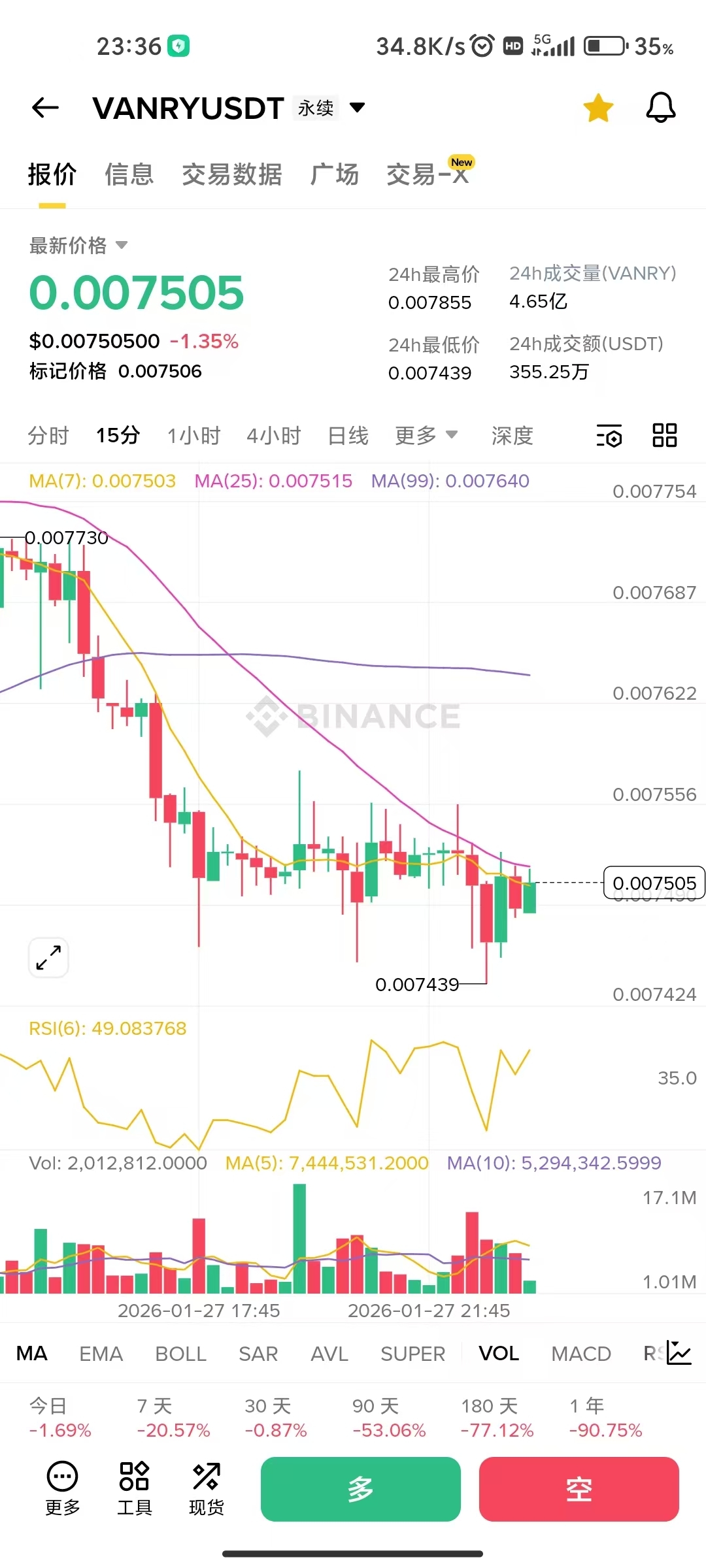
Vanar Chain has also achieved bidirectional adaptation between institutions and retail investors: institutions can reduce slippage through large transaction modules, and smart contracts automatically liquidate to avoid net value shocks; retail investors can enjoy RWA dividends at low thresholds, no longer being harvested by premiums and purchase limits. Data does not lie; the trading volume of physical asset tokens within its ecosystem has increased by more than 50% month-on-month for three consecutive months, with the VANRY token achieving a 24-hour maximum increase of 18.52% and a transaction volume of 48.3 million USD, indicating that institutional funds are accelerating their layout.
For cryptocurrency investors, this silver frenzy is an important revelation: traditional financial tools are already outdated, and Vanar Chain has restructured the rules of the game with technology. The silver bull market will eventually have corrections, but the explosion of the RWA track has just begun. From precious metals to bulk commodities, the on-chainization of physical assets is an irreversible trend. Instead of chasing risky SLV, it’s better to invest in core infrastructures like Vanar Chain—it connects Web2 and Web3, with an ecosystem covering diverse scenarios like gaming and the metaverse, and user activity has increased by 70% annually. The future is here; positioning early in core RWA targets is the only way to capture the next wave of wealth!