


For years, the race among Layer 1 blockchains has revolved around transaction speed. Higher TPS (transactions per second) was considered the ultimate benchmark of superiority. Yet as Web3 matures, fueled by artificial intelligence and tokenized real-world assets, the old metrics are proving insufficient. Vanar Chain highlights a new truth: raw speed alone is not only inadequate but potentially counterproductive when intelligence, privacy, and verifiable data integrity are absent.
Vanar Chain is the first AI-native Layer 1 blockchain built from the ground up to serve the emerging “Intelligence Economy.” Its vision goes beyond simple transaction throughput, providing an entire stack that allows data to be understood semantically, handled privately, and acted upon intelligently. In this ecosystem, TPS matters far less than the ability to process sensitive, high-value information in a secure and compliant way.
At the heart of Vanar’s innovation is its five-layer AI-native architecture. This stack transforms Web3 applications from static smart contracts into living systems capable of reasoning, automation, and decision-making.
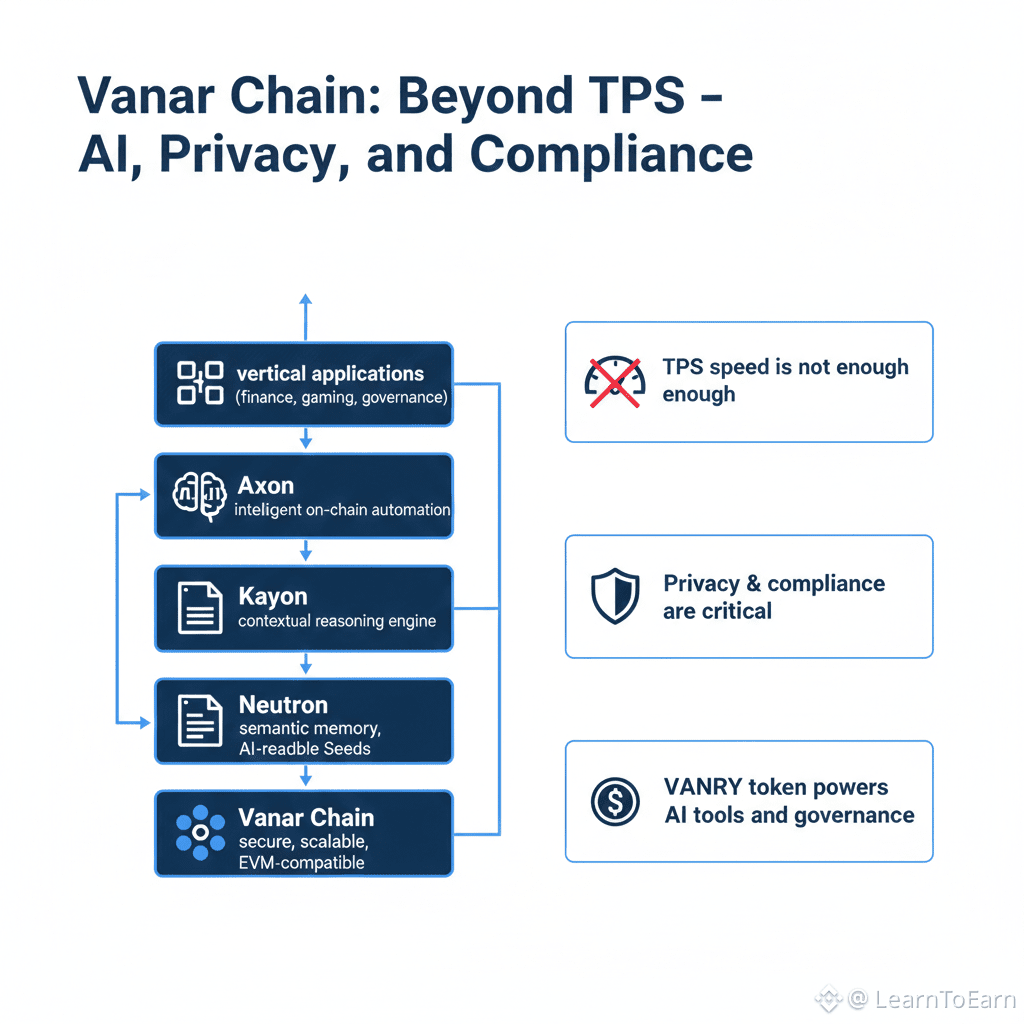
The base layer, Vanar Chain itself, offers a secure, scalable, and EVM-compatible foundation. Unlike other blockchains that simply execute transactions, Vanar integrates AI-optimized consensus and built-in support for semantic data structures. On top of this, Neutron serves as the semantic memory layer, converting raw data into AI-readable “Seeds” that preserve context, meaning, and legal or financial proof directly on-chain. Kayon, the contextual reasoning engine, allows natural language queries across blockchain and enterprise data, delivering predictive insights while ensuring compliance. Axon automates intelligent on-chain actions, enabling AI models to respond without relying on external oracles. Finally, Flows delivers pre-built vertical applications for sectors like finance, gaming, and governance, proving that AI intelligence can drive safe, automated business outcomes.
The real breakthrough lies in Vanar’s seamless integration of AI, privacy, and compliance. While many projects attempt to retrofit AI onto existing infrastructure, they encounter fragmented data and slow inference. Vanar’s native approach ensures that intelligence, verification, and settlement coexist in a single, efficient process. This is crucial for sensitive enterprise or personal data, which cannot simply exist on transparent ledgers. AI systems need selective disclosure, lawful confidentiality, and verifiable reasoning.
myNeutron demonstrates that semantic memory can live at the infrastructure layer, compressing documents like invoices or deeds into private Seeds that AI can read without exposing the raw data. Kayon proves that reasoning and explainability can also exist on-chain, answering complex queries—such as which wallets require EU AML reporting—privately and audibly. For institutions, this compliance-by-design approach is vital. It transforms pilot projects into scalable, secure adoption pathways by allowing verification without compromising sensitive information.
The VANRY token fuels this intelligent ecosystem. Beyond serving as gas for transactions and enabling staking and governance, it is directly tied to real economic activity. Advanced AI tools like Kayon will require VANARY for access, creating demand aligned with actual usage. Cross-chain expansion, beginning with Base, further increases VANRY’s utility, allowing AI agents to manage compliant payments and assets across multiple ecosystems.
The broader lesson for new Layer 1 blockchains is clear: infrastructure alone is no longer enough. High TPS is meaningless if a chain cannot handle real-world intelligence, maintain privacy, and enforce compliance. Vanar’s live products—myNeutron, Kayon, and Flows—demonstrate that this AI-native stack is operational today, not just a future roadmap.
As 2026 unfolds, the convergence of AI, blockchain, and payments will define success. In this landscape, chains that merely prioritize speed will be obsolete. The true winners will be those capable of thinking, verifying, and transacting natively—securely, privately, and intelligently. Vanar Chain is already leading this shift, proving that in the new era, TPS alone cannot guarantee relevance.
Vanar Chain’s Architecture for Isolated AI Contexts: The Foundation for Private, Intelligent Web3
In the era of artificial intelligence, context is everything. An AI’s power comes not just from sophisticated algorithms, but from the specific, relevant data it can access and interpret. On a blockchain, this requirement presents a unique challenge. Handling sensitive enterprise data, personal information, or proprietary financial logic cannot rely on a single, fully transparent ledger. Doing so risks privacy breaches, compliance violations, and operational noise. Vanar Chain addresses this challenge head-on, introducing a new paradigm of isolated, secure, and semantically rich data pods that enable intelligent Web3 applications without compromising confidentiality.
Traditional blockchains were designed for universal verifiability. Once data is written, every node and user can see it. While perfect for cryptocurrency transfers, this transparency is disastrous for AI applications requiring privacy, regulatory compliance, or operational isolation. Sensitive information cannot be processed safely on-chain; all applications share a global state, increasing risk; and raw data is stored without semantic meaning, leaving AI models with limited ability to reason or infer.
Vanar Chain solves these problems with a revolutionary approach centered on Neutron and the concept of “Seeds.” Neutron, the semantic memory layer, does more than store data—it transforms documents, transactions, and other inputs into compressed, AI-readable knowledge pods called Seeds. Each Seed is a private, queryable representation of information, retaining meaning, context, and legal or financial proof, while remaining isolated from other applications and users.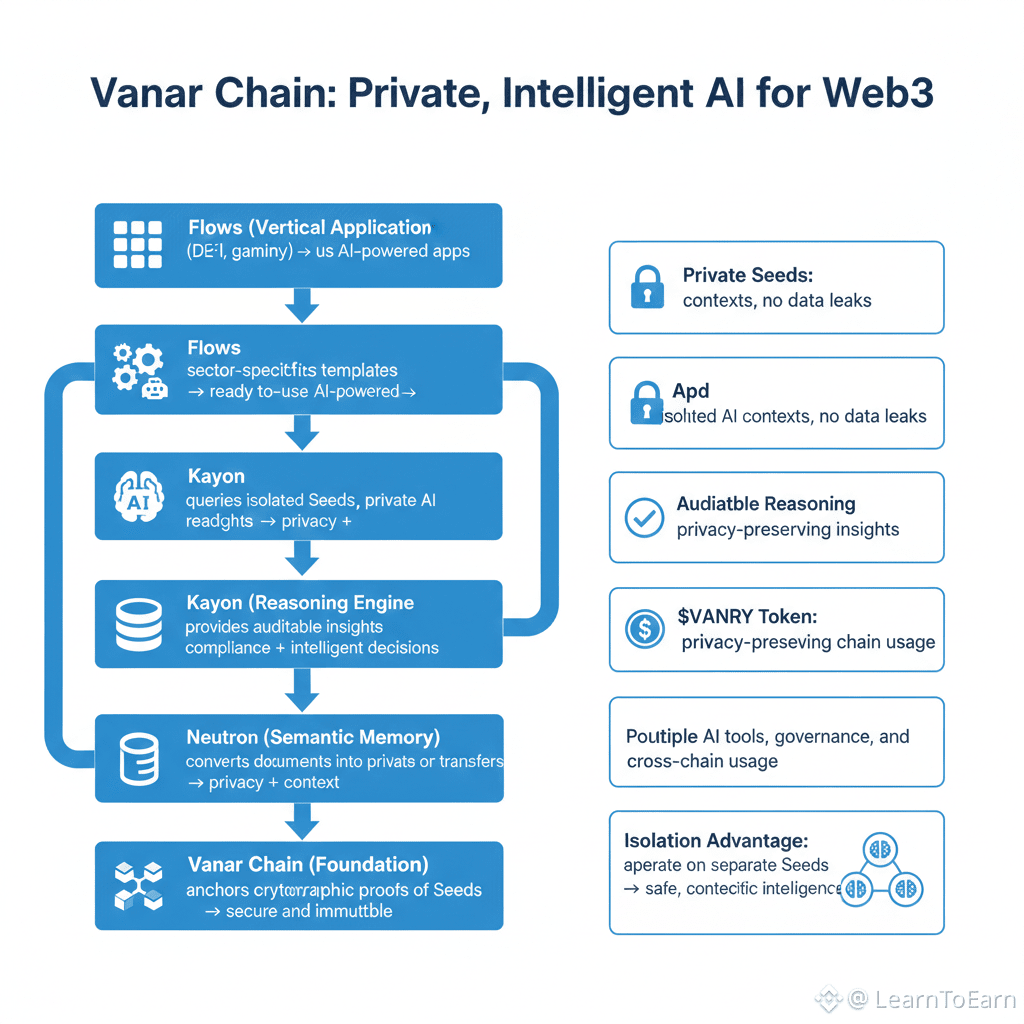
The process begins with private ingestion: a user or enterprise uploads a document—an invoice, contract, KYC form, or digital asset record—into Neutron. Next, semantic compression and encryption extract key entities, relationships, and meaning, creating a structured representation of the data. This Seed is encrypted and stored with a unique access key. On-chain, only a cryptographic proof—a hash—anchors the Seed to Vanar’s immutable Layer 1, verifying its existence without exposing the raw content. When an AI agent such as Kayon needs to reason over this data, it receives permissioned access to the specific Seed. It can answer complex questions like “Does this transaction require an AML flag?” or “What is the termination clause in this contract?”—all while preserving the privacy of the underlying information.
This approach creates a powerful isolation mechanism. Each Seed is a self-contained private context. An AI analyzing corporate financial data accesses one set of Seeds, while an AI managing a gaming ecosystem accesses a completely separate, isolated set. Contexts do not leak, merge, or contaminate one another, enabling precise, secure, and compliant intelligence across multiple domains.
Vanar Chain’s full-stack architecture makes this isolation practical and actionable. The Layer 1 foundation anchors all proofs, providing tamper-resistant validation without exposing data. Neutron manages private Seed pods, ensuring AI agents only access permitted information. Kayon operates within granted contexts, pulling only relevant data and delivering insights that are both auditable and privacy-preserving. Axon executes intelligent automations, triggering actions such as compliant payments or asset transfers based on isolated reasoning. Flows offers pre-built templates for sectors like DeFi, gaming, or loyalty programs, allowing developers to deploy AI-driven applications with isolated contexts by default.
The real-world impact of this architecture is already evident. myNeutron enables users to upload documents and create private, queryable Seeds, proving persistent AI context can exist at the infrastructure layer. Kayon for compliance allows enterprises to analyze wallets and transactions within regulated contexts, generating auditable answers without revealing sensitive data. In gaming and metaverse environments like Virtua, AI agents maintain isolated knowledge of individual player inventories, achievements, and trades, enabling personalized experiences and secure asset management.
The $VANRY token fuels this ecosystem of isolated intelligence. Using Neutron and Kayon at scale requires $VANRY, linking token demand directly to private AI usage. Governance decisions for data access, private context management, and network evolution are also tied to $VANRY. As Vanar expands to other chains like Base, the token enables cross-chain queries and actions while preserving context isolation.
Vanar Chain demonstrates a critical insight: AI cannot thrive on a public stage. It requires private rooms—isolated, secure contexts where it can process confidential data and produce actionable insights. By building this capability natively with Neutron and Kayon, Vanar is not simply adding AI features; it is laying the infrastructure for the next generation of applications: compliant enterprise AI agents, private DeFi systems, and personalized user experiences. In the emerging Web3 intelligence economy, privacy and context are not optional—they are the foundation of value, and the chains that understand this will define the future.
Privacy Risks of Retrofitting AI Onto Legacy L1s: Why AI-First Architecture Is Non-Negotiable
The race to integrate artificial intelligence into blockchain is accelerating at unprecedented speed. A common trend sees legacy Layer 1 (L1) blockchains attempting to retrofit AI onto infrastructures originally designed for transparent, atomic value transfers. While this approach may seem pragmatic, it introduces serious, often underestimated privacy and security risks that threaten the very feasibility of AI on-chain. In contrast, AI-native chains like Vanar demonstrate that designing for intelligence from day one is not a feature—it is a foundational necessity.
At the heart of the problem is a fundamental conflict: transparent ledgers versus private intelligence. Legacy L1s such as Ethereum, Solana, and Avalanche were engineered for global state transparency. Every transaction, smart contract interaction, and data update is publicly verifiable. While this is a strength for decentralized finance (DeFi) and NFTs, it becomes a critical liability for AI applications, which must process sensitive, private, and proprietary data.
Retrofitting AI onto these chains typically falls into one of three flawed patterns. The first is the Oracle Model, where AI computation occurs off-chain in a “black box,” with only inputs and final results posted on-chain. This sacrifices verifiability and trustlessness, undermining blockchain’s core principles. The second, the On-Chain Leak Model, attempts to run AI directly on transparent data, exposing all training data, model weights, and user queries. The third, the Fragmented Layer 2 Model, pushes AI computations to separate privacy layers, creating complex, often insecure bridges between public settlement layers and private computation layers. Each introduces architectural mismatches and exploitable gaps.
The privacy risks of retrofitting are severe. Data provenance leakage occurs when AI agents access off-chain data via oracles or APIs. Patterns of data requests, even without exposing content, can reveal sensitive operational intent, corporate strategies, or user behavior. Inferred privacy breaches are another concern: analyzing gas costs, transaction timing, and interaction sequences on a public ledger allows adversaries to reverse-engineer private data. The so-called “Consensus Privacy Gap” arises because legacy L1s have no native mechanism for validating private computations. Off-chain AI results can only be accepted or rejected based on signatures, reintroducing a trusted third-party problem. Finally, adding privacy layers or AI coprocessors creates fragmented security models, where the system is only as strong as its weakest link—often the custom bridge connecting private AI modules to the public chain.
Vanar Chain provides an alternative. Its AI-native architecture embeds privacy and intelligence at the foundational level, avoiding the vulnerabilities of retrofit approaches. Sensitive data is transformed into encrypted, structured “Seeds” by Neutron. Only minimal cryptographic proofs anchor on-chain, while AI reasoning occurs in isolated, permissioned contexts via Kayon. Context isolation ensures each application, user, or enterprise operates within its own semantic environment, eliminating cross-context leakage. Compliance-by-design is built directly into Flows, with pre-configured rules for regulatory standards, data sovereignty, and governance.
Live products demonstrate the power of this approach. myNeutron allows a user to upload a private document, generating a Seed that Kayon can query—for instance, calculating the total amount on an invoice—without ever exposing the underlying data on-chain. Such secure, auditable functionality is impossible to achieve safely on retrofitted chains without introducing significant trust assumptions.
The $VANRY token fuels this architecture. It powers private data operations in Neutron, governs access for secure AI reasoning in Kayon, and derives demand directly from economic activity in real private AI contexts—from enterprise compliance and confidential asset management to personalized gaming experiences. Its value is aligned with utility, not speculation.
The lesson is clear: retrofitting AI onto legacy L1s is a fundamental architectural mismatch. Attempting to force private, context-heavy intelligence onto public, context-agnostic ledgers results in unacceptable privacy risks and security compromises. The next wave of Web3 adoption—driven by enterprises, regulated institutions, and mainstream users demanding data control—will require AI-native infrastructure. Chains that think, reason, and act without exposing sensitive data will define the future. Retrofitted chains will struggle under the weight of their legacy constraints.
