
Bitcoin is approaching an important macroeconomic event against the backdrop of rushed attempts by American lawmakers to prevent another shutdown of the U.S. government before the funding deadline of January 30. The market is currently under pressure: the January rally failed, and participant sentiment has noticeably worsened.
Historically, Bitcoin has not proven to be a reliable safe-haven asset during U.S. government shutdowns. Typically, its price continued to follow the already established overall market trend.
Where the new shutdown threat comes from.
The risk of a new shutdown arose after Congress failed to approve several budget bills for the 2026 fiscal year. Temporary funding ends on January 30, and negotiations have stalled – particularly acute is the issue of funding for the Department of Homeland Security.
If lawmakers do not pass either a new temporary budget or a full annual package before the deadline, some federal agencies will immediately begin to suspend operations. Currently, markets perceive January 30 as a key macro event with a dual outcome.
The price dynamics of Bitcoin in January 2026 have already reflected increasing instability. After attempting to break into the $95,000–$98,000 range in the middle of the month, BTC could not maintain its height and sharply corrected downwards.
The history of shutdowns repeats itself.
An analysis of Bitcoin's price dynamics against the backdrop of previous U.S. shutdowns does not confirm an optimistic scenario for the market.
Over the past ten years, in four episodes of government shutdowns, Bitcoin either fell or continued its already initiated decline in three cases.

Only one shutdown, a brief pause in funding in February 2018, coincided with a rise. At that time, the increase was more related to a technical rebound after oversold conditions rather than a reaction to events in the U.S.
Overall, the trend remains the same. Such events usually provoke spikes in volatility but do not change the main direction of movement. Bitcoin typically reinforces the current trend rather than reversing it.
Miner data indicates tension.
Fresh on-chain data heightens investor caution. According to CryptoQuant, several large American mining companies have sharply reduced Bitcoin production in recent days. Winter storms and power supply restrictions have affected equipment operations.
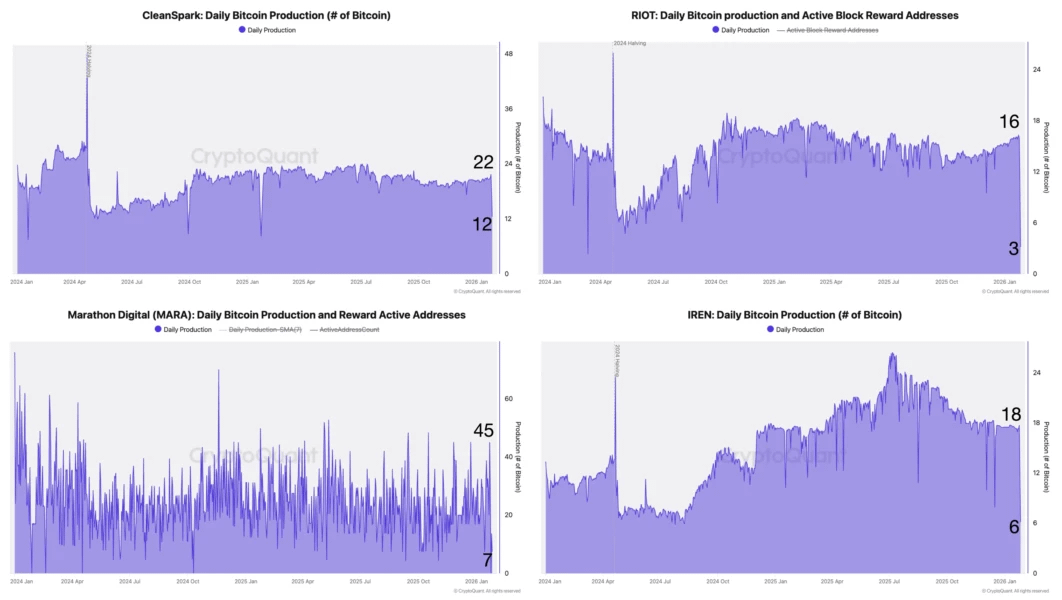
Daily production volumes have significantly decreased for companies such as CleanSpark, Riot Platforms, Marathon Digital, and IREN. While the reduction in production temporarily alleviates selling pressure, it also indicates tension in the mining industry.
Throughout Bitcoin's history, restrictions on the miner side have rarely compensated for large macroeconomic sell-offs if demand remained weak. Currently, there are no significant signs of demand revival in the market.
Fixed losses in cryptocurrencies continue to grow.
Net Realized Profit and Loss (NRPL) data also indicates cautious sentiment among market participants. In recent weeks, a rise in realized losses has been recorded, while large waves of profit-taking, as seen in early 2025, are almost absent.
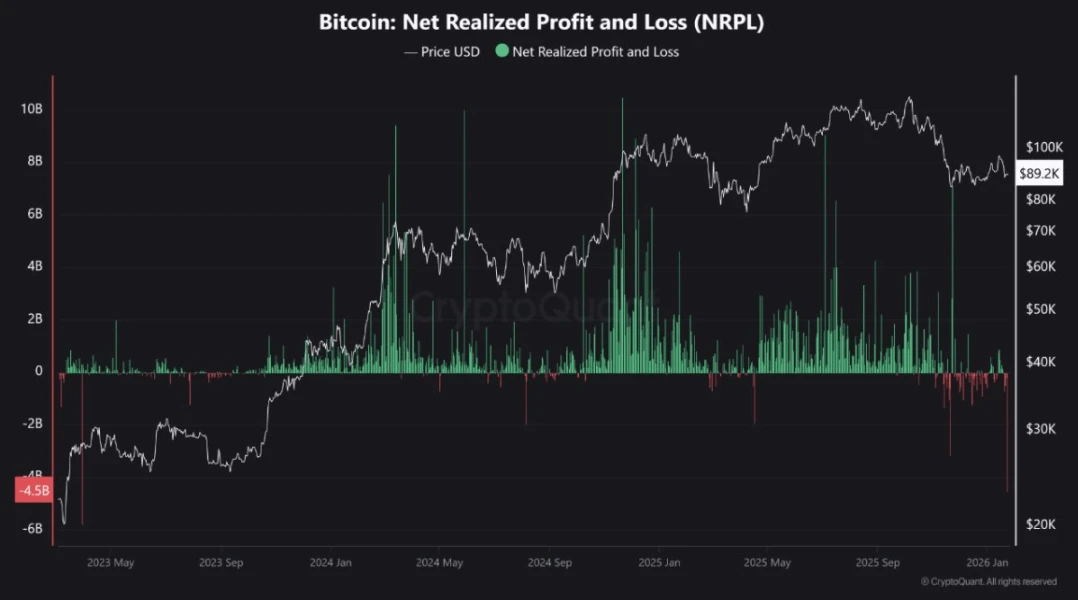
The dynamics show that investors are exiting positions at unfavorable prices, hesitating to reallocate capital. Such behavior is typical for the late phases of the market cycle, when distribution and risk reduction occur rather than asset accumulation.
In such conditions, negative macroeconomic news only amplifies volatility during declines, rather than becoming a catalyst for sustained rallies.
How Bitcoin may react on January 30.
If a shutdown begins in the U.S. on January 30, Bitcoin is likely to behave like a risky asset rather than a safe haven.
In such a situation, a short-term spike in volatility aimed at decline is most likely. Breaking local January lows corresponds to market dynamics during past shutdowns and the current market structure. A rebound, if it occurs, is unlikely to last long unless there is an influx of liquidity.
A strong rise in Bitcoin only against the backdrop of a shutdown discussion seems unlikely. Previously, Bitcoin rarely showed stable growth during shutdowns without simultaneous capital inflow and a change in market sentiment – this is not currently observed.
Currently, Bitcoin approaches the risk of a shutdown without relying on strong positions. Outflows from ETFs, a rise in realized losses, tension among miners, and unsuccessful attempts to break resistance create cautious expectations.
With January 30 approaching, the threat of a shutdown may become a stress test for already fragile market confidence.
So far, history and data show that Bitcoin is repeating an already established trend rather than going against it.
