

If we explain the Walrus Protocol in simple words, it is not just a decentralized storage network. It is a system that aims to make data genuinely usable for Web3 and AI applications. Built on the Sui blockchain, the focus of Walrus is not only to store data but also to enable verification, programmability, and to become an active part of the logic of real applications.
In traditional cloud storage, data is under the control of a centralized provider. Walrus breaks this model. Here, data is distributed across multiple independent nodes in the network, which improves availability and almost eliminates the risk of a single point of failure. Even if some nodes go offline, the data remains recoverable. This approach strengthens both censorship resistance and long-term reliability.
One important difference of Walrus is that it is designed for large data. Videos, images, AI datasets, training files — things that are typically heavy for decentralized systems — are efficiently handled as a core part of Walrus's architecture. By using advanced encoding and redundancy techniques, the protocol ensures that data remains usable even after being fragmented.
However, Walrus is not limited to storage. Here, stored data is treated like on-chain programmable objects. This means that smart contracts and decentralized apps can interact directly with the data. Data does not remain just a 'thing to upload and forget', but becomes a part of the application logic. This feature is quite important for data-driven dApps, AI workflows, and composable Web3 systems.
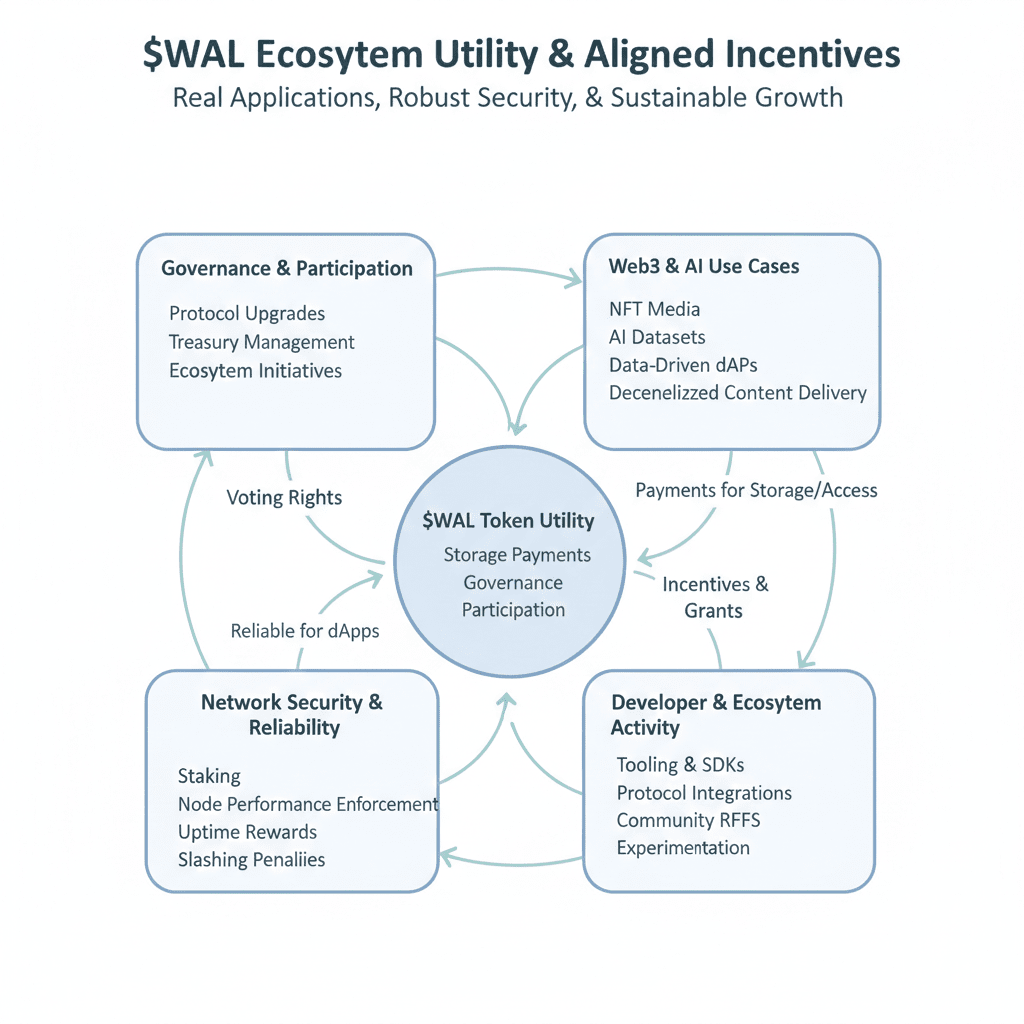
This entire ecosystem is powered by the native token $WAL. The role of WAL is not limited to trading or speculation. It is actively used in storage payments, staking, network security, and governance. Users pay for storage through WAL, node operators and delegators earn rewards for keeping the network secure, and token holders can participate in protocol decisions. If a node does not perform according to network standards, penalties are also applied, which helps maintain overall network health.
When it comes to use cases, the scope of Walrus is quite wide. NFT media assets, AI training datasets, decentralized content delivery, identity-related data, and high-volume Web3 applications — the storage layer of Walrus can fit everywhere. The integration of Sui blockchain's fast finality and performance also makes Walrus relevant for enterprise-grade use cases.
There are also visible movements on the ecosystem side. Developers are actively experimenting with Walrus's tools, integrations are being built, and community-driven initiatives like RFP programs are pushing ecosystem growth. These signals indicate that Walrus is not just a whitepaper idea, but is moving towards a working infrastructure layer.
Final Thought
The core idea of the Walrus Protocol is simple, but its execution is ambitious. It aims to transform data into a programmable, verifiable, and reliable asset for Web3 and AI, rather than just a passive resource. The $WAL token is the economic glue of this system, aligning incentives, security, and governance. If Web3 is to handle data at real-world scale, infrastructure layers like Walrus could play an important role in the future stack.

