
Leverage allows you to trade amounts that significantly exceed your own capital. It looks tempting: 'Why trade on $100 if with 10x leverage you can trade on $1000?'. But leverage is not free money; it is a tool that proportionally brings you closer to losing everything.
What is leverage?
This is a loan provided by the exchange against your capital (margin). If you use 10x leverage, then every 1% price movement gives you a 10% profit or a 10% loss.
Real example: Why a 20x leverage is like playing 'Russian roulette'?
Let's say you buy Bitcoin ($BTC ) at a price of $100,000, having your own $1,000.
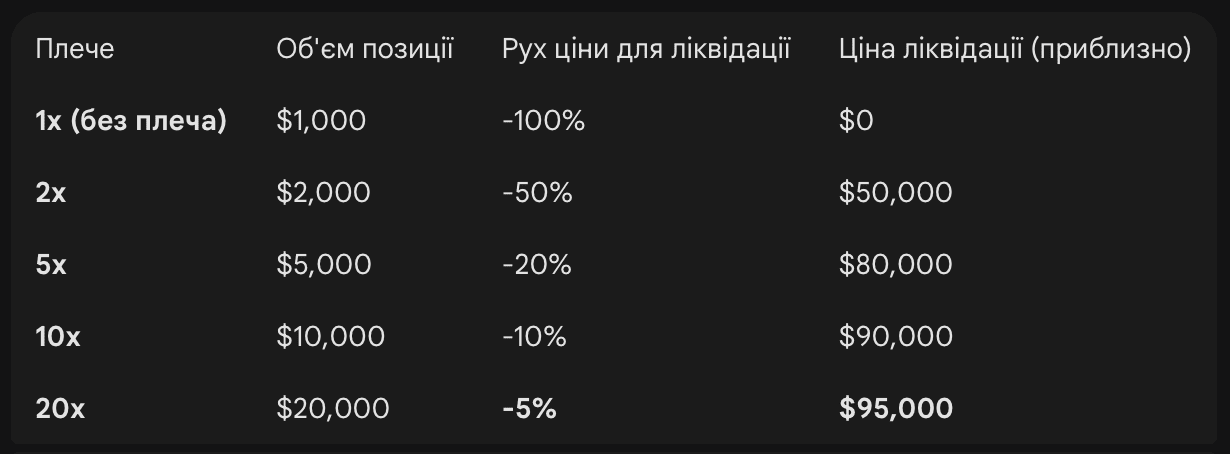
What’s the trap? In the crypto market, a daily price fluctuation (volatility) of 5% is common. With 20x leverage, even random market 'noise' or a small correction can instantly wipe out your position, even if later the price moves in your desired direction.
Liquidation price formula (simplified):

Expert advice
Leverage does not change your risk; it changes your flexibility. Professionals use leverage solely to avoid keeping all their capital on the exchange, not to increase the risk per trade beyond the established 1%.
Avoid high leverage. For beginners, safe leverage is considered to be 3x–5x. Anything above 10x turns trading into a casino due to the high probability of liquidation from random movements.
Isolated vs Cross margin. Beginners should use isolated margin so that in case of a mistake, they only lose the allocated amount for the trade, not the entire wallet balance.
Conclusion
Leverage is like a sharp scalpel: in the hands of a surgeon, it saves lives; in the hands of a child, it leads to tragedy. Use it wisely, not impulsively.
Want to understand how your emotions are manipulated during trading? Subscribe to my channel @MoonMan567 ! In the final post of our series, we will discuss psychology: FOMO, tilt, and how to learn to stick to the rules when your heart races from the charts.
Disclaimer
The conclusion about the danger of 5% fluctuations is based on the historical volatility of cryptocurrencies.
Assumptions about professional strategies are based on common risk management practices.
The choice between Cross and Isolated margin depends on the specific strategy and the trader's experience.
