


As blockchain technology enters its next evolutionary phase, artificial intelligence is no longer a passive tool operating at the edge of decentralized systems. Autonomous AI agents are rapidly becoming first-class economic actors—entities capable of making decisions, executing transactions, and coordinating complex workflows on their own. These agents often require access to highly sensitive data, from financial records to personal identity information. This shift fundamentally changes the infrastructure requirements of blockchain networks. Privacy, intelligence, and security are no longer optional enhancements; they are core necessities. Vanar Chain is designed specifically for this future, and at the heart of its architecture lies the VANRY token, which transforms private AI execution from a technical concept into a secure, economically aligned, and governable system.
Vanar Chain is not a general-purpose blockchain retrofitted with AI features. It is a fully AI-native Layer 1, engineered from the ground up to support intelligent applications that can reason, remember, and act autonomously. Its architecture is built as an integrated stack where each layer addresses a critical requirement for AI agents operating in real-world environments.
At the base sits Vanar Chain itself, a modular and high-throughput Layer 1 that provides scalability, security, and composability. Above this foundation is Neutron, a semantic memory layer that converts raw data—such as documents, transaction histories, or invoices—into compressed, verifiable cryptographic objects known as Seeds. These Seeds allow AI agents to reference and prove the existence and integrity of data without revealing the underlying information, enabling true privacy-preserving memory.
Kayon builds on this memory layer by introducing contextual reasoning. It is an on-chain AI engine that allows smart contracts and agents to query Neutron Seeds and make informed decisions based on private context. Instead of executing blind logic, AI agents can now reason over protected data while remaining fully verifiable. Axon then takes these decisions and translates them into automated execution, handling workflows such as payments, compliance checks, or asset reallocation. At the top of the stack are Flows—industry-specific applications tailored for sectors like compliant finance, tokenized assets, and enterprise automation.
This sophisticated AI-native infrastructure is animated and secured by the VANRY token, whose role extends far beyond that of a simple transaction fee asset. VANRY functions simultaneously as computational fuel, a security bond, and a governance instrument, forming the economic backbone of private AI execution on Vanar Chain.
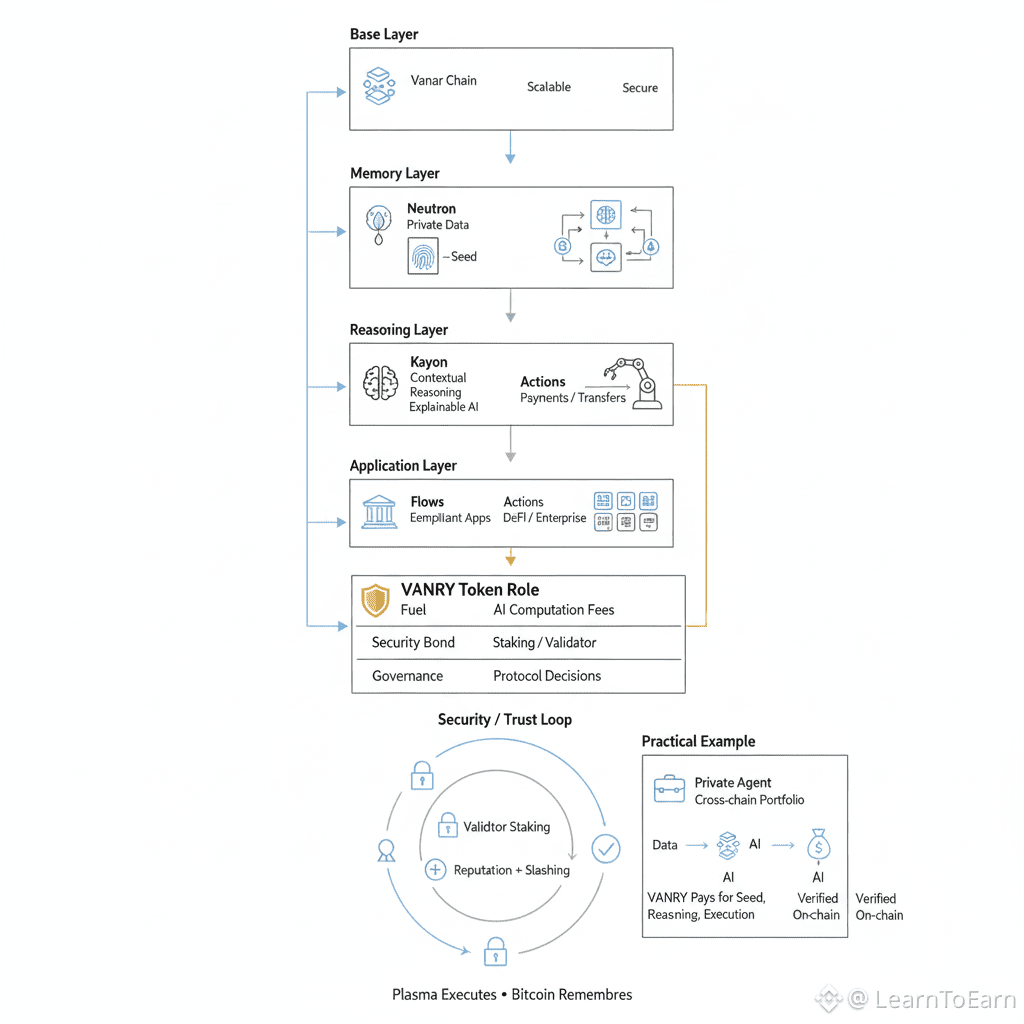
Every operation performed within Vanar’s private AI environment consumes network resources, and these resources are priced in VANRY. When a Neutron Seed is created to anchor private data on-chain, VANRY is required. When an AI agent queries Kayon to reason over private context, VANRY is consumed. When Axon executes an automated action—such as a compliant payment or asset transfer—fees are paid in VANRY. This directly links token demand to real AI activity rather than speculative usage, creating an economic model where value accrues from genuine computational utility.
Security is reinforced through a hybrid consensus mechanism that places VANRY staking at its core. Vanar combines Proof of Authority and Delegated Proof of Stake under a Proof of Reputation framework. Validators are selected by the Vanar Foundation based on their real-world and Web3 reputation, ensuring that known and trusted entities are responsible for securing the network. Token holders can stake their VANRY to these validators, delegating trust while strengthening network resilience.
This staking model aligns incentives across the ecosystem. Validators and delegators earn rewards for honest participation, while malicious behavior results in slashing, where staked tokens are forfeited. This makes attacks economically irrational and is particularly critical for private AI execution, where validators may process sensitive proofs and confidential computation results. Reputation-backed validation combined with economic penalties ensures that integrity is not just encouraged but enforced.
Beyond utility and security, VANRY also serves as the governance key for the ecosystem. Token holders can participate in decisions that shape the protocol’s future, including upgrades to the AI layers responsible for handling private data. As advanced AI tools, enterprise features, and subscription-based services are introduced on Vanar, VANRY is positioned to become the access token for these capabilities. Its value is therefore designed to grow alongside real-world adoption rather than short-term market narratives.
A practical example illustrates this dynamic clearly. Consider a private financial AI agent managing a user’s cross-chain DeFi portfolio. The user grants the agent access to encrypted portfolio data, which is converted into a Neutron Seed that proves ownership and structure without revealing balances. The creation of this Seed is paid for in VANRY. The agent then queries Kayon to evaluate market conditions against the user’s private risk profile, with computation again settled in VANRY. Once a strategy is approved, Axon executes the rebalancing trades across decentralized exchanges, with transaction fees paid in VANRY. Throughout this process, validation is handled by reputation-backed nodes secured through staked VANRY, ensuring tamper-proof execution without exposing sensitive information.
In this flow, privacy is preserved, intelligence is verifiable, and security is economically enforced—all through a single integrated token system.
For autonomous AI to transition from experimental deployments to mainstream economic infrastructure, trust must be absolute. Users, enterprises, and regulators need guarantees that private data remains confidential, that decisions are auditable, and that execution cannot be manipulated. Vanar Chain provides the technical architecture to meet these demands, but it is VANRY that activates and secures the system as a living economy.
VANRY functions as the fuel that powers private intelligence, the bond that secures a reputation-based network, and the governance key that shapes the ecosystem’s evolution. In a landscape crowded with blockchains that offer little more than empty throughput, Vanar and VANRY stand out by delivering concrete utility. They represent not speculative AI hype, but foundational infrastructure for a future where intelligent, private, and autonomous systems operate securely at global scale.
Vanar Chain’s Privacy-First Design for Autonomous Agents
As autonomous AI agents emerge as a defining force in the digital landscape, a critical limitation in most existing blockchain platforms becomes immediately apparent. Public ledgers, by design, expose every transaction and decision, making them fundamentally incompatible with the discreet, intelligent operations required by autonomous agents. For these agents to be genuinely useful—managing personal finances, negotiating confidential business contracts, or acting as a sovereign digital extension of a user—they must operate with access to sensitive data and execute logic privately. Exposing every decision and data point on a public blockchain is not only impractical but introduces serious security and compliance risks. Vanar Chain confronts this challenge directly. Built from the ground up as an AI-native infrastructure stack, it offers a privacy-first architecture that provides the secure, intelligent, and verifiable environment autonomous agents need to evolve from experimental prototypes into indispensable components of digital life.
Autonomous agents are self-directed programs capable of perceiving their environment, making decisions, and executing complex tasks with minimal human intervention. Their potential is constrained when forced to operate on infrastructure that demands a trade-off between intelligence and confidentiality. On traditional blockchains, all data and logic are publicly visible, exposing sensitive strategies, personal details, and proprietary business operations. In regulated sectors like finance or legal services, public transparency can conflict with strict privacy laws, creating barriers to compliance. Furthermore, agents require persistent, contextual memory to function effectively. If this memory is stored publicly, it creates a permanent, exposed record of user or business interactions and intentions, undermining confidentiality and sovereignty. Vanar Chain’s mission is to eliminate these barriers by building a blockchain that does more than record transactions; it actively protects and understands the data agents rely upon.
The solution lies in Vanar’s integrated five-layer architecture, where privacy and intelligence are mutually reinforcing rather than competing goals. At the foundation, Vanar Chain itself serves as a secure, high-throughput, and EVM-compatible Layer 1 designed specifically for AI workloads. Unlike chains that retrofit AI capabilities, Vanar’s base layer provides native support for privacy-preserving operations without reliance on external solutions. This sovereignty ensures that autonomous agents can operate with the full trust and security required for sensitive applications.
Central to Vanar’s privacy-first approach is Neutron, a semantic memory layer that transforms large, raw files such as contracts, videos, or conversation logs into cryptographically verifiable data objects called Seeds. A 25-megabyte document can be compressed into a Seed as small as 50 kilobytes, preserving semantic meaning, context, and relationships without revealing the original content. Users maintain full control over their data through tools like myNeutron, which allow them to keep files encrypted locally or anchor a proof on-chain for verifiability. Client-side encryption, granular permissions, and revocable access ensure that sensitive business information or personal data remains protected, while still enabling intelligent applications to reason over it safely.
Privacy alone, however, is not sufficient; it must be paired with actionable intelligence. Kayon, Vanar’s on-chain reasoning engine, enables agents and smart contracts to query Neutron Seeds and perform context-aware analysis without ever exposing the underlying data. For instance, Kayon can determine whether a wallet meets compliance requirements by analyzing a private Seed representing a regulatory document. The engine produces explainable, auditable outputs, providing verifiable attestations for agent actions while maintaining the confidentiality of the sensitive information that informs those decisions. This combination of privacy and explainability establishes a trust layer where agent logic can be verified, even when the data remains private.
The stack is completed by Axon and Flows, the layers where private intelligence translates into automated real-world action. Axon handles agent-driven workflows, and Flows provides industry-specific applications for sectors such as PayFi, gaming, and enterprise operations. Together, these layers enable autonomous agents to perform complex tasks efficiently while remaining fully within the privacy-preserving framework of the system.
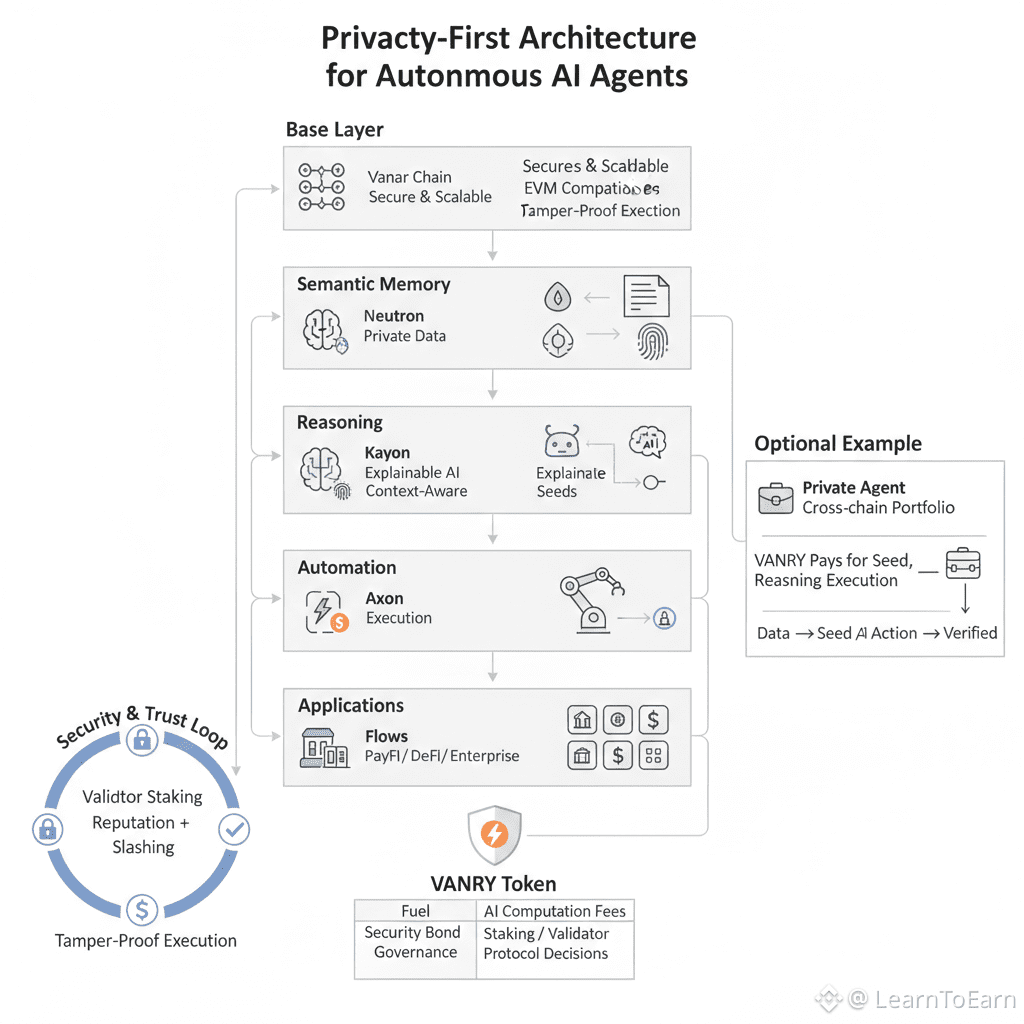
Underlying this ecosystem is the VANRY token, which powers computation, secures the network, and aligns economic incentives. Every intelligent operation, from creating Neutron Seeds to querying Kayon or executing automated actions via Axon, consumes VANRY, providing the network with a resource-based economy. Validators stake VANRY to secure the network, ensuring the integrity of both private data attestations and the public ledger. This staking mechanism aligns incentives, discourages malicious behavior, and guarantees honest operation of the privacy-first infrastructure. As autonomous agents increasingly perform private, intelligent tasks, demand for VANRY scales with ecosystem activity, linking token utility directly to real-world usage rather than speculation.
Vanar’s architecture unlocks transformative applications where privacy is essential. Corporate negotiation agents can use Neutron Seeds to store confidential pricing and contract terms, while Kayon finds mutually agreeable terms and executes the final contract on-chain, providing verifiable proof without exposing either company’s secrets. Personal financial agents can manage encrypted cross-chain portfolios, execute trades, and report strategy performance without revealing net worth or transaction specifics. DeFi and PayFi protocols can approve loans based on private Seeds representing creditworthiness, with Kayon validating proofs and Axon executing loans, ensuring compliance while protecting sensitive financial details.
The future of Web3 will be defined not solely by human users, but by intelligent, autonomous agents operating as independent digital entities. For this future to be secure, functional, and trustworthy, these agents require a native environment that respects private context, enables verifiable intelligence, and supports sovereign operation. Vanar Chain’s privacy-by-design, AI-native architecture provides this foundation. By integrating confidential semantic memory through Neutron, explainable reasoning via Kayon, and secure automation with Axon and Flows, Vanar offers a complete ecosystem where autonomous agents can thrive without compromise. The VANRY token powers this ecosystem, acting as the fuel and security mechanism for a new economy of intelligent, private, and truly autonomous digital agents, positioning Vanar Chain as critical infrastructure for the coming age of agent-driven Web3.
The Inseparable Future of AI: Why Explainable AI Must Also Be Private AI
The rise of artificial intelligence presents a profound paradox. For AI to be trusted in domains such as finance, healthcare, or law, stakeholders must understand how a system reaches its decisions—a principle central to Explainable AI, or XAI. Yet, for AI to generate meaningful explanations, it requires access to the detailed, often highly sensitive data that informs its reasoning. This creates a fundamental tension: transparency demands exposing information, while privacy requires protecting it. True trust in AI cannot be achieved without resolving this paradox. Explainability and privacy must be engineered together from the ground up, rather than treated as competing priorities—a principle that lies at the heart of Vanar Chain’s architecture.
Explainable AI is designed to transform opaque "black box" systems, where even creators cannot trace the decision path, into transparent frameworks that inspire trust, meet regulatory standards, and ensure fairness. However, traditional XAI methods face a critical limitation. Techniques like Local Interpretable Model-Agnostic Explanations (LIME) attempt to identify which input features influenced a decision. For instance, a system explaining a loan denial might highlight a low credit score or a high debt-to-income ratio as key factors. Yet generating such explanations requires processing the applicant’s full confidential profile. Even if only the reasoning is revealed, sensitive patterns can inadvertently leak, creating privacy vulnerabilities. This tension between transparency and confidentiality lies at the very core of XAI’s challenge: one cannot fully explain a decision without referencing its underlying data, yet exposing that data compromises privacy. Vanar Chain addresses this dilemma through a purpose-built, AI-native infrastructure in which privacy and explainability are inseparable rather than conflicting.
Unlike blockchains that retrofit AI features onto existing infrastructure, Vanar Chain was designed from day one as an AI-native stack. Its layered architecture allows privacy and explainability to operate in tandem, forming the backbone of trusted, autonomous applications. Two layers are particularly crucial: Neutron, which safeguards privacy, and Kayon, which enables explainable reasoning. Neutron functions as a semantic memory layer, converting raw data such as contracts, invoices, or financial records into cryptographically verifiable “Seeds.” By compressing large datasets into small, manageable representations—turning a 25-megabyte document into a 50-kilobyte Seed—Neutron preserves the semantic meaning, context, and relational information of the original content without storing the readable data itself. The original data never leaves its secure location; the Seed alone can be stored and used on-chain to prove facts, such as identity verification or asset ownership, while keeping the sensitive content private. This approach enables AI systems to reason safely over critical data, ensuring trust without compromising confidentiality.
Kayon, Vanar’s AI reasoning engine, provides explainability without sacrificing privacy. When an intelligent agent must act—such as approving a transaction under regulatory constraints—it queries Kayon, which references the relevant Neutron Seeds to analyze context and derive insights. Kayon produces auditable reasoning paths: it can demonstrate that a transaction complies with a regulation because the attached Seed verifies the necessary credential, all without revealing the credential itself. The logic behind decisions becomes transparent, while the sensitive details that informed them remain confidential. This dual capability builds trust with both users and regulators, combining privacy and explainability in a single system.
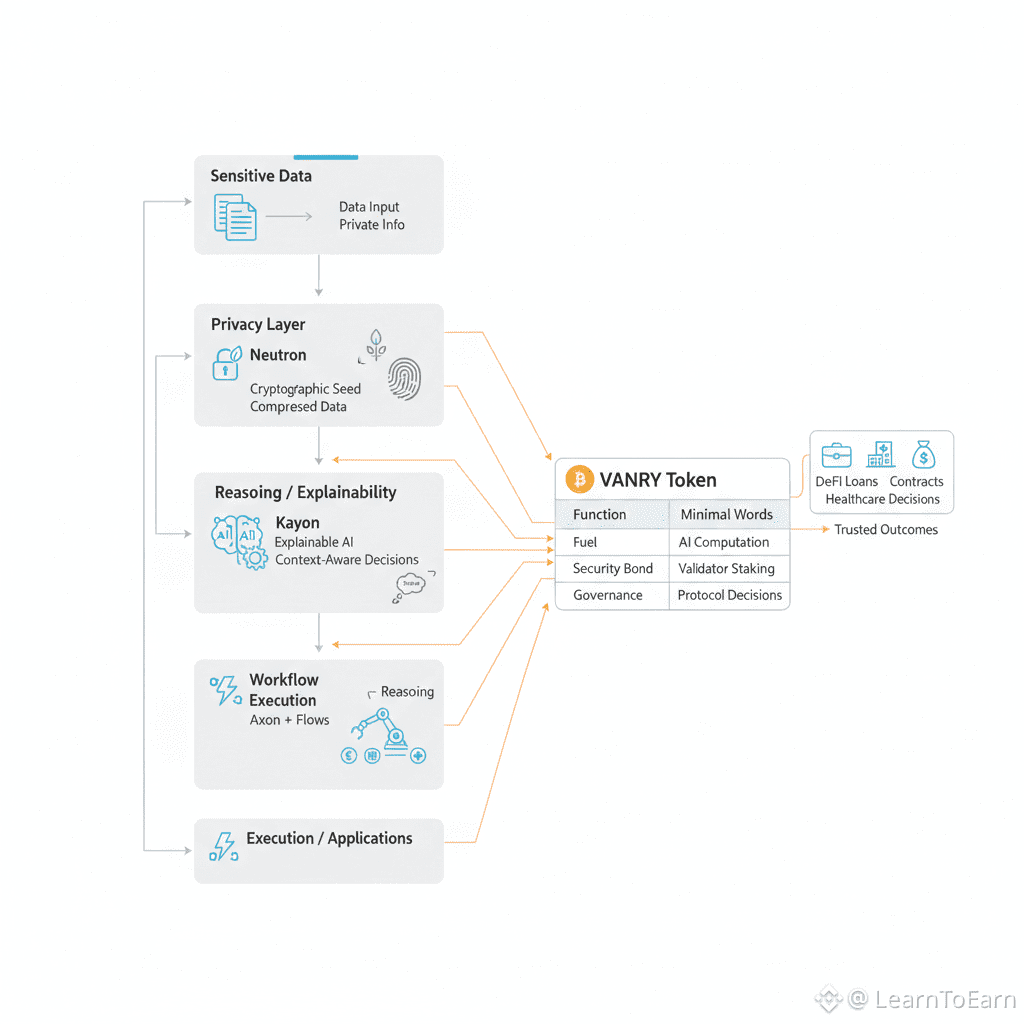
This integration unlocks transformative real-world applications. In compliant decentralized finance, smart contracts can approve loans while generating an auditable trail, with Neutron Seeds proving collateral exists without revealing an individual’s full portfolio. In confidential enterprise agreements, companies can negotiate and execute smart contracts while protecting proprietary data; Kayon explains the state of agreements while Neutron keeps sensitive operational details private. In healthcare, diagnostic models can provide treatment recommendations with fully explainable reasoning, while Neutron ensures patient histories remain confidential, enabling compliance with strict privacy regulations and building trust with doctors and patients alike.
Underlying this ecosystem is Vanar’s native token, VANRY, which powers and secures operations. Every action—creating a Neutron Seed, querying Kayon, or executing an automated workflow—consumes network resources, paid in VANRY. Validators stake VANRY to maintain the integrity of private data proofs and public reasoning logs, aligning economic incentives with honest operation and discouraging malicious behavior. As applications that leverage explainable and private AI proliferate, the demand for VANRY grows organically, linking token utility directly to real-world usage rather than speculation.
The future of AI depends on this convergence. Explainability without privacy is reckless, while privacy without explainability is untrustworthy. Vanar Chain demonstrates that these goals can coexist. By combining Neutron’s cryptographic privacy with Kayon’s contextual reasoning, it provides a foundation for intelligent, agent-driven Web3 applications that are both auditable and secure. VANRY fuels this ecosystem, serving as the engine, security bond, and governance key for a new economy built on trustworthy AI. As autonomous systems assume increasingly high-stakes responsibilities, privacy and explainability are no longer optional—they are inseparable pillars of a system that can truly be trusted.
