

@Vanarchain #vanar $VANRY
If you look at Vanar only through the familiar lens of crypto, it’s easy to question: why do they talk so much about performance, latency, UX, and practical application, while 'standard Web3' things like absolute decentralization or flashy technical metrics are not prioritized.
But the more I observe closely, the more I see this is not a marketing choice, but a direct consequence of how Vanar views the core issue that Web3 has yet to solve.
The harsh reality is that most current Web3 products only work well when users are already accustomed to Web3.
Wallet, gas, signing transactions, waiting for confirmation, sometimes failing — all of these are considered 'normal'.
But if you put those products in the context of games, real-time applications, or AI workflows, then the entire experience collapses immediately.
Ordinary users do not care which chain you use, they only know whether the product is smooth or not. And if it’s not smooth, they leave, very quickly.
Vanar starts from this very point.
Instead of asking how to make blockchain 'more correct' theoretically, they ask a much more uncomfortable question: if a product needs instant feedback, needs to run continuously, needs to bear heavy loads, where is blockchain obstructing it.
When viewed from that angle, prioritizing performance and practical application is almost unavoidable, rather than a whimsical trade-off decision.
One thing I see very clearly is that Vanar does not consider blockchain the center of the product.
For them, blockchain is just a layer of infrastructure behind, responsible for the parts that really need it: confirming value, ownership, and verifiability.
Anything related to real-time interaction is not forced to go through block time or the full transaction lifecycle.
This may make some pure Web3 enthusiasts feel 'impure', but if you have ever built a game or a real-time system, you will understand that there are no other options.
The difference is that Vanar does not try to convince users that they should accept a worse experience in exchange for decentralization.
They accept that if Web3 wants to go beyond its own boundaries, the experience must at least match Web2.
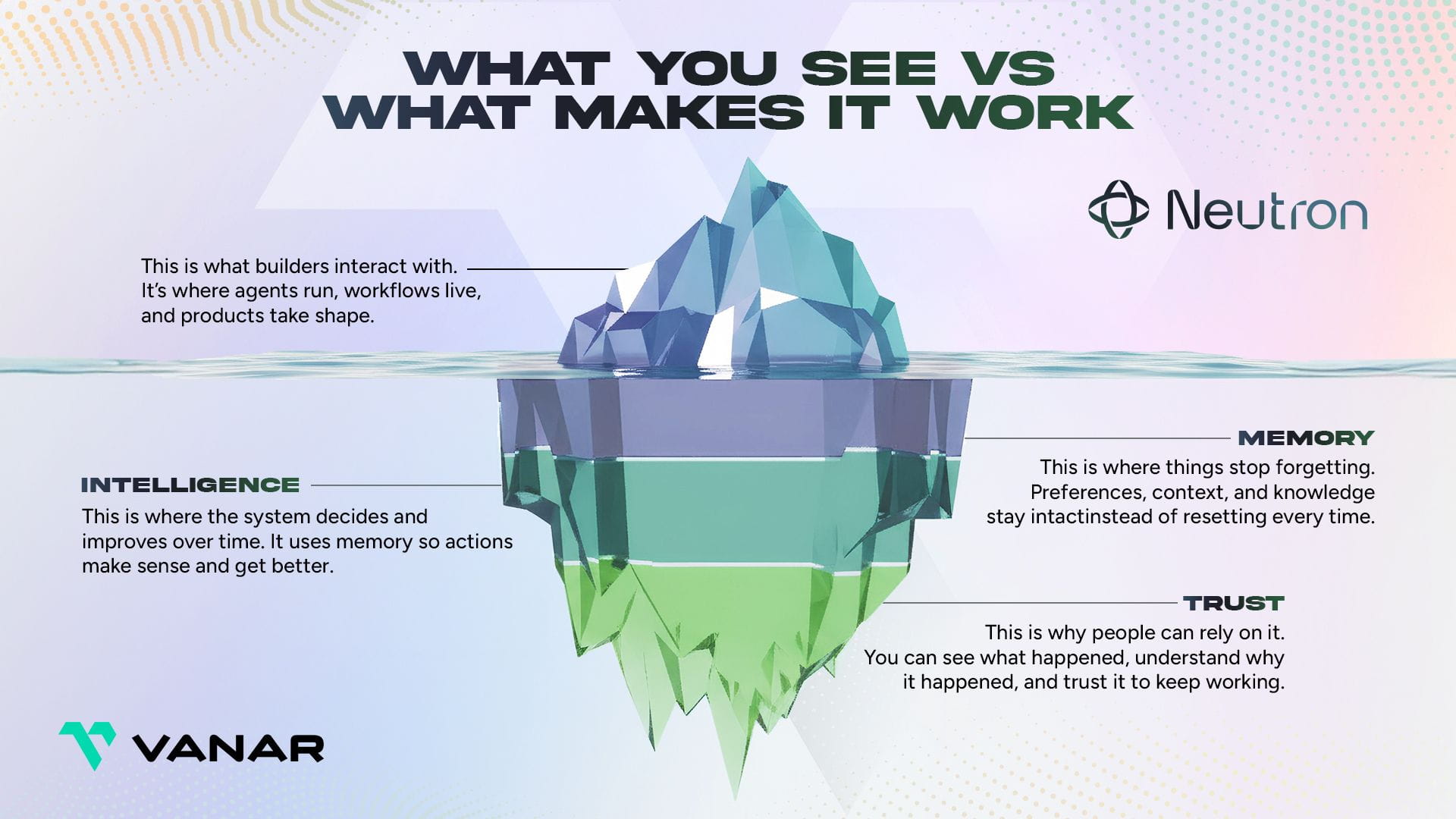
And that leads to a series of very pragmatic decisions: stronger abstraction, lower latency, less friction surfaces, even if it makes blockchain 'invisible'.
I also noticed that Vanar does not chase after metric races.
High TPS or low block time only matters if it translates into a better experience for end users.
Many chains have nice metrics on paper, but when building real products, developers still struggle with broken UX, hidden fees, and unpredictable edge cases.
Vanar goes against the grain: they start from use cases, then go back to design infrastructure.
Performance here is not for bragging, but to reduce friction at the points users truly feel.
Another reason why Vanar focuses strongly on practical applications is that they do not view Web3 as a closed ecosystem.
If compared only to other chains, many current solutions are 'okay'.
But compared to Web2 games, Web2 apps, or AI systems outside of crypto, Web3 is still far behind in terms of experience.
Vanar chooses to place itself in this more difficult comparison.
And in that comparison, performance is not a competitive advantage, but a minimum condition for participation.
From a builder's perspective, this approach says a lot.
It shows that Vanar is not targeting hackathon demos or short-term proofs of concept.
They target products that need to run long-term, bear real loads, and retain users.
This requires infrastructure to be stable, predictable, and less changeable due to narrative.
For game studios or teams building AI systems, this is much more important than how 'hot' that chain is.
Another often overlooked point is the cognitive cost for users.
Every time users have to understand one more blockchain concept, the dropout rate increases.
Vanar chooses to absorb this complexity into the infrastructure: wallets are abstracted, fees are processed in the background, on-chain logic does not disrupt the flow of use.
This does not make blockchain less important, but puts it in the right place: to serve the product, not to force the product to revolve around blockchain.
Of course, prioritizing performance and practical application is not a risk-free path.
It must accept some trade-offs regarding the degree of decentralization at certain layers.
But what I appreciate is that Vanar does not shy away from that issue.
They do not promise 'fast, cheap, and absolutely decentralized'.
Instead, they ask more practical questions: where to focus to improve the experience, and what value needs to be protected by verifiability.
This approach is not glamorous, but honest.
If looked at more broadly, I think Vanar's focus on performance and practical application reflects a shift in Web3.
In the early stages, blockchain was the selling point.
In the next stage, blockchain must step back to allow the product to move forward.
Vanar is clearly choosing to stand in the second phase.
They are not trying to make blockchain stand out, but trying to make the products built on it have a chance to be truly used.
Ultimately, in my opinion, the deepest reason is that Vanar does not believe that Web3 will win just by ideals.
It only wins when users do not have to care about whether they are using Web3.
To reach that point, performance and practical application are no longer options, but foundations.
Vanar is building on that foundation, accepting to move slower in narrative, to have the opportunity to go further in terms of usage.
