

If one day stablecoins are used as frequently as cash, then there is only one question left: does the settlement system match this level of usage? A little slower, a little more expensive might be tolerable in investment scenarios, but in payment and clearing, these will directly become costs and risks.
Plasma (XPL) was born around this real-world issue as a Layer 1 blockchain. It did not choose the route of a 'general public chain', but rather, from a fundamental logic perspective, placed stablecoins at the core of the system. All design trade-offs ultimately point to the same thing: how to complete settlements with stablecoins more efficiently and reliably.
In terms of performance, Plasma achieves almost instant clarity of transaction results through a sub-second finality consensus mechanism. This is significant because what stablecoin settlements fear most is not slowness, but uncertainty. Compared to models that rely on multiple confirmations, certainty itself is efficiency.
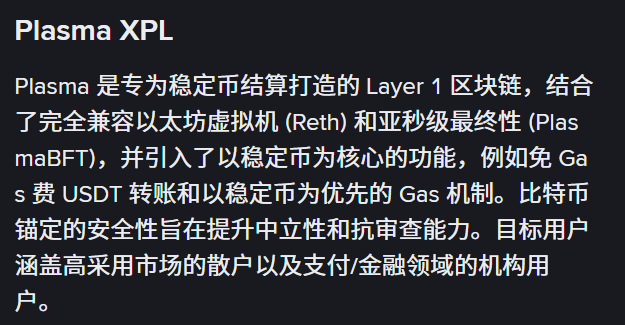
The fee mechanism further reflects its orientation. Plasma supports USDT zero gas transfers and introduces a gas model that prioritizes stablecoins, allowing users to complete operations without having to prepare native tokens in advance. This not only lowers the usage threshold but also reduces implicit losses caused by operation failures in high-frequency scenarios.
In terms of architectural choice, Plasma is fully compatible with EVM, allowing existing contracts, tools, and wallets to connect directly. This is not about pursuing ecological scale, but rather about enabling stablecoin settlement applications to be deployed faster, avoiding delays in real-world adoption due to technical migration.
In terms of security, Plasma enhances the network's neutrality and censorship resistance through a Bitcoin-backed security mechanism, providing a more solid trust foundation for long-term capital flow. This design is particularly crucial for payment and finance-grade users, as they need a sustainably operating system rather than a short-term performance showcase.
Plasma does not attempt to reshape the entirety of blockchain forms, but rather addresses a more pragmatic question: when stablecoins have already been widely used, does the settlement network finally begin to operate like a true financial infrastructure?

