
Introduction
Recently, PerpDex projects like Lighter and EdgeX are gradually coming to an end, and funds are gradually flowing back to other projects. StandX just launched its mainnet at the end of this week's Alpha season, providing an excellent window of opportunity.
StandX, developed by the former Binance contract team as a PerpDEX, officially launched its mainnet this week, achieving a trading volume of 55M and a TVL of 176M DUSD on its first day. Unlike other PerpDEXs that focus on trading volume points, StandX centers on deposit points, offering early users a low-threshold scoring advantage. Polymarket predicts its FDV will be in the range of $1-2B, and it is advisable to seize the early mainnet benefits by completing daily tasks through depositing DUSD and small trades to gain an early advantage, avoiding later high competition for scoring.
How to cost-effectively earn points after StandX's mainnet launch? How to rush ahead before the trading rules are announced? This article will detail the background and development history of the StandX project, explaining the detailed point rules from Alpha season to mainnet, guiding readers to participate in StandX points in the best way!
StandX project introduction
StandX project features
In this year's Defi space, PerpDex has become a hot on-chain track. StandX is a high-performance emerging PerpDex operating on BSC and Solana, initially positioned as an efficient on-chain perpetual contract platform focused on solving the pain points of slow trading speed, liquidity, and user experience in traditional Dex transactions.
Its unique product automatically earns interest $DUSD is its main feature, emphasizing that $DUSD can not only serve as trading collateral, but also earn interest automatically without the need for staking.
StandX team & funding background
The StandX project was co-founded by AG.Stand, the former head of the Binance contracts team, and Justin.Stand, the contract growth director at Binance. The Binance team background allows it to be viewed as a Binance ecosystem project alongside Aster, garnering significant market endorsement.
In addition to its Binance background, StandX emphasizes self-funded operations and community-driven initiatives. Unlike most VC-backed projects with high financing, StandX opts to independently raise funds and develop, rejecting external investments to maintain focus on technology and community.
The team adheres to the philosophy of "Stand by our own technology, capital, and community" and rapidly iterates product features through self-research and development. The official statement indicates that they have received support from the Solana Foundation for the Solana ecosystem and integrated liquidity from PancakeSwap and Raydium, allowing users to earn yield points by providing liquidity on StandX.
StandX development history
StandX launched earlier this year, introducing $DUSD yield-bearing stablecoin, offering 6% APR minting yield. In October, it launched the Alpha testnet season, allowing users to earn points through $DUSD deposits, staking, or forming LP. They could also participate in $tDUSD simulated trading tests to amplify point earnings until this week when the mainnet opened, heralding a new chapter in point acquisition on the mainnet.
StandX's vision is to create an ecosystem called "Stand to Earn," where users can not only conduct efficient trading but also accumulate points through holding DUSD and participating in interactions to qualify for future airdrops. StandX provides self-custody wallets and social logins, emphasizing decentralization and security. With increasing competition in the Perp DEX space, StandX's Binance endorsement and high-performance design make it one of the most noteworthy airdrop projects by the end of the year.
StandX advantages comparison
Trading points dominate
The PerpDex space has been quite hot recently, with projects like Aster, Lighter, and EdgeX all focusing on trading volume to attract significant capital to improve TVL and OI data. These platforms typically incentivize users to trade through a "point system" to issue points and obtain airdrop rewards.
According to DefiLlama, the 24-hour trading volumes of major PerpDex are as follows: Lighter 9.3B, Hyperliquid 7.9B, Aster 6.3B, EdgeX 5.1B; high trading volumes create an arms race for high-frequency traders.
However, a common ending in the points season is "trading volume weight being extremely high → participation costs increase." When trading volume becomes the main source of points, users are often forced to make trade-offs between higher fees, larger slippage, and greater leverage risks. StandX, as a newcomer, only requires depositing DUSD and forming LP to earn points, making it more suitable for average users with its design of holding points combined with low-threshold tasks.
Binance background endorsement benchmarking against Aster
StandX's biggest advantage compared to other PerpDex is its Binance background. Its founding team comes from the former contracts department of Binance, which not only brings technical support to StandX but also many potential supports from BSC ecosystem projects.
Benchmarking against Aster, another leading PerpDex in the Binance ecosystem, StandX also focuses on high-performance perpetual contracts. However, Aster has already launched its mainnet and accumulated over 10B in market expectations. In contrast, StandX has just launched its mainnet and still belongs to the early stage, with not only a low-threshold point participation mechanism and user-friendly point holdings, but $DUSD will also automatically earn interest at 4-6% APR, maximizing the utilization of idle funds.
StandX supports dual-blockchain BSC and Solana, with trading latency below 10ms, supports up to 100x leverage, and cross-chain mechanisms make it more scalable. There is also a Fluid Order Book providing real-time liquidity views, allowing users to trade with better market insights.
StandX's early low volume, Binance endorsement, and high-yield mechanisms have made it a new favorite in the PerpDex space. Whether for users with high trading demands or those seeking stable returns, StandX provides a suitable place.

StandX Alpha Season
StandX closed its first season at the end of October and launched the Alpha season, which is the core activity of the testnet phase, aimed at familiarizing users with the platform's operational mechanisms through Alpha tasks, while also accumulating points to pave the way for mainnet airdrops.
The focus of the Alpha season revolves around the dual asset system of DUSD/tDUSD, where users can mint or swap DUSD through USDT, and stake DUSD to receive tDUSD for participating in trades during the Alpha period. All margin, fees, and profits and losses are calculated in tDUSD. DUSD staked during the Alpha period continues to earn 4-6% real yield. The core mechanism for Alpha season points is shown below.
1. Swap DUSD
To obtain $DUSD, it needs to be exchanged from BSC chain USDT, which can be exchanged on the StandX platform, granting 5% points on the exchange volume. For every 1000U exchanged, you can earn an additional 50 points. You can interact once to earn points during the first exchange, but it is not recommended to exchange large volumes for points due to the 5% scoring, as trading volume can be overly consumed.
2.USDT/DUSD LP liquidity pool
USDT/DUSD LP was the most chosen lying flat strategy in the first season. As long as stablecoins are deposited, users can earn 1.4x points, which used to be the best channel for point accumulation.
The LP lying flat strategy during Alpha season is still feasible, but the point multiplier has been adjusted to 1.2x, so depositing 1000 USDT and 1000 DUSD will yield only 2200 points in one day, a slight adjustment but still easy, and no locking is better than tDUSD.
3. tDUSD deposits & Perp trading
tDUSD is the core of the Alpha season. As the test token for the Alpha season, locking DUSD will yield 1:1 tDUSD. Transferring tDUSD to Perp or the vault will earn 1.2x points, and the locked DUSD will also earn 4-6% basic interest.
Transfer tDUSD to the Perp wallet to participate in StandX's perp simulated trading, which can earn more tDUSD, while the points accumulated will also increase, calculated at 1.2x the tDUSD balance.
Assuming 1000 tDUSD profits to 1500 tDUSD in Perp, the daily points earned would be 1500*1.2 = 1800 points.
However, it should be noted that if tDUSD decreases due to losses, it will also affect the daily points earned. However, there is a guarantee of 50% of DUSD deposits (500*1.2 points). Therefore, tDUSD can not only be held mindlessly for points but also greatly increase the point ceiling through Perp, with a bottom guarantee of 50%, ensuring that it does not affect the DUSD principal refund at the end of the season, making it the best path in the Alpha season.
4. Daily trading tasks
Every day, achieving a trading volume of 100 through tDUSD will grant an additional 10 points, requiring at least two transactions. The extra points are minimal and are mainly a testing bonus task.
During the Alpha period, users can increase tDUSD through Perp trading to amplify point profits, with a minimum 50% guaranteed points. Meanwhile, DUSD can be fully redeemed after the season ends, making it an excellent opportunity for zero-cost point acquisition. Points earned during the Alpha season have been locked since last week, laying the groundwork for the newly opened mainnet.

Changes from Alpha to mainnet
StandX ended the Alpha season on 11/21, and previously earned points were locked. This week, on 11/24, StandX officially transitioned from the Alpha season to the mainnet, marking a key turning point from testnet to real-world operations. The Alpha season simulated trades with tDUSD, allowing risk-free participation to incentivize early users; the mainnet will automatically transfer users' staked DUSD into the Perps Wallet, using DUSD as collateral assets for practical operations, removing the 50% bottom protection, and users will need to bear the full trading risks.
Join mainnet points
https://standx.com/referral?code=john
New point system for mainnet
The points mechanism during the mainnet period is similar to that of the Alpha season, continuing the framework of holding, tasks, and LP. The actual point system is shown below:
Detailed rules for categories Point multiplier Holding DUSD in Perps wallet/Vault (including unrealized profits and losses) 1.2 pts/DUSD/day Daily tasks ≥2 orders/UTC day + ≥100 DUSD total trading volume +10 pts/day LP PancakeSwap/Raydium DUSD LP DUSD: 1.0x + USDT: 1.2x Swap DEX exchange trading 5% exchange volume points
Thanksgiving points doubled
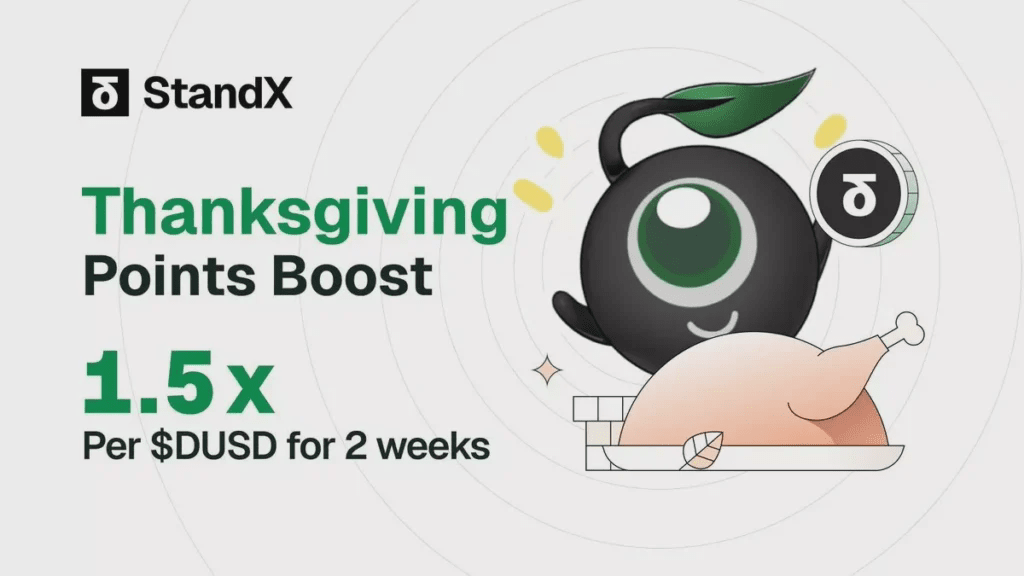
To celebrate Thanksgiving, StandX is launching a points doubling event over the next two weeks. The originally deposited $DUSD in Perps Wallet and Vault can earn 1.2x points per day. Now, with Thanksgiving bonuses, it directly grants a 1.5x multiplier, meaning every 1000U can earn 1500 points daily, making it the best window for point accumulation.
StandX mainnet strategy: Should we make the transaction?
According to the above rules, the mainnet rules and the point acquisition methods of the Alpha season are quite similar. My strategy is to directly deposit the originally staked DUSD in the Perps Wallet and complete a task by maintaining an active trading volume of 100 USD per day. Active storage can earn a 1.2x point multiplier. If stored in the Vault, additional StandX platform profit-sharing can be obtained, but withdrawals from the Vault require 4 days to unlock.
Currently, StandX's trading fee rates are: Maker 0.01%, Taker 0.04%, and calculated based on the nominal transaction value. It is suggested to hedge trading volume with emerging fee-free DEXs like VAR and Paradex, as VAR even offers loss rebates that can recover costs.
Currently, the market is most concerned about whether "trading volume points" will be launched. StandX officials have hinted that significant trading activities are about to be launched. I suggest maintaining activity with small volume points in a low-cost way, establishing holding days and active days. It is expected that the officials will subsequently launch formal trading points, which will also retroactively account for current transactions, avoiding forced high-cost point acquisition after the rules become clear.
StandX valuation analysis
StandX currently lacks official tokenomics. The following valuation calculations use Polymarket's forecast market sentiment and comparisons with other PerpDex projects.
Polymarket: StandX's FDV one day after launch
Polymarket has a StandX TGE forecast market, where the FDV is above a certain threshold one day after, as shown in the current probability on 11/30:
FDV > $800M: 83%
FDV > $1B: 69%
FDV > $2B: 38%
FDV > $3B: 21%
The total estimated trading volume is approximately $240,000, with market consensus pointing to a range of $1-2B, with over 70% of funds clearly bullish on FDV above 1B.
Competitor valuation benchmark: Aster & PerpDex valuation
StandX and Aster are both Binance ecosystem PerpDex projects, often used for benchmarking comparisons. Additionally, competitive analysis with currently popular Lighter, EdgeX, and the established DEX leader Hyperliquid is as follows.
Project valuation FDV 24H trading volume Hyperliquid approx 32B 6.2B Lighter 1.5~2.4B 7.2B EdgeX 800M~1.2B 3.9B Aster approx 1B 5.7B StandX 1~1.2B 156M
Although StandX's trading volume on its mainnet launch day was low at 55M, considering its previous Binance background and unique DUSD margin interest mechanism, it initially achieved a TVL performance of 180M. The author believes that based on the above comparisons, considering the poor performance of recently launched projects, StandX's reasonable valuation is between 1-1.2B.
Airdrop shares are allocated based on other PerpDex distributions, mostly 25-30% of the total token supply allocated to point airdrops (Aster 30%, Lighter 25-30%). Based on the above valuation calculations, airdrop values range from 250M to 360M, distributed according to average points.
Conclusion: Mainnet rules remain the same, seize points in advance
In the context of increasing competition in the current PerpDex space, StandX provides users with an opportunity that combines technical strength and early benefits. With differentiated advantages and the technical capabilities of the previous Binance contracts team, it successfully gained market attention after its mainnet launch.
As some PerpDex narratives gradually enter the finishing stage, attention and capital in the market are flowing back to projects in the "early point window," forming predictable capital rotation. StandX is pushing forward to mainnet after the Alpha season, adopting the same point rules, allowing users to easily secure positions with low volume and no loss deposits.
It is recommended that readers seize the early mainnet point opportunities by depositing and using moderate trading strategies to secure positions before the official announcement of trading weights, gradually establishing point accumulation and active participation to lay a foundation for future airdrop benefits.
This report is for informational sharing purposes only. The content does not constitute any form of investment advice or decision basis. The data, analysis, and opinions cited in the text are based on the author's research and public sources, and may have uncertainties or be subject to change at any time. Readers should make investment judgments based on their own circumstances and risk tolerance. For further guidance, it is recommended to seek professional advice.

