
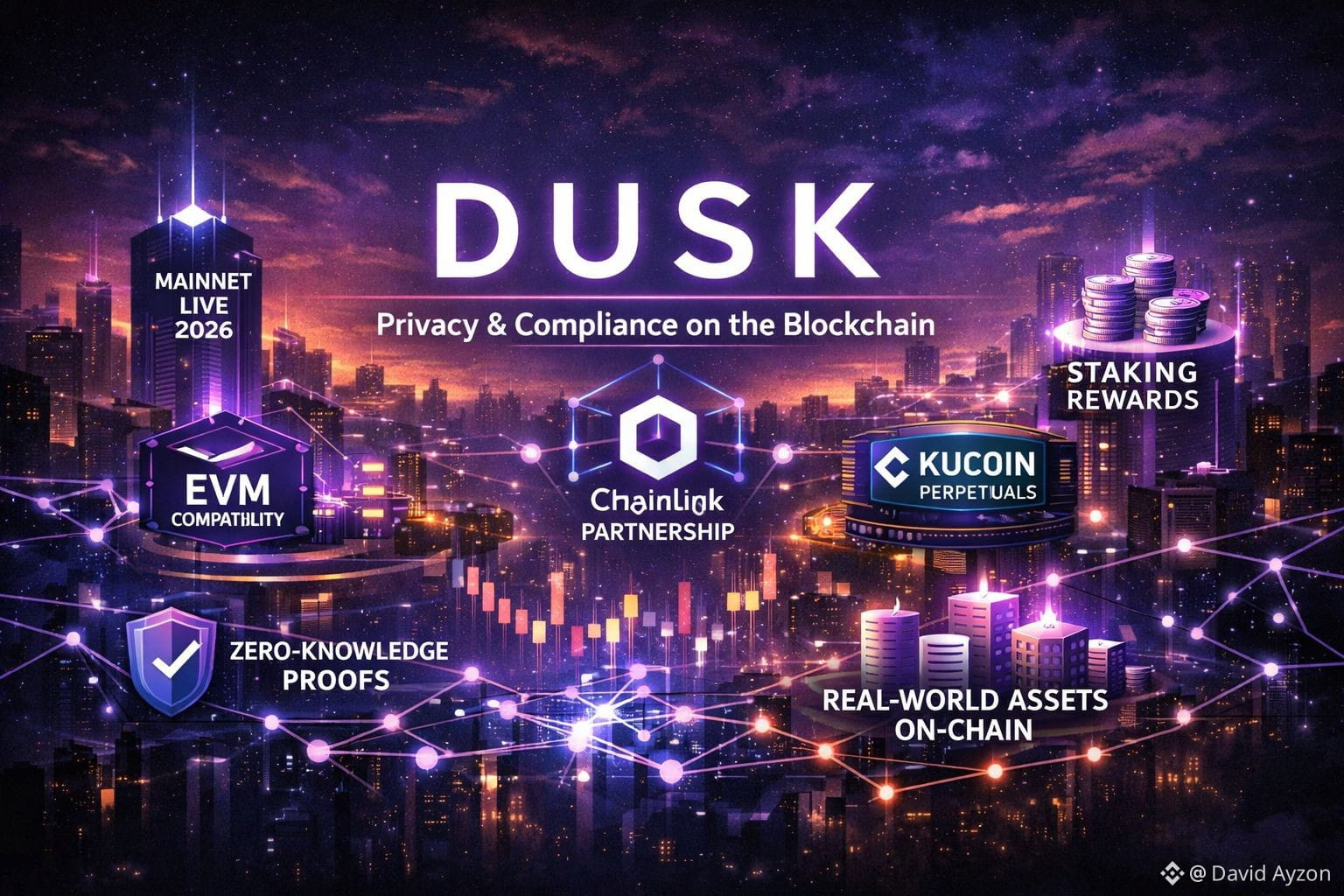
Dusk didn’t start with the dream of replacing finance or chasing hype cycles, it started with a very grounded observation about how real markets behave. In traditional finance, privacy is not a rebellious idea or a luxury feature, it is basic infrastructure. Funds don’t publish their positions in real time, companies don’t expose their full cap tables to strangers, and investors don’t broadcast their identities to the entire market just to participate. At the same time, those same markets are heavily regulated and constantly audited. Institutions live in a world where confidentiality and accountability must exist together, not as opposites but as partners. Dusk’s core idea is that blockchain finance will never grow up if it forces institutions to choose between those two. It tries to build a public system where sensitive information stays protected, while compliance is still provable and enforceable.
The phrase “selective disclosure” sounds technical, but in practice it describes a very human need: the ability to prove something important without revealing everything about yourself. Imagine an investor who is legally allowed to hold a certain regulated asset but does not want their identity and wealth profile permanently etched into a public ledger. On many chains, participating means radical transparency by default. On Dusk, the investor can submit a cryptographic proof that says, in effect, “I am eligible,” without saying, “Here is exactly who I am and what I own.” The network checks the proof, the rules are enforced, and the transaction settles. From the outside, the system remains trustworthy because the logic is verified. From the inside, the person remains protected because their private data never becomes public property. That balance is less about cryptography and more about dignity in financial participation.
The same logic applies to issuers who operate under strict regulatory frameworks. Consider a company launching a tokenized bond. In the real world, that process is full of constraints: who can buy, how much they can hold, and where the asset is allowed to circulate. At the same time, the company has competitive information it cannot afford to expose, like internal allocation strategy or negotiation details. Dusk allows the issuer to encode the regulatory rules directly into the asset so every transfer is automatically compliant, while the sensitive business context remains shielded. Regulators and auditors can still access what they are authorized to see, but the public does not get a free window into corporate strategy. It is a system that respects the fact that markets run on both trust and discretion.
Dusk’s modular architecture matters because finance is not a single product, it is an ecosystem of very different instruments with very different obligations. A regulated liquidity pool, a tokenized equity instrument, and a private credit structure do not share identical legal or privacy requirements. A rigid system forces all of them into the same mold and eventually breaks under that pressure. A modular system allows each application to define how privacy, disclosure, and validation should work for its specific use case while still living on a shared network. This flexibility mirrors how traditional financial infrastructure evolved: layered, specialized, and adaptable rather than monolithic.
To understand what this looks like in practice, it helps to walk through a full scenario instead of abstract features. Picture an institutional issuer preparing a tokenized bond. The issuer completes onboarding through a compliance partner connected to the network, handling identity verification and legal structuring off-chain, just like today. Once approved, they deploy a bond contract that encodes the interest rate, maturity schedule, and transfer restrictions required by law. Investors also onboard through authorized channels and receive credentials that prove their eligibility. When an investor subscribes, they submit a transaction containing proof that they meet the requirements, not their personal file. The network validates the proof, allocates the bond tokens, and records the event without turning private investor data into a public artifact.
After issuance, the bond can trade on a compliant secondary market built on the same infrastructure. Every transfer automatically checks eligibility proofs in the background. Unauthorized holders are blocked by code rather than by slow manual oversight. Settlement happens quickly, removing the long reconciliation chains that traditional systems struggle with. Interest payments distribute according to the contract logic, visible as correct events on-chain without exposing individual portfolio strategies. When reporting time arrives, the issuer can generate regulator-facing disclosures using selectively revealed data, sharing what is required and nothing more. The entire lifecycle runs on a shared ledger that guarantees correctness, while information flows are controlled with intention instead of chaos.
What makes this model powerful is that privacy is not treated as secrecy for its own sake. It is treated as structure. Markets depend on participants being able to act without leaking every strategic detail to competitors or opportunists. At the same time, regulators depend on being able to confirm that rules are followed. Dusk tries to encode that dual reality directly into infrastructure so that compliance becomes automated logic instead of paperwork layered on top of fragile systems. In that world, privacy does not fight regulation, it enables scalable regulation.
For compliant DeFi, the implications are similar. A regulated trading venue can enforce jurisdiction rules, investor classifications, and risk limits at the protocol level. Traders prove they are allowed to participate without publishing their entire identity to the crowd. Risk checks happen instantly as part of transaction validation. Operational mistakes shrink because the rules are enforced by design rather than by human memory. The result is a market that feels closer to professional finance while still benefiting from the speed and composability of blockchain infrastructure.
The real test for a network like Dusk is not philosophical elegance but operational trust. Institutions care about whether systems survive audits, integrate cleanly with existing processes, and behave predictably under stress. Advanced privacy technology only matters if developers can use it without feeling like they are stepping into a research lab. The more Dusk can turn complex cryptography into ordinary developer experience, the more it lowers the psychological barrier to adoption. Infrastructure wins when it feels boring in the best possible way: reliable, documented, and repeatable.
Competition in tokenized assets and institutional DeFi is crowded, and many platforms lean toward extremes. Some prioritize transparency so aggressively that sensitive financial activity becomes uncomfortable. Others retreat into private networks that lose the benefits of open infrastructure. Dusk’s bet is that the middle ground is not a compromise but a necessity. Public systems must learn to support confidentiality if they want to host serious capital. The risk is that privacy technology is often misunderstood, and performance tradeoffs can discourage builders if not handled carefully. Success depends on proving, over time, that confidentiality, usability, and speed can coexist in production rather than just in theory.
If Dusk executes on its vision, the long-term outcome is not a dramatic reinvention of finance but a quiet upgrade. Asset issuance becomes programmable. Settlement becomes faster and less error-prone. Compliance becomes embedded into transaction logic. Markets retain the confidentiality that professionals expect while gaining the efficiency of shared digital infrastructure. The promise is not chaos or opacity, it is a system where on-chain finance starts to resemble how real finance actually works, just with fewer frictions and stronger guarantees. In that sense, Dusk is less about escaping the rules of finance and more about rebuilding the rails so the rules can operate smoothly in a digital world.
