
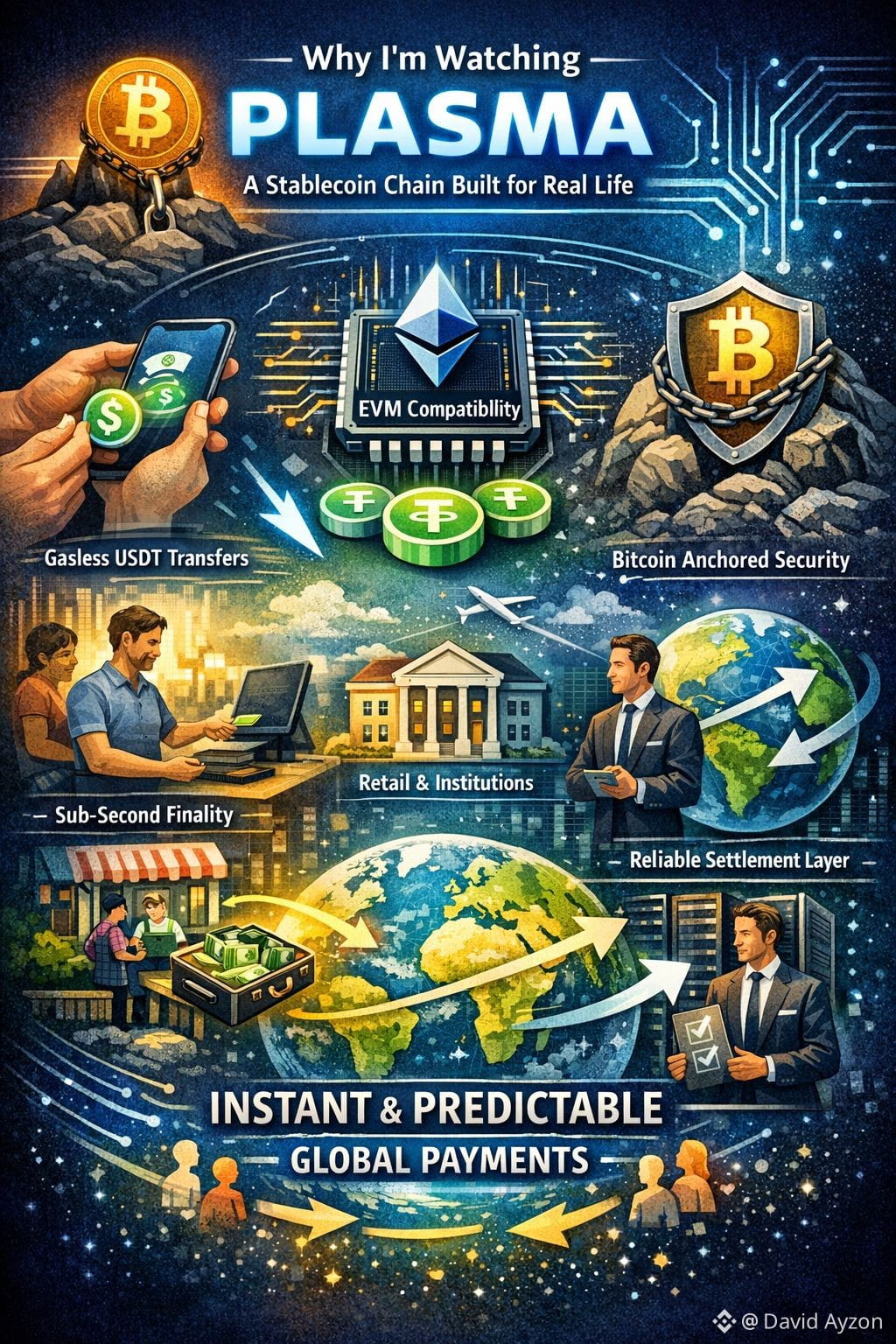
I keep coming back to the same thought whenever I look at stablecoins, which is that most people are not chasing yield or experimenting with smart contracts, they’re just trying to move money without fear, and I’m realizing that the infrastructure we built for crypto speculation was never really designed for that emotional need, because sending value should feel calm and predictable, not like navigating a technical system, and Plasma reads to me like a chain that starts from that human truth instead of from developer ego. When I imagine someone sending savings to their family or paying a supplier across borders, I’m not picturing TPS charts first, I’m picturing the feeling of pressing send and wanting certainty, and Plasma’s entire design seems anchored around compressing the gap between intention and settlement until the transfer feels almost invisible.
What pulls me in is the idea that Plasma is not trying to be everything at once, because most chains compete by stacking features, while Plasma narrows its focus around stablecoin settlement and treats that as the main workload, and I’m seeing how powerful that constraint is. If a chain assumes stablecoins are the dominant unit of account for real-world activity, then every design choice changes, from fees to finality to user experience, and suddenly the question is not how many experimental apps you can host, but how reliably you can move digital dollars at scale. That shift feels less like a crypto experiment and more like infrastructure planning, because payments are not a playground, they’re a trust system, and trust is built from boring consistency rather than flashy novelty.
The EVM compatibility through Reth matters to me not because it’s trendy, but because it reduces friction at the exact layer where ecosystems usually stall. Developers don’t have infinite patience to relearn tools, and users don’t care what virtual machine runs underneath their wallet, so Plasma choosing compatibility feels like a quiet admission that adoption is about removing excuses. I’m thinking about how many good ideas die because they ask builders to start from zero, and They’re essentially betting that familiarity is a growth strategy. If developers can port existing contracts and infrastructure with minimal resistance, then Plasma doesn’t have to win an ideological war, it just has to deliver a better settlement experience, and that’s a much more winnable battle.
Sub-second finality is where the emotional dimension becomes obvious to me, because speed in payments is not about bragging rights, it’s about psychological closure. When a transaction confirms instantly, the brain relaxes, and I’m noticing how rare that feeling still is in most crypto systems. PlasmaBFT pushing toward near-real-time certainty is less about engineering theater and more about aligning blockchain with human expectations. If it becomes normal for stablecoin transfers to settle as fast as a message is sent, then the category stops feeling experimental and starts feeling inevitable, and that’s the threshold where mainstream behavior changes quietly without needing a marketing campaign.
The gasless USDT loop is probably the clearest example of Plasma understanding where people actually get stuck. Most users do not want to manage multiple assets just to move one asset, and forcing them to acquire a volatile token to send stable value is a design contradiction that crypto normalized but ordinary people never accepted. I’m reading Plasma’s stablecoin-first gas model as an attempt to remove that contradiction entirely. When the asset people hold is the same asset they use to pay fees, complexity collapses, and We’re seeing how small reductions in friction compound into large adoption differences. The first transaction decides whether someone trusts a system, and if the first experience feels clean, the system earns another chance.
The Bitcoin-anchored security angle adds another layer that feels less about performance and more about long-term credibility. Settlement networks eventually become political objects because they carry real economic weight, and I’m aware that neutrality is not a marketing word once institutions start depending on a chain. Anchoring security signals to Bitcoin is Plasma’s way of borrowing the strongest cultural and technical narrative around immutability, and even if users never study the mechanics, the message is that rewriting history should be extraordinarily hard. For payment rails, that assurance is not abstract, it’s directly tied to auditability, dispute handling, and the confidence that large transfers will not evaporate because of governance drama.
I’m also thinking about how retail and institutional users converge around the same needs even when they speak different languages. A retail user says they want instant, cheap transfers, while an institution says they want predictable settlement and operational guarantees, but they’re describing the same system from opposite ends. Plasma targeting both is not contradictory if the base layer is reliable enough, because a chain that behaves like infrastructure can serve a shopkeeper and a treasury desk with the same properties. Reliability, low variance in fees, and fast finality scale across contexts, and that universality is what gives a settlement chain staying power.
The real challenge I see is not the vision but the discipline required to protect the stablecoin-first experience under pressure. If speculative activity overwhelms the network or incentives drift toward short-term hype, the very features that make Plasma distinct could erode. Settlement chains cannot afford identity confusion, because the moment payments become unreliable, trust leaks out faster than it was built. I’m convinced that Plasma’s success depends on its willingness to prioritize payment flows even when other opportunities look more exciting, because infrastructure wins by being dependable, not by chasing every trend.
What excites me is the possibility that Plasma turns stablecoins from a crypto feature into a default behavior. If sending USDT becomes as natural as sending a text, the technology fades into the background and the economic effect moves to the foreground. That’s when a chain stops being judged as a blockchain and starts being judged as a utility. I’m watching Plasma as an experiment in whether crypto can mature into a settlement layer that ordinary people never have to think about, and if they pull it off, the biggest achievement will not be technical elegance, it will be emotional invisibility. The best payment systems are the ones users forget are even there, and I’m seeing Plasma aim directly at that disappearing point where infrastructure becomes trust and trust becomes habit.

