
Dusk begins from a feeling most people understand but rarely say out loud. Money is personal. Your savings, your investments, your business operations, your payroll, your partnerships, all of it carries emotional weight. Traditional finance protects that privacy by default, yet most early blockchains exposed everything as if transparency alone could solve trust. Dusk was created around the belief that privacy and accountability should not fight each other. I’m talking about a deeper human tension here. People want systems that are open enough to trust but private enough to feel safe inside. Dusk tries to design a blockchain where confidentiality is normal and proof is still possible, so users and institutions don’t feel like they must sacrifice dignity just to gain efficiency.
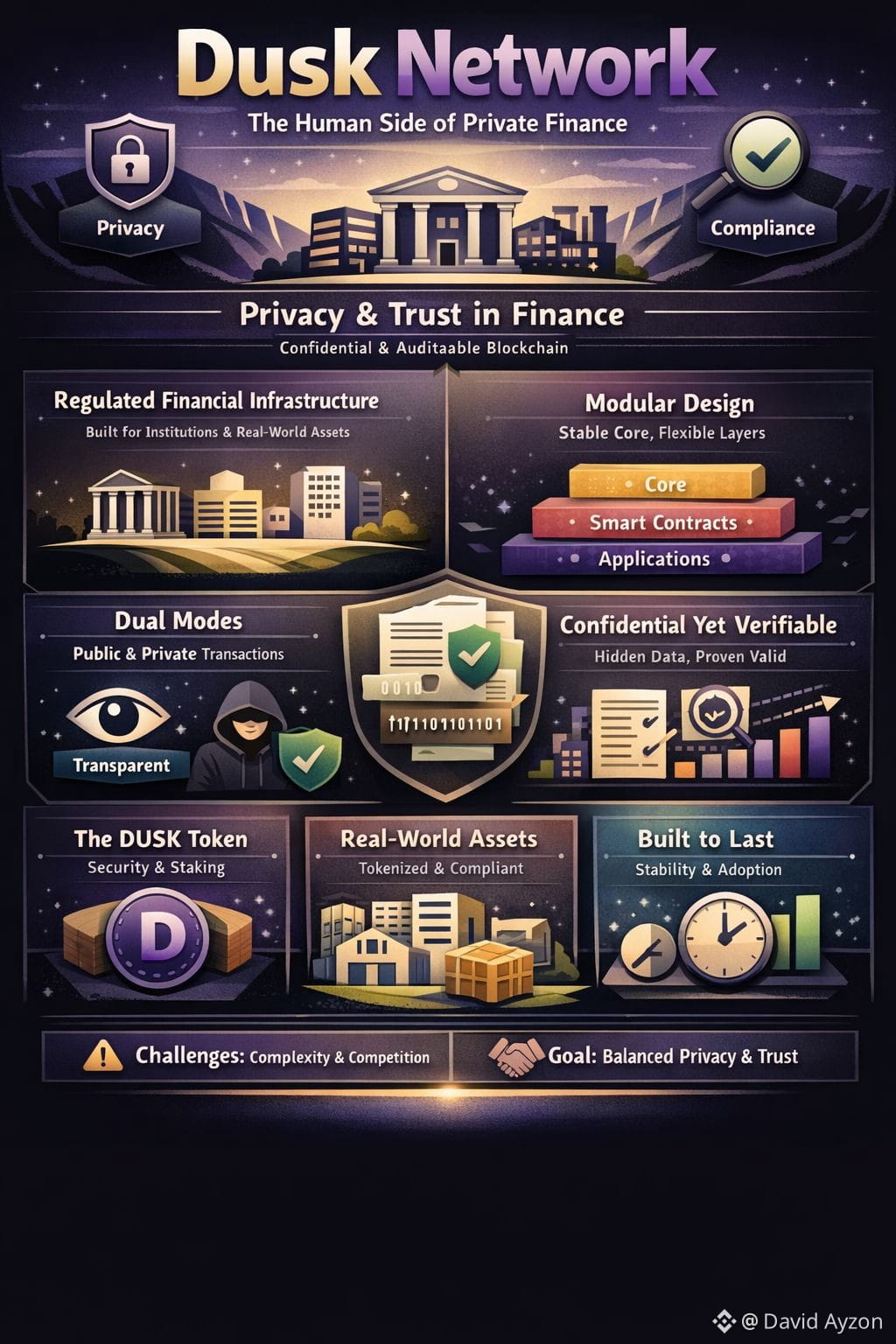
Dusk is a Layer 1 blockchain focused on regulated financial infrastructure. That phrase sounds technical, but emotionally it means building rails for finance that real institutions can live on without fear. They’re not trying to create a playground chain where anything goes. They’re trying to create an environment where assets can be issued, transferred, and settled while respecting laws, audits, and real-world responsibilities. Privacy is not treated as rebellion here. It’s treated as protection. At the same time, the system is designed so that correctness can be proven when needed. That balance is the heart of Dusk. It acknowledges that markets need confidentiality to function and verification to remain fair.
Finance is allergic to instability. A system handling serious value cannot reinvent itself every month. Dusk leans into a modular architecture because it separates the stable foundation from the evolving layers above it. The settlement core is meant to remain dependable, while execution environments can adapt as developer needs change. If It becomes easier to upgrade application layers without shaking the ground beneath them, institutions gain confidence. They can adopt innovation without fearing collapse. This design choice feels less like chasing trends and more like respecting how cautious real finance actually is.
One of the most human aspects of Dusk is its recognition that privacy is not binary. Some actions should be visible. Others must remain confidential. Dusk supports both realities by allowing public-style and private-style transactions to live on the same chain. They’re acknowledging that real life is mixed. A company might want transparent reporting for certain flows while protecting strategic details elsewhere. A user might want public interactions in one context and shielded balances in another. We’re seeing a system designed around choice instead of forcing everyone into one extreme. That flexibility is not just technical. It respects how people actually behave.
Privacy often gets misunderstood as secrecy, and secrecy gets mistaken for danger. Dusk approaches privacy as controlled visibility. Instead of revealing sensitive data, the chain can prove that transactions are valid without exposing personal details. This is where cryptography becomes emotional, not just mathematical. It allows users to say, “You don’t need to see my information to trust the outcome.” That shift matters because it protects dignity while preserving accountability. It tells participants that the system respects their boundaries without asking others to blindly believe.
Fast systems are exciting, but financial systems need certainty more than excitement. Settlement that can reverse feels unstable. Dusk’s consensus design aims to provide strong finality, meaning once something is recorded, it stays recorded. This is not about marketing performance numbers. It’s about confidence. Institutions need to know that a transfer representing real value is not a temporary event. Users need to feel that their actions are anchored in a stable ledger. Money is emotional because it represents effort, time, and trust. A chain that handles money must carry that weight responsibly.
Financial applications are not simple transfers. They involve rules, permissions, lifecycles, disclosures, and conditional behavior. Dusk’s smart contract environment is designed to support complex financial logic while interacting with private states. That combination is difficult to achieve, but it’s essential for building products that resemble real financial infrastructure instead of experiments. Developers need tools that allow them to encode compliance, governance, and structured workflows directly into the system. When that works, applications stop being demos and start becoming platforms institutions can rely on.
Dusk’s focus on real-world assets is grounded in realism. Financial instruments already exist. They already have rules, regulators, and responsibilities. Bringing them on-chain requires a system that understands those constraints. Privacy protects competitive and personal information. Auditability ensures obligations are met. Dusk positions itself as the environment where those requirements can live together. It’s not chasing hype. It’s chasing compatibility with how markets actually operate. That approach feels less glamorous, but far more sustainable.
The DUSK token supports staking security and network operation. Behind the scenes, this is what keeps the system honest. A blockchain targeting institutional use cannot rely on weak incentives. It needs strong participation and predictable behavior from its operators. Staking is not just economics. It’s a signal that the network is defended by people with skin in the game. Reliability grows from aligned incentives, and aligned incentives create confidence. Without that, no amount of technology matters.
Success for Dusk is not measured by social noise. It’s measured by stability, adoption depth, and meaningful usage. Security participation, developer activity, and the presence of real financial applications tell a clearer story than price charts. Privacy features matter only if they’re used in practice. Adoption matters only if it survives beyond pilots. Institutions care about consistency, tooling, and integration comfort. Those quiet metrics are the ones that predict whether a chain becomes infrastructure or remains an experiment.
Dusk’s biggest challenge is complexity. Privacy plus compliance plus programmability is a heavy engineering load. Every layer must be correct. Another risk is time. Institutional adoption is slow, and patience becomes a strategic requirement. There’s also the narrative risk of privacy being misunderstood. Dusk must continuously prove that its privacy model strengthens trust rather than weakening it. Competition is another reality. Many teams are chasing similar goals, and execution quality will decide outcomes. The project’s survival depends less on promises and more on consistent delivery.
If Dusk works as intended, it creates a future where financial infrastructure feels safer without becoming restrictive. Institutions could operate on-chain without exposing sensitive information. Users could interact with markets without feeling watched. Compliance could become a natural property of the system instead of an awkward afterthought. We’re seeing a gradual shift in how people think about transparency. Absolute exposure is no longer seen as progress. Balanced privacy is becoming a sign of maturity. A chain that normalizes that balance could quietly redefine how finance integrates with blockchain.
I’m drawn to Dusk because it speaks to a human truth. Trust is not built by forcing everyone into the light. Trust grows when people know their boundaries are respected and their actions are still verifiable. They’re trying to build a system where privacy is not suspicious and accountability is not oppressive. If It becomes normal for serious financial value to move through infrastructure like this, the emotional impact will be subtle but powerful. People will feel safer participating. Institutions will feel safer innovating. We’re seeing the early shape of a system that tries to respect both freedom and responsibility at the same time. That balance is rare, and if it holds, it may be the quiet foundation of a more human financial future.
