

The Migration Tax: Why Developers Hate Switching Blockchains
Every blockchain project faces an uncomfortable reality: the vast majority of developers are not native to their ecosystem. A developer with expertise on Ethereum, years of experience with Solidity, established libraries they depend on, and production systems running in the EVM does not casually abandon all of that to learn a new language, new frameworks, and new tools on a competitor's chain. The switching cost is too high. The friction is too great. The risk is too real.
This is the fundamental reason that L1 blockchains accumulate developer network effects. It is not because Ethereum is technically superior to all alternatives, but because the cost of leaving exceeds the benefit of migrating. Building on an unfamiliar chain means rewriting code from scratch. It means learning new tooling. It means rebuilding developer relationships. It means starting production deployments from zero. It means a six-month project becomes an eighteen-month project because of relearning curves and unexpected incompatibilities.
For the consumer projects—gaming studios, metaverse platforms, brands—that Vanar is targeting, this tax is even more debilitating. A studio like Viva Games with production games running on multiple chains cannot afford to migrate code to yet another blockchain. The effort would delay product launches, introduce risk, and distract from core product development.
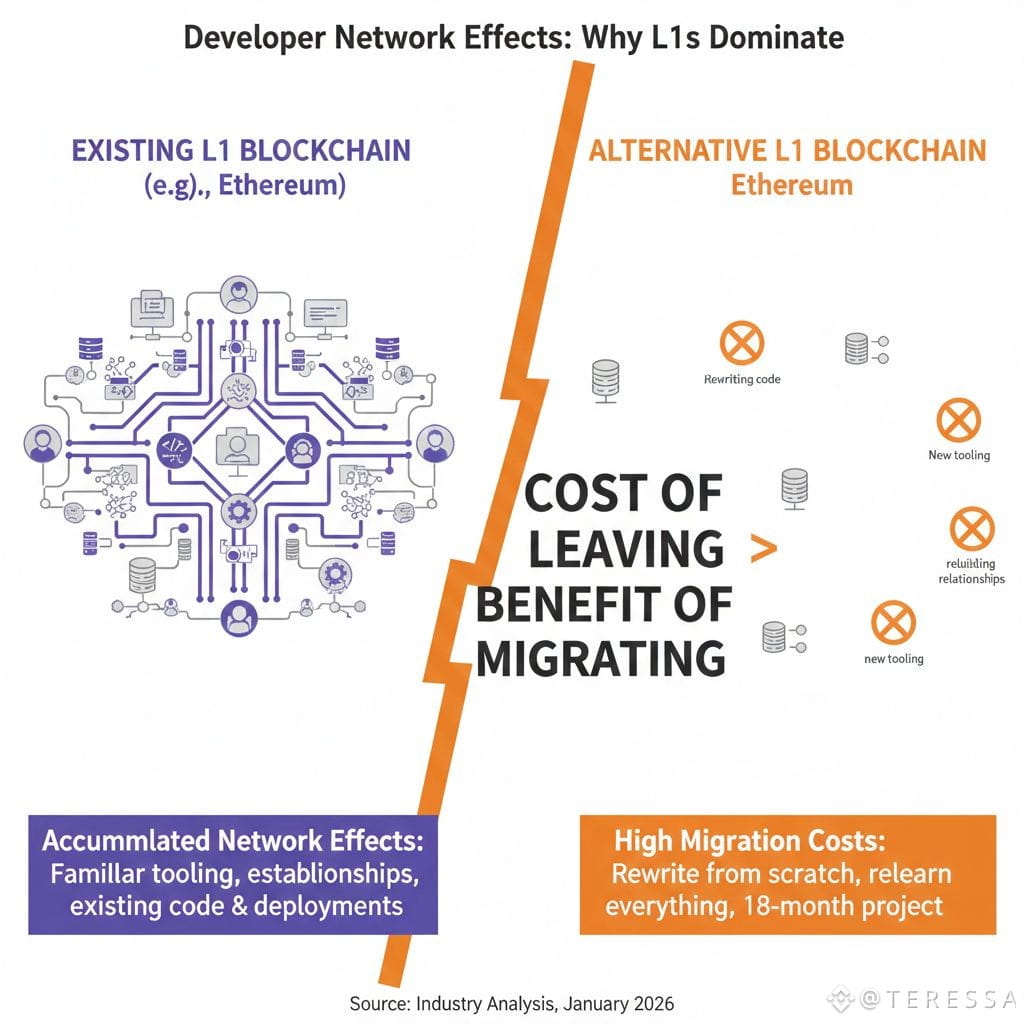
A brand launching a Web3 activation does not want to spend engineering resources learning blockchain-specific languages when they should be focused on user experience. The migration tax is not merely a technical inconvenience; it is a business barrier that prevents mainstream adoption.
Vanar's response to this barrier is not to claim superior technology that justifies the pain of migration. Instead, it says: eliminate the migration entirely through native compatibility. By being fully EVM-compatible, Vanar allows developers to port applications with minimal code changes. By supporting familiar languages and frameworks, Vanar lets developers apply existing expertise. By offering drop-in replacements for common tools, Vanar reduces the learning burden to near zero. The result is that developers can adopt Vanar not because they are switching, but because they are integrating.
EVM Compatibility: The Foundation of Frictionless Integration
@Vanarchain 's "full Ethereum Virtual Machine (EVM) compatibility streamlines integration for projects already built on Ethereum. This feature allows developers to seamlessly port their applications to Vanar without extensive code modifications, benefiting from Vanar's high-speed transactions and low fees." This is not a marketing slogan; it is a fundamental architectural choice with cascading consequences.
EVM compatibility means that any smart contract written in Solidity—the most widely-used blockchain programming language with millions of developers—can run on Vanar with minimal changes. Developers do not need to learn new syntax. Debugging tools they already know still work. Testing frameworks they have built muscle memory around remain compatible. The cognitive load of adoption drops from "learning a new blockchain system" to "deploying on a new network." This distinction might seem subtle, but it is the difference between a six-month migration project and a two-week integration.
For enterprises and larger studios, this matters profoundly. A financial institution with production smart contracts on Ethereum can deploy clones of those contracts to Vanar in days. A gaming studio can run identical code across multiple chains without maintaining separate codebases. A brand can activate Web3 features without requiring blockchain experts on staff. The barrier to trying Vanar is low enough that experimentation becomes reasonable. Low barriers to experimentation convert to adoption.
Moreover, EVM compatibility positions Vanar not as a competitor to Ethereum, but as a complementary network. A developer does not choose Ethereum or Vanar; they choose Ethereum and Vanar. They maintain their core systems where they are, and they extend capabilities to Vanar for specific use cases—high-frequency gaming transactions, low-cost brand interactions, AI-native applications. This multi-chain reality is the future of blockchain adoption, and Vanar's compatibility enables seamless participation in that future.
Cross-Chain Infrastructure: Assets Flow, Knowledge Stays
Vanar goes beyond protocol compatibility to implement broader ecosystem interoperability through strategic partnerships. The "Nitro Router activation is expected to be a game changer, promising seamless connections with Vanar Chain Mainnet and other chains, EVM and Non-EVM compatible. This integration marks a leap towards a smoother, safer and faster exchange process across various blockchain networks." What this means practically is that assets stored on Ethereum, Polygon, Solana, or any other chain can flow to Vanar without complexity or custody risk.
This is crucial because it removes another source of developer friction: liquidity fragmentation. If a token is deployed on ten different chains, liquidity is fractured across those networks. A developer trying to build on a new chain faces the challenge of bootstrapping liquidity for assets their users depend on. Vanar's bridge infrastructure through Router Protocol solves this by making liquidity portable. A token that exists on Ethereum automatically has a bridged version on Vanar. Users can move assets between chains seamlessly. Applications can access unified liquidity pools that span multiple networks.
What is remarkable about this approach is that it solves the problem without requiring Vanar to fork every existing token. The bridges themselves handle the integration. Developers building on Vanar do not need to manage multiple token versions manually. The infrastructure layer handles the complexity, leaving developers free to focus on application logic.
No New Standards, No New Paradigms
A common trap in blockchain development is creating custom tooling that developers must learn specifically for your ecosystem. "Use our custom language for optimal performance." "Adopt our unique framework." "Learn our proprietary standards." These demands accumulate friction and deter adoption. Vanar explicitly rejects this pattern.
Vanar SDKs for JavaScript, Python, and Rust mean developers use tools they already know. Documentation mirrors patterns from other blockchains because the underlying architecture is familiar. Debugging a transaction on Vanar feels like debugging on Ethereum because the EVM is the same. There is no special knowledge required. This consistency is not a limitation; it is a feature that accelerates adoption.
For enterprise projects, this has additional consequences. A company evaluating blockchain infrastructure can now compare Vanar to competitors on merit without the excuse of "we do not have bandwidth to learn a new system." The friction is gone. The decision becomes purely about capabilities, cost, and reliability—the actual factors that matter.
The Intelligence Layer as Non-Disruptive Addition
Vanar's most distinctive capabilities—Neutron for semantic data compression and Kayon for on-chain reasoning—could easily become sources of friction. They require developers to understand new concepts. They expose unfamiliar abstractions. They could complicate the integration story.
Instead, Vanar positions these as optional layers that enhance existing functionality without disrupting it. A developer can build a traditional application on Vanar using only the base blockchain layer. They can then, at their own pace, integrate Neutron Seeds for intelligent data storage or Kayon for on-chain reasoning. The integration is incremental, not wholesale. This allows developers to adopt intelligence capabilities gradually, learning and experimenting without forcing complex architectural changes.
This approach removes the false choice between "staying simple" and "embracing AI." A game developer can launch a game on Vanar using basic smart contracts, then later integrate Kayon to adjust game economies dynamically. A brand can run loyalty programs using standard tokens, then enhance them with Neutron Seeds to enable intelligent rewards. The platform grows with the developer, not against them.
The Ecosystem as Bridge, Not Barrier
Vanar has structured its partnerships and middleware providers specifically to reduce integration friction further. Nexera "serves as the core middleware for Vanar Chain, bringing modular, plug-and-play solutions that simplify the process of RWA tokenization, even for developers with no prior Web3 expertise." What this means is that developers do not need to understand how real-world asset tokenization works on blockchain. They use Nexera's abstracted interface, which handles compliance, regulatory mapping, and on-chain registration automatically.
This is the opposite of the typical blockchain approach, where developers are expected to master every layer of the stack. Instead, Vanar's ecosystem provides pre-built solutions for common problems. Gaming developers get marketplace tools. Finance developers get compliance middleware. Brand managers get activation frameworks. The common case is solved by the ecosystem, leaving developers free to focus on unique value.
The partnerships themselves become distribution channels. When a developer integrates Nexera to build RWA applications on Vanar, they are automatically exposed to Vanar's infrastructure. When a gaming studio uses Vanar's gaming tools, they learn about the platform's AI-native capabilities. The ecosystem grows through organic integration, not through marketing campaigns convincing developers to switch.
The Multi-Chain Reality Without Multi-Chain Burden
The world is not moving toward a single dominant blockchain. It is fragmenting into specialized networks: Ethereum for settlement, Solana for high-frequency trading, Polygon for scaling, Arbitrum for rollups, and Vanar for gaming and AI. The multichain world is already here. The question is not which blockchain wins, but how to operate effectively across many chains simultaneously.
Vanar's integration philosophy acknowledges this reality. The network does not ask developers to choose Vanar as their exclusive blockchain. It asks them to add Vanar to their multi-chain strategy. A gaming studio can run core mechanics on Vanar, settle payments on Ethereum, and use Polygon for scalability—with asset bridges and compatible tooling making the integration seamless. This reality-grounded approach gains adoption where idealistic promises of a single-chain future fail.
The Unstated Promise: You Will Never Need to Move Again
By making integration frictionless, Vanar makes a subtle but powerful promise: if you build on Vanar, you will never need to migrate. Not because Vanar is perfect, but because the friction of integration means you can always add capabilities and network opportunities without rebuilding. If a new opportunity emerges on another chain, you bridge to it. If you need new capabilities, Vanar's roadmap brings them to your application natively. You do not rip and replace; you extend and integrate.
This is the opposite of the migration treadmill many developers experience on newer L1s. Build, then realize you need liquidity, then discover you are isolated on a low-adoption network, then consider moving to something more established, then face months of painful porting and redeployment. Vanar sidesteps this cycle by beginning from a position of maximum compatibility and forward compatibility.
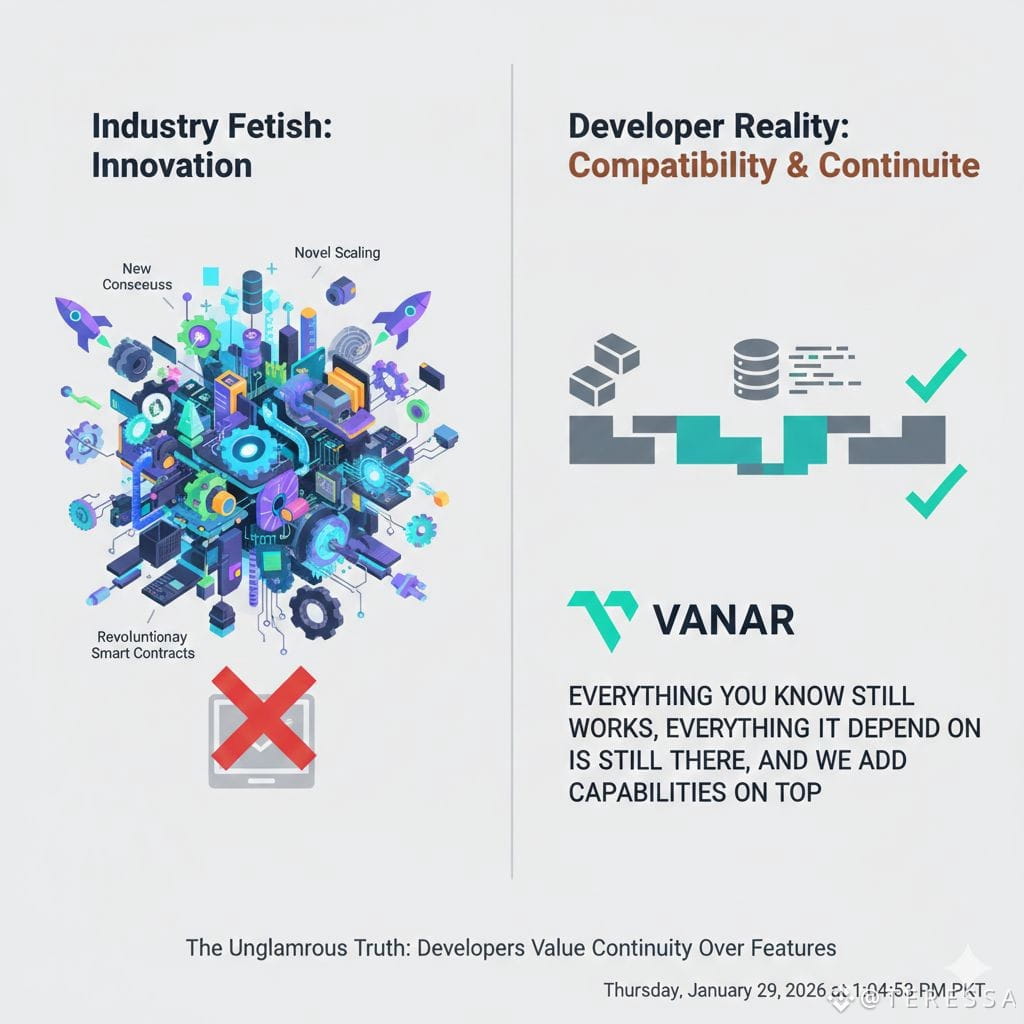
The Unglamorous Truth: Developers Value Continuity Over Features
The blockchain industry fetishizes innovation. New consensus mechanisms, novel scaling solutions, revolutionary smart contract capabilities. Yet the feature that actually drives adoption is boring: compatibility. Developers value continuity because continuity is what enables shipping products. Vanar's message—"everything you know still works, everything you depend on is still there, and we add capabilities on top"—is unglamorous but powerful.
No moving. No relearning. No migration tax. Just integration. This is not the narrative that wins hype cycles, but it is the narrative that wins the battle for real developer adoption. Vanar is betting that in a market tired of promises and false starts, the most radical thing a blockchain can offer is stability and continuity alongside innovation. The evidence so far suggests the market agrees.
