

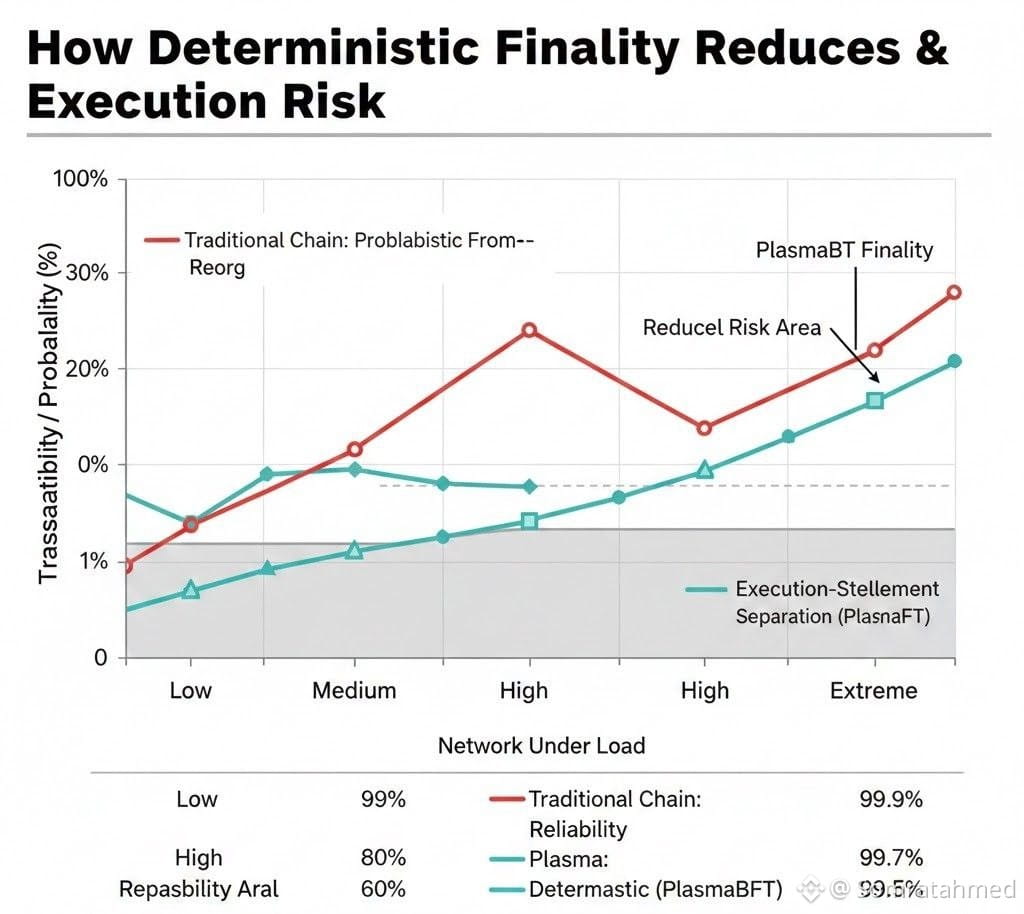


DeFi promises permissionless access to lending, trading, and yield, but most blockchains force users to overcollateralize, overpay fees, and overcompensate for network uncertainty. Gas volatility, slow execution, and probabilistic finality lock capital unnecessarily — the very opposite of efficiency. Plasma solves this at the infrastructure level, creating a blockchain where capital works harder, not just faster.
Execution‑First Architecture: Immediate Action, Deterministic Settlement
Plasma separates execution from settlement. Transactions run instantly on the execution layer, giving users and protocols real-time feedback. Settlement occurs securely in the background via PlasmaBFT, ensuring deterministic finality. For DeFi, this is revolutionary: lenders, traders, and liquidity providers no longer need huge capital buffers just to hedge against execution or reorg risk.
PlasmaBFT Finality: Certainty Where It Matters
In probabilistic chains, “final” transactions may reverse, forcing overcollateralization and operational overhead. PlasmaBFT ensures transactions are irreversible once committed, giving enterprises and protocols the confidence to optimize capital allocation. Every stablecoin transfer, trade, or derivative settlement can be executed knowing finality is guaranteed.
Stablecoin‑First Gas and Gasless Transfers: Frictionless Economics
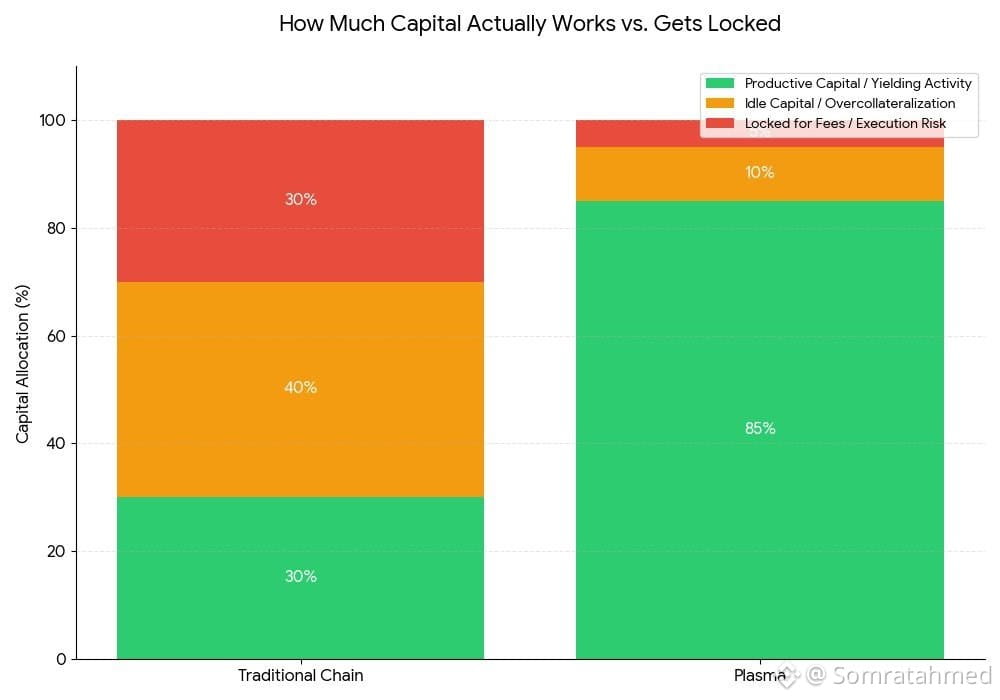
Traditional gas models fragment capital: users hold volatile native tokens in addition to stable assets. Plasma flips this: fees are paid in stablecoins, and gasless stablecoin transfers remove friction. The result? Capital is used directly for economic activity — lending, trading, or liquidity provision — instead of sitting idle as a fee buffer. Productivity and efficiency rise, unlocking new DeFi possibilities.
$XPL: The Infrastructure Backbone
$XPL secures the network, rewards validators, and provides measurable insights into usage. Beyond a utility token, $XPL acts as a metric for network health and capital efficiency, letting developers and enterprises track usage, optimize operations, and ensure predictable outcomes. Capital that flows through Plasma is transparent, auditable, and reliable.
Capital Efficiency in Practice
Liquidity pools can operate with tighter spreads and smaller reserves.
Lending protocols reduce overcollateralization without increasing risk.
Derivatives and options settle cleanly, free from reorg uncertainty.
Cross-chain settlements gain speed and reliability, boosting participation.
Plasma’s design transforms DeFi from a high-risk, capital-heavy experiment into a predictable, capital-efficient financial infrastructure.
Conclusion: Reliability Meets Economic Sense
Speed alone does not make a blockchain usable. What matters is how capital behaves under pressure. Plasma’s execution-first architecture, stablecoin-first gas, gasless transfers, and PlasmaBFT finality ensure that DeFi users can trust the system, optimize their resources, and build sustainable protocols. In other words, Plasma is not just fast — it’s smart, reliable, and capital-efficient.