


Over the past few days, X announced the removal of API access for several so-called InfoFi projects.
The decision sparked strong reactions across the Web3 ecosystem, where InfoFi had been positioned as the future of information monetization.
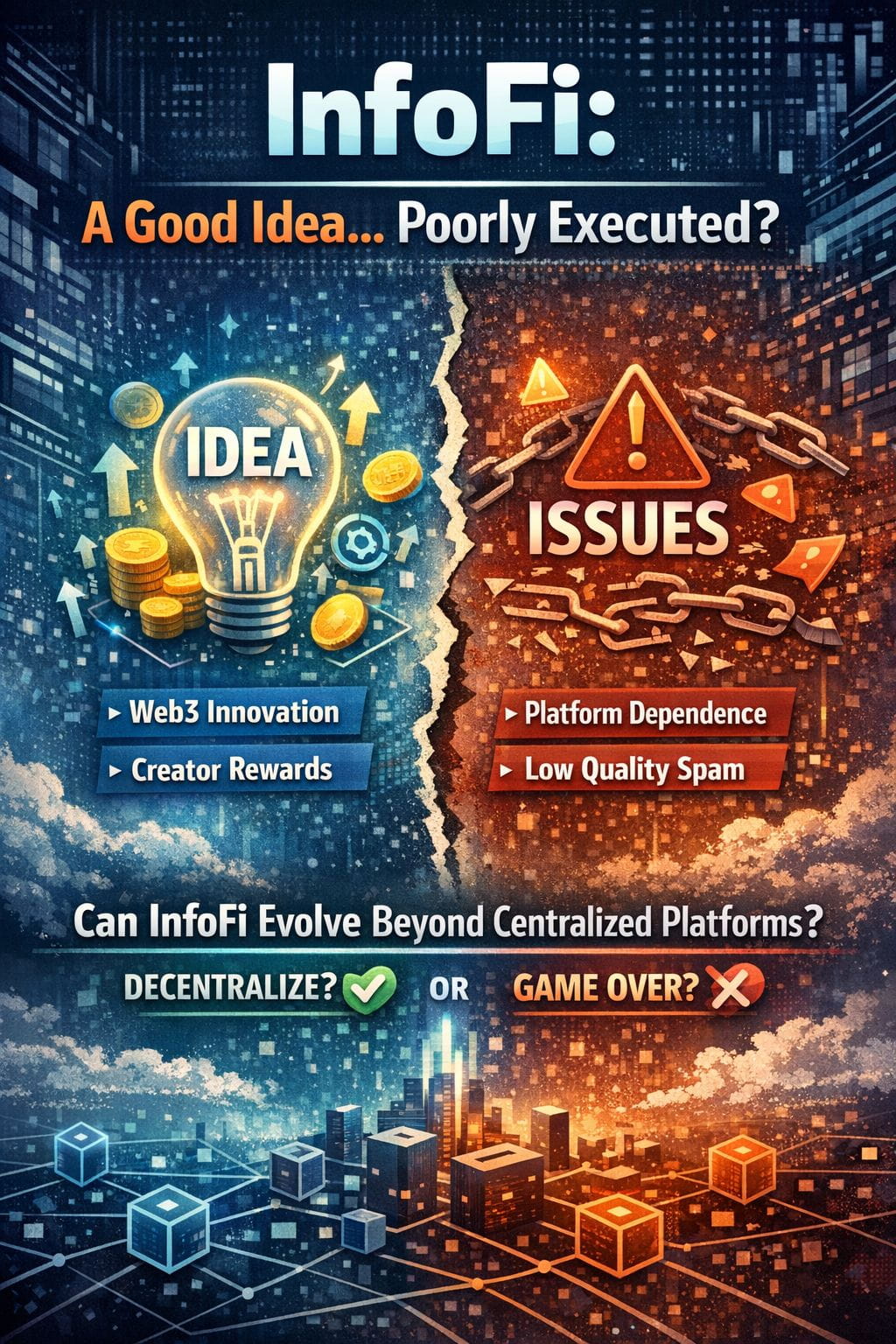
This raises a fundamental question:
Is InfoFi actually good or bad?
My view is clear: InfoFi is not bad by nature, but its current implementation has exposed serious structural flaws.
What Is InfoFi Really About?
InfoFi (Information Finance) is built on a powerful idea:
Information and attention have value, so the people who create them should be rewarded.
In practice, many InfoFi projects introduced systems where:
• posting content
• replying to others
• generating engagement
• earned users points, tokens, or rewards.
On paper, this makes sense.
From a Web3 perspective, it even feels logical: redistributing value back to creators instead of keeping it within platforms.
Why InfoFi Attracted So Much Attention
To be fair, InfoFi came with real strengths.
✅ A Vision Aligned With Web3
Monetization of information
Fair value redistribution
Incentivized participation
✅ A New Opportunity for Creators
For many users, InfoFi represented:
an alternative income stream
a break from traditional ad-driven models
recognition for their social contribution
✅ A Bold Social Experiment
Blinding finance, content, and attention was ambitious, and innovative.
But this is where the problems began.
What X’s Decision Really Exposed
The API shutdown didn’t kill InfoFi randomly.
It exposed weaknesses that were already there.
❌ Total Dependence on a Centralized Platform
Most InfoFi projects:
relied entirely on X’s API
had no fallback strategy
confused Web3 with tokenized Web2
When X changed the rules, everything stopped overnight.
👉 This is not X’s fault.
👉 It’s a design flaw.
❌ A Massive Decline in Content Quality
Let’s be honest.
Incentives often led to:
spam
artificial replies
content created solely to “farm rewards”
The result:
• less real value
• more noise
• a degraded user experience
• InfoFi frequently rewarded activity, not insight.
❌ A Fragile Economic Model
If a project collapses the moment an API is cut, then:
it isn’t sovereign
it isn’t resilient
and it isn’t truly Web3
X’s decision didn’t destroy InfoFi.
It simply revealed how immature the model still is.
So, Is InfoFi Bad?
👉 No. The idea itself is strong.
👉 But the execution has been weak.
InfoFi’s main mistakes were:
1. Over-reliance on a single platform
2. Poor incentive alignment
3. Lack of independent infrastructure
What a Viable InfoFi 2.0 Could Look Like
For InfoFi to survive, it must evolve.
• Less Platform Dependency
• Multi-platform design
• Hybrid on-chain / off-chain data
• Verifiable signals beyond a single API
• Reward Value, Not Volume
• Quality over quantity
• Genuine engagement over spam
• Smarter weighting of social signals
• Put Users Back at the Center
• Data sovereignty
• Portable reputation
• Long-term contribution tracking
• InfoFi should stop being a farming game. It should become an economy of credibility and knowledge.
Conclusion
X’s decision may feel harsh, but it’s revealing.
👉 InfoFi isn’t dead.
👉 It’s being forced to grow up.
Like many Web3 experiments, it moved too fast, leaned too heavily on Web2 platforms, and forgot true decentralization.
The projects that survive will understand one simple truth:
> You can’t build a decentralized future on centralized foundations.
And you, what do you think 👇
Can InfoFi realistically be reborn in a healthier, more sustainable form, or was it a flawed vision from the start?

