
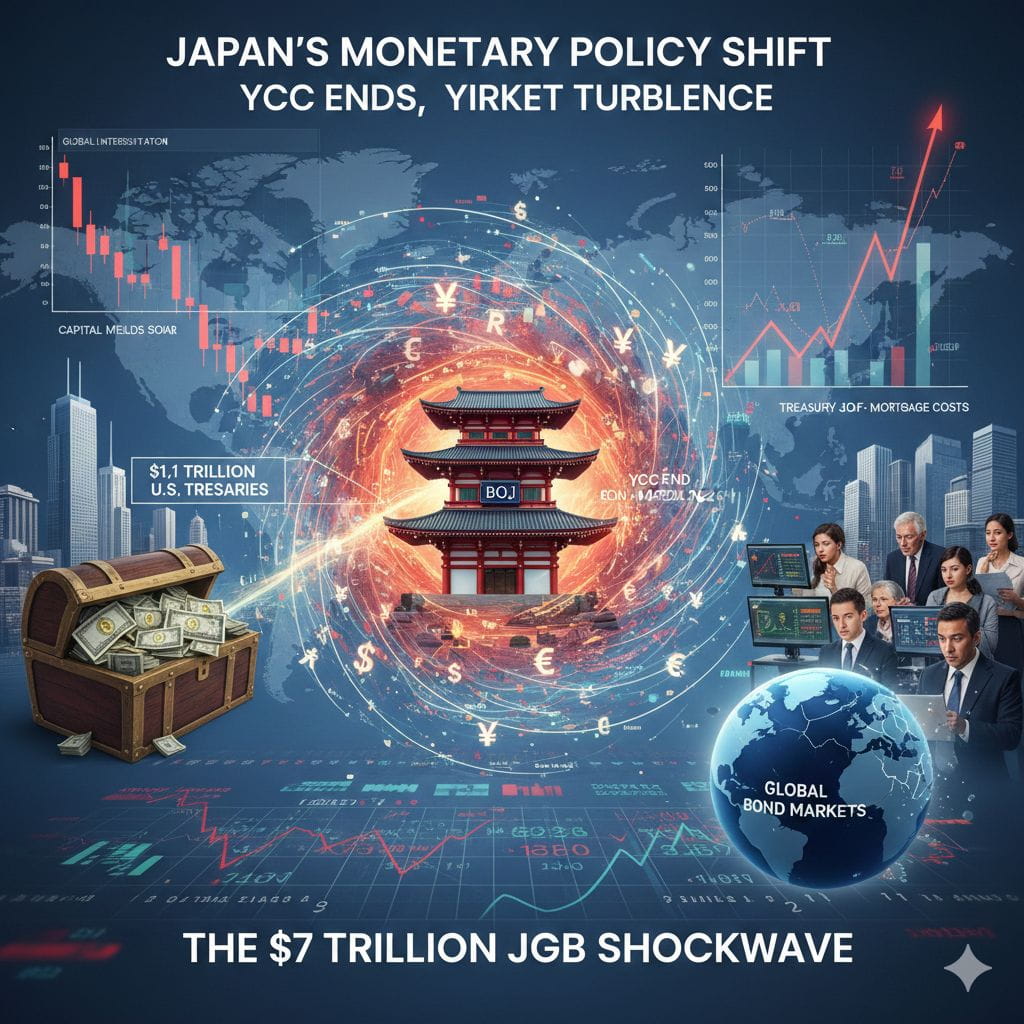
Japan’s recent monetary policy shifts, particularly the **Bank of Japan (BOJ)** ending its long-standing **Yield Curve Control (YCC)** program in March 2024, are now contributing to significant turbulence in global bond markets as of early 2026. This policy change has allowed Japanese government bond (JGB) yields to rise sharply, with long-end yields (such as 30-year and 40-year bonds) hitting record highs amid fiscal concerns, political uncertainty, and a potential snap election.
The BOJ's move away from capping yields—previously targeting around 0-1% for the 10-year JGB—has triggered a rapid sell-off in domestic bonds. Higher domestic yields are making Japanese investments more attractive compared to low-yielding foreign assets, prompting a wave of **capital repatriation**.
Japan remains one of the largest foreign holders of U.S. Treasuries, with holdings around **$1.1–1.2 trillion** as of late 2025. As Japanese institutions (including banks, pension funds, and insurers) reassess their portfolios in light of rising JGB yields and unfavorable currency hedging costs, there is growing pressure for them to sell U.S. Treasuries and other foreign assets. This isn't necessarily a full-scale panic dump but a strategic **rotation** of capital back home.
Key Potential Impacts on Global Markets
- **Rising U.S. Borrowing Costs** — Large-scale selling of Treasuries could push U.S. yields higher, increasing borrowing costs for the government, businesses, and consumers (including mortgages). This acts as a headwind against expectations for lower U.S. rates.
- **Pressure on Bonds and Risk Assets** — Liquidity could be withdrawn from global markets, weighing on equities, corporate bonds, and other risk-sensitive investments that benefited from years of Japanese outflows.
- **Broader Spillovers** — The $7+ trillion JGB market's volatility has already sent shockwaves worldwide, contributing to sell-offs in other bond markets and complicating central bank efforts elsewhere.
This reversal is monumental because Japan has long been a major creditor nation, fueling global liquidity through investments abroad (especially in U.S. assets). With the flow now potentially reversing, markets could face tighter conditions in the near term.
While the situation remains fluid—driven by factors like Japan's fiscal challenges, yen dynamics, and global events—the coming weeks and months could indeed reshape aspects of the global financial landscape. Investors are closely watching for signs of accelerated Treasury sales or further BOJ interventions to stabilize yields.
This development underscores how interconnected the world's major economies are: a policy pivot in Tokyo can ripple across Wall Street and beyond. Stay tuned for updates as data on foreign holdings and bond flows emerge. 🌍💹