I watch markets long enough to notice a pattern.
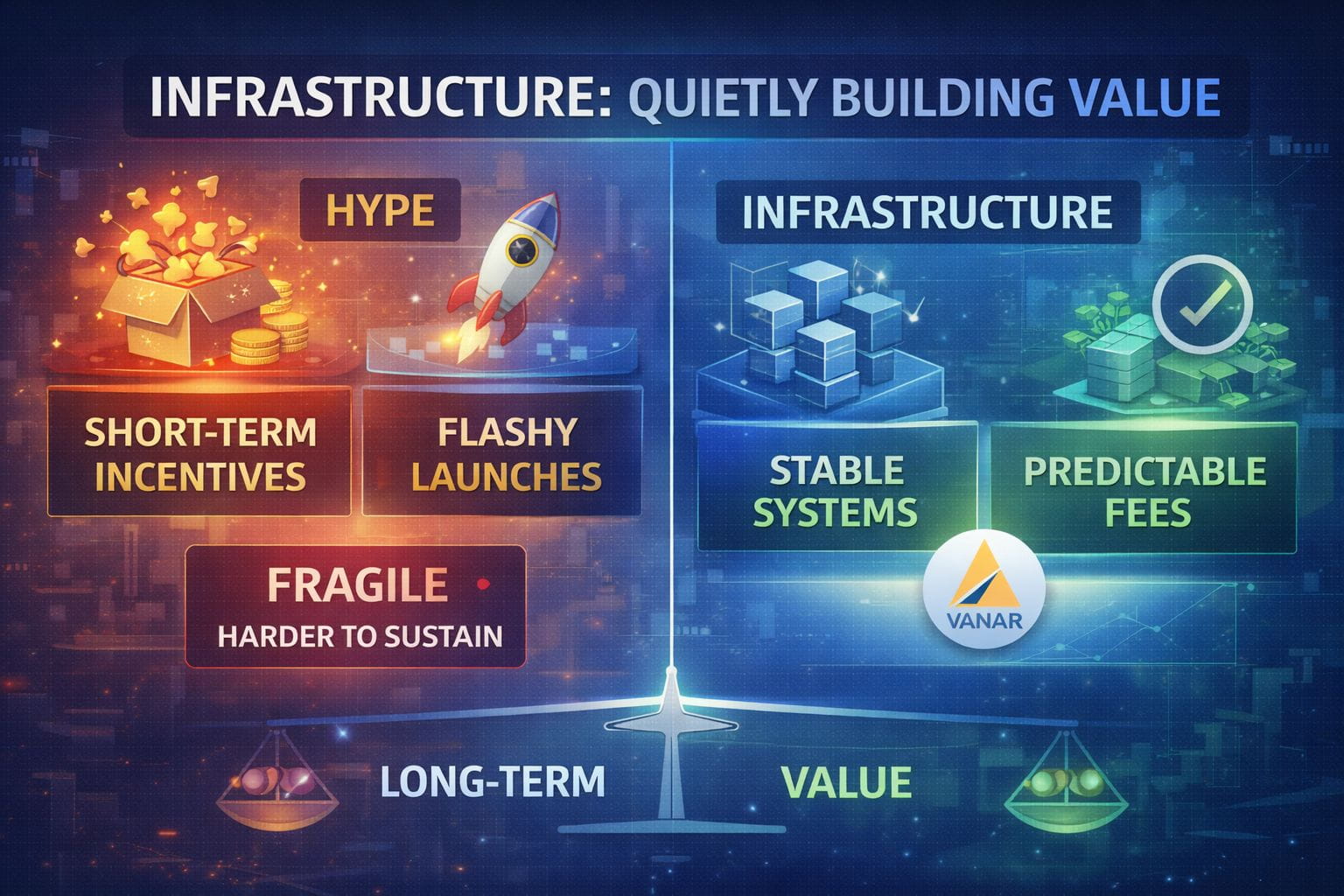
That memory is why “infrastructure before hype” keeps coming up again in 2026, especially around Vanar. After multiple cycles, traders and investors are slowly re-learning a hard lesson: attention can move price, but only infrastructure can hold value.
Hype is easy to manufacture. Incentives, airdrops, flashy metrics—those things travel fast on social feeds. Infrastructure doesn’t. It works quietly, often invisibly, and usually gets noticed only after something breaks elsewhere. Vanar’s relevance today comes from that contrast. While many networks still optimize for excitement, Vanar is clearly optimized for reliability.
Let’s ground this in something concrete. Infrastructure, in blockchain terms, means the base system that applications depend on—fees, speed, transaction ordering, and reliability. If those elements are unstable, everything built on top inherits the problem. Traders feel it as slippage and missed fills. Developers feel it as failed transactions. Users feel it as frustration.
Vanar made a deliberate choice early on to stabilize these fundamentals. Fixed transaction fees, priced in dollar terms rather than floating with token volatility, reduce uncertainty. Around late 2025, as network activity increased, this design choice started to matter more. While other chains saw fee spikes during usage surges, Vanar maintained predictable costs. That’s not exciting news, but it’s deeply important.
Speed is another pillar. Vanar’s block time, capped around three seconds, aligns with how humans interact with software. Faster confirmation reduces doubt. Slower confirmation creates hesitation. I’ve traded enough to know that hesitation costs more than bad analysis. When infrastructure responds quickly, decisions feel cleaner. When it doesn’t, traders adapt in unhealthy ways.
This is why infrastructure-first thinking is trending again. The market has matured. Capital is more selective. Investors are asking fewer “what if” questions and more “does it work” questions. Since late 2025, Vanar’s on-chain activity—particularly in gaming and NFT-related use—has grown steadily without heavy incentive programs. That kind of growth is harder to fake.
From my own experience, I trust boring systems more than exciting ones. Boring doesn’t mean stagnant. It means predictable. Predictability builds confidence. Confidence builds usage. Usage builds value. This sequence rarely works in reverse.
There’s also a philosophical angle worth sitting with. Markets often confuse visibility with importance. The most important parts of a bridge are not the parts you see—they’re the parts that don’t move. Infrastructure is like that. When it’s good, nobody talks about it. When it fails, everything else collapses.
Vanar’s approach suggests an understanding of that truth. Instead of trying to attract users with short-term rewards, it reduces friction so users stay naturally. That’s slower, yes. It’s also more durable. As a trader, I care about environments where execution doesn’t surprise me. As an investor, I care about systems that don’t depend on constant attention to survive.
Why does this matter now? Because the industry is transitioning. The easy phase—where anything new could attract capital—is over. What’s left is competition on quality. Infrastructure quality. Developer experience. User retention. Those battles are quieter, but they define the next decade.
I’ve learned not to ask whether a project is trending today. I ask whether it will still function when nobody is watching. Vanar’s focus on infrastructure suggests it’s designed for that moment, not just the spotlight.
Hmmm… yes, hype moves fast, but it also moves on. Infrastructure moves slowly, but it stays.
In the long run, markets reward what people can rely on. And after watching cycles rise and fall, that trust—earned quietly—is the rarest asset of all.