


Most blockchain systems are designed around entry. How fast can capital arrive? How easily can users deposit? How frictionless is onboarding? Exit is usually treated as a secondary concern, something to be optimised for speed or convenience once everything else is working. This bias makes sense in early-stage systems where growth matters more than stability. But as networks mature and liquidity scales, this imbalance becomes dangerous.
@Plasma stands out because it was never built around this assumption.
From the beginning, Plasma treated exit not as an edge case but as a core economic action. That decision reshapes how liquidity behaves, how risk propagates, and how shared systems remain coherent under stress. Plasma does not attempt to control liquidity through lockups or incentives. Instead, it shapes liquidity behavior by making exit a deliberate, contextual process rather than an instantaneous reaction.
To understand why this matters, it helps to observe how liquidity behaves in most on-chain environments today.
Liquidity is fast because it can be. It responds to yield changes, incentive programs, governance votes, and sentiment shifts in real time. This agility is often celebrated as efficiency, but it comes with a cost. When capital can move instantly and without context, it amplifies reflexive behavior. Markets overreact. Liquidity drains suddenly. Systems that appeared healthy minutes earlier experience stress not because fundamentals changed, but because behaviour did.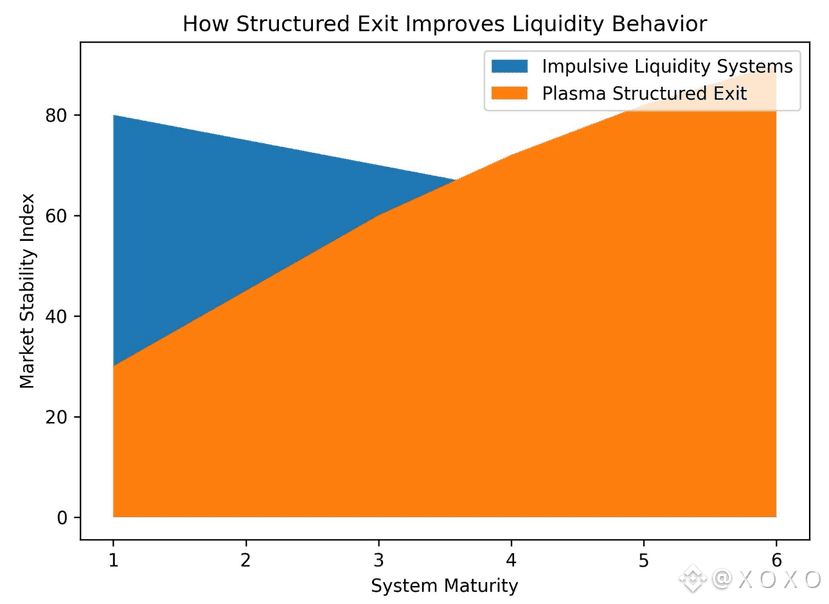
Protocols have tried to address this with increasingly complex mechanisms. Lockups delay exits. ve-token models reward patience. Protocol-owned liquidity attempts to stabilize pools by reducing reliance on external actors. These tools work to a degree, but they all share a common trait: they attempt to discipline liquidity after it has already entered the system.
Plasma takes a different route. It embeds discipline directly into the exit process itself.
In a Plasma system, exiting is not a click-and-forget action. It is a structured transition. Users initiate an exit, acknowledge the state they are leaving, and wait through a dispute window during which that exit can be challenged if it is invalid. This window is often described in purely technical terms, but its economic effect is far more interesting than its cryptographic mechanics.
The dispute window introduces time.
Time changes behavior.
When liquidity knows it cannot vanish instantly, it behaves differently. Not because it is trapped, but because it is aware. Capital must consider its position, its history, and its obligations to the shared state it participated in. Exit becomes intentional rather than impulsive.
This is where Plasma begins to feel less like a scaling solution and more like a market design.
In most DeFi systems, liquidity is passive. It provides capital, earns yield, and leaves when conditions change. Plasma transforms liquidity into an active participant in settlement. Exiting is not an escape hatch. It is a formal acknowledgment of transition. The system and the user both recognize the change, and that recognition happens within a shared framework.
This subtle shift creates accountability without enforcement.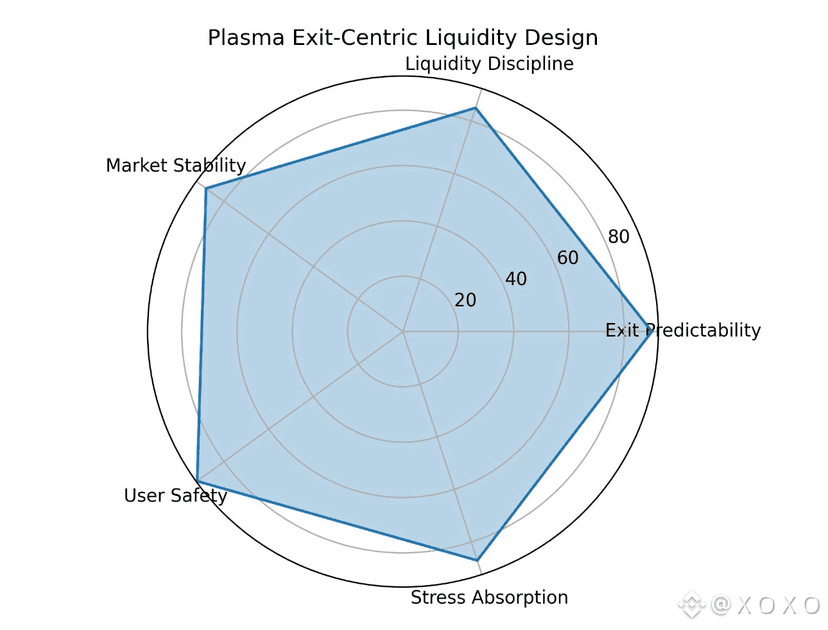
Plasma does not punish fast exits. It does not forbid them. It simply makes them legible and contestable. Actors who do not understand the system, or who are attempting to extract value through opacity, are less comfortable operating in such an environment. Actors who are managing risk thoughtfully, on the other hand, find the structure reassuring.
Over time, this creates a filtering effect.
Liquidity that thrives in Plasma-based environments tends to be liquidity that values predictability over speed, clarity over opportunism, and settlement correctness over instant gratification. This is why Plasma aligns naturally with institutional capital, DAOs managing treasuries, and long-horizon participants. These actors are not trying to exit at the first signal. They are trying to unwind positions responsibly.
The dispute window supports that goal.
Rather than being a delay imposed by the protocol, it acts as a cooling layer for markets. It slows reaction cycles just enough to reduce emotional volatility. Panic exits become harder to execute reflexively. Cascading failures lose momentum. Systems gain time to absorb transitions rather than amplify them.
This does not eliminate risk. It reshapes it.
Security in Plasma is not defined as instantaneous correctness. It is defined as procedural correctness. The system is safe because it allows disagreement to surface and resolve before final settlement. This is closer to how real-world financial systems operate than how most blockchains do. Trades settle with finality, but disputes have windows. Errors can be corrected, but only within defined processes.
Plasma encodes this philosophy on-chain.
Importantly, the exit process is not adversarial by default. It is cooperative. Most exits complete without challenge because most actors behave honestly. The existence of the challenge mechanism is what keeps behavior honest in the first place. This mirrors legal and financial systems where enforcement exists not to punish constantly, but to shape expectations.
This design becomes increasingly important as blockchain systems interconnect.
Liquidity today does not move within isolated protocols. It flows across chains, rollups, restaking layers, derivative markets, and synthetic instruments. An abrupt exit in one environment can trigger downstream effects elsewhere. Without buffers, these transitions become shocks. Plasma’s exit window acts as a buffer between layers. It slows the propagation of stress without blocking movement entirely.
This is a critical distinction.
Plasma does not freeze liquidity. It sequences it.
Sequencing allows systems to adapt. Oracles update. Markets rebalance. Governance reacts. Participants reassess. The system remains legible while change occurs. This is the difference between a system that absorbs stress and one that fractures under it.
Plasma’s approach also contrasts sharply with lockup-based models. Lockups create commitment through restriction. They bind capital regardless of context. Plasma creates commitment through clarity. Liquidity remains because the environment supports orderly exit, not because it is forcibly retained.
This leads to healthier participation.
When users know they can leave safely and predictably, they are more willing to enter. This may seem counterintuitive, but it reflects human behavior. People trust systems that treat exit as a first-class concern. They are wary of systems that prioritize entry while making exit chaotic or costly.
Plasma understands this dynamic.
By designing exit as carefully as execution, Plasma completes the lifecycle of participation. Entry, interaction, disagreement, and exit are all accounted for. Most systems only design for the first two. The latter stages are left to improvisation.
As the blockchain ecosystem matures, this completeness becomes valuable.
Modular architectures separate execution from settlement, data from security, and activity from finality. In such an environment, the transitions between layers matter as much as the layers themselves. Plasma provides logic for those transitions. It defines how liquidity moves with awareness, not just how transactions execute.
This is why Plasma feels less like a relic and more like a missing piece rediscovered.
Its original critics focused on complexity and delay. What they missed was intent. Plasma was not designed to be fast at all costs. It was designed to be coherent at scale. That coherence matters more now than it did when throughput was the dominant concern.
Plasma did not fail. It waited.
The ecosystem had to experience volatility cycles, liquidity crises, and cascading failures before it could appreciate a design that prioritizes deliberation over speed. Today, with deeper capital, more interconnected systems, and higher stakes, Plasma’s assumptions align with reality.
Exit with intention is not a limitation. It is a philosophy.
It recognizes that liquidity is not just capital moving through code. It is human decision-making expressed economically. Systems that ignore this reality become unstable. Systems that respect it endure.
Plasma may not be the loudest component of the modular stack. But in a world where reliability matters more than novelty, it may be one of the most stabilizing forces we have.