
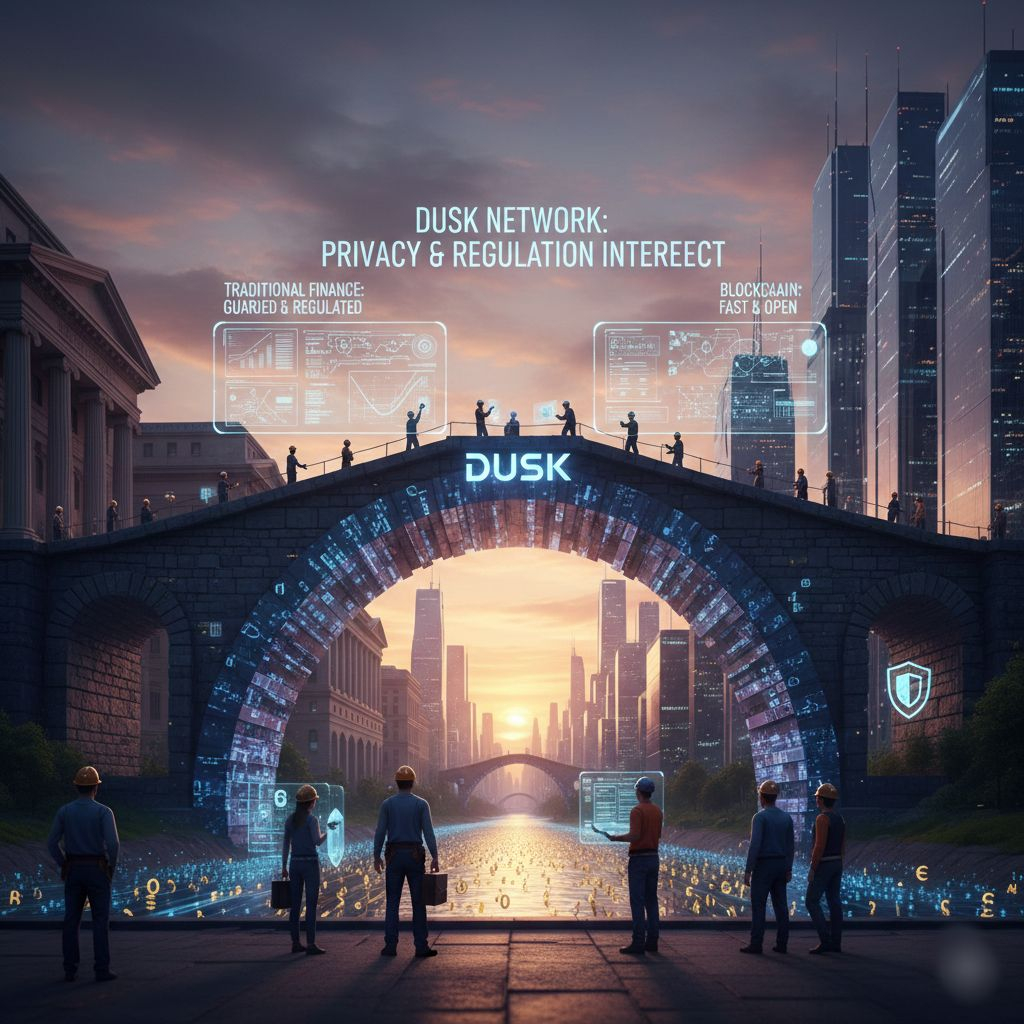
@Dusk When I first looked deeply into it did not feel like discovering a crypto project in the usual sense. It felt more like uncovering an unfinished bridge between two worlds that rarely speak honestly to each other. On one side there is traditional finance, slow and guarded, full of rules and paperwork but also full of real people, real salaries, real companies, and real responsibility. On the other side there is blockchain, fast and open, powerful but often careless with privacy and detached from how regulated money actually works. Dusk exists because someone finally decided that this gap is not acceptable anymore and that money systems should be both modern and humane at the same time.
The project began in 2018, not during a moment of clarity but during a period when most of the industry was obsessed with speed, speculation, and visibility. From the start, the team behind Dusk took a very different path. They did not try to sell a dream of instant disruption. They focused on infrastructure, the kind that does not make noise but holds weight. Their belief was simple but difficult to execute. If blockchain is ever going to support real financial markets, then privacy and regulation must live together instead of fighting each other. This belief shaped everything that followed, from how the network is designed to how its technology is explained.
At its core, Dusk is a layer one blockchain built specifically for regulated and privacy focused financial applications. That sentence may sound technical, but the idea behind it is very human. In real life, not everything about money should be public. Salaries are private. Business strategies are private. Investment positions are private. At the same time, rules must be followed, taxes must be calculated, and fraud must be prevented. Dusk is designed around this reality. It allows financial activity to be verified without forcing people to expose sensitive details to the entire world. This is not about hiding wrongdoing. It is about restoring the natural boundaries that exist in offline finance and bringing them into a digital system.
The technology that makes this possible is built around zero knowledge proofs, but Dusk does not treat this as a buzzword. Instead, it treats it as a tool. In simple terms, zero knowledge proofs allow someone to prove that a condition is met without revealing the underlying data. On Dusk, this means a transaction can be confirmed as valid and compliant without showing who the parties are or how much value moved between them. It becomes possible to say the rules were followed without forcing unnecessary disclosure. For institutions and regulators, this is critical. For users, it is dignity.
What makes this approach stronger is that privacy on Dusk is not optional or external. It is built directly into the protocol. Smart contracts on the network can be confidential by design, meaning their logic and data are protected while still remaining verifiable. This is especially important for financial instruments like securities, bonds, and other regulated assets. These are not experimental products. They already exist in the real world, and Dusk is trying to give them a native home on blockchain without breaking the laws that govern them.
Another important aspect of Dusk is its modular architecture. This is not something most people think about, but it matters deeply. Financial systems do not stay still. Regulations evolve. Market structures change. New requirements appear. By building the network in a modular way, Dusk allows parts of the system to adapt without tearing everything down. This is a sign of long term thinking. It shows the team is not building for the next market cycle but for years of gradual integration into existing financial frameworks.
Tokenized real world assets are a major focus of the network, but again, the tone is different from what we usually see. Instead of promising a revolution overnight, Dusk talks about practical use cases. Small and medium sized companies being able to issue compliant digital securities. Institutions being able to trade assets without revealing sensitive positions. Investors gaining access to regulated opportunities without sacrificing privacy. These are not flashy ideas, but they are powerful because they touch real economic life.
The DUSK token plays a supporting role in this system. It is used for staking, securing the network, and enabling transactions and smart contracts. Its purpose is functional rather than promotional. Validators stake it to keep the network secure. Developers use it to deploy applications. The value of the token is tied to the usefulness and security of the network, not to constant marketing. This quiet utility driven approach fits the overall philosophy of the project.
Over time, Dusk has attracted attention from researchers, developers, and major platforms that focus on infrastructure rather than speculation. Independent analyses exist because the architecture invites scrutiny. Binance is only relevant when research or technical evaluation is discussed, not as an endorsement or marketing partner, and that distinction matters. Serious financial infrastructure must be able to stand on its own technical merit, and Dusk seems designed to be examined rather than blindly trusted.
Of course, challenges remain. Building privacy compliant systems is complex. Institutional adoption takes time. Regulation differs across regions. The team does not pretend otherwise. They publish updates, refine their documentation, and adjust their approach as new realities emerge. This transparency builds confidence because it shows they understand the responsibility they carry. They are not promising perfection. They are committing to progress.
What stays with me most about Dusk Network is not the cryptography or the architecture, but the values behind it. In a digital world that often treats exposure as a feature, Dusk quietly argues that privacy is not a flaw. It is a requirement for trust. It reminds us that financial systems exist to serve people, not to put them on display. If the future of finance is going to be built on blockchains, then those blockchains must respect human boundaries while still upholding rules. Dusk feels like a serious attempt to do exactly that, not loudly, not quickly, but carefully and with intention, and sometimes that is how the most important foundations are laid.
