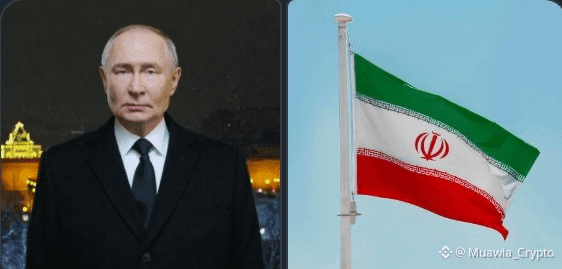
Intervene 🇷🇺🇮🇷
Over the past several months, unprecedented shifts in global alliances have quietly but profoundly reshaped the strategic landscape of the Middle East. At the centre of this tectonic shift is a striking announcement from Russian President Vladimir Putin — a declaration that Russia will not deploy its military forces to defend Iran in the event of an escalation with the United States or other Western powers.
This revelation marks one of the most consequential redefinitions of Russian geopolitical posture since the beginning of its full-scale invasion of Ukraine — a pivot that carries implications far beyond Tehran and Moscow.
🧠 A Strategic Pivot, Not a Status Quo
In a series of high-level statements over the last year, President Putin has underscored that Tehran has not formally requested military assistance from Moscow despite rising regional tensions and repeated U.S. pressure over Iran’s nuclear program. Putin clarified that previous Russian offers — including discussions about joint air-defence cooperation — were not pursued with enthusiasm by Iran, and that the current “Comprehensive Strategic Partnership” with Tehran does **not constitute a defence treaty obligating Russian military intervention.” �
Yeni Safak +1
This clarification is critical because it disproves the assumption held by many analysts that Russia would be bound to support Iran if conflict with the U.S. or Israel escalated. The absence of a mutual defence clause in the 2025 treaty reflects both Moscow’s strategic caution and Tehran’s desire to avoid being drawn into a broader global war. �
Wikipedia
📌 Why Moscow is Drawing This Line
Analysts point to several overlapping pressures shaping Russia’s position:
1. Domestic Strain from the Ukraine War
Russia’s prolonged, resource-intensive conflict in Ukraine has strained its military and economic capacity, making it increasingly reluctant to open a new major front far from its immediate sphere of influence.
2. Diplomatic Balancing Act
Moscow continues to condemn U.S. or Israeli strikes on Iranian territory, characterizing them as destabilizing. Yet it frames its stance in diplomatic terms — appealing to international institutions rather than signalling readiness for joint combat operations. �
The Moscow Times
3. Strategic Ambiguity as Leverage
By distancing itself from a formal defence commitment while remaining a vocal critic of Western military actions, Russia retains political leverage. It can appear supportive to Tehran without being tied down by the obligations of direct military engagement — a posture that enhances its diplomatic flexibility.
🌍 What This Means for Iran and the Region
Putin’s announcement carries several seismic implications for regional dynamics:
🔹 Iran Must Re-Evaluate Its Strategic Assumptions
For years, Tehran may have treated Russia as a deterrent against U.S. military action. That assumption is now being tested — forcing Iranian strategic planners to reassess alliances and defence postures.
🔹 U.S. Decision-Making Is Less Constrained
Without the spectre of a Russian military response, U.S. policymakers arguably have greater latitude in considering options — diplomatic or military — in confronting Iran’s nuclear program or proxy operations. This does not guarantee conflict, but it changes the calculus significantly.
🔹 Gulf States and Regional Powers Face Uncertainty
Nations such as Saudi Arabia, the UAE, and others in the Gulf must now reassess how they navigate security concerns, given that one of the region’s longest-standing great-power relationships may no longer offer the military shield once presumed.
📉 Broader Geopolitical Fallout
This development signals a broader realignment:
A Russia increasingly focused on preserving its own frontiers,
An Iran still committed to pursuing its nuclear and regional ambitions amid rising pressure, and
A United States navigating a complex mix of negotiation, deterrence, and military signalling. �
Reuters +1
It also reinforces an emerging narrative: strategic partnerships without formal defence obligations can quickly reveal their limits under crisis conditions.
📊 The Stakes Ahead
With tensions between Tehran and Washington showing no signs of abating, and with the U.S. engaging in high-stakes diplomacy and military posture adjustments, the absence of Russian military backing for Iran transforms a regional flashpoint into a potential global pivot point.
In the weeks and months ahead, the world will be watching whether:
Iran seeks new security guarantees,
Moscow deepens its diplomatic role, or
Washington and Tehran find a path to de-escalation.
One thing is clear: Putin’s message to Iran marks a watershed moment — and one likely to shape Eurasian geopolitics for years to come.